Apparently he liked to play German marching bands at top volume while he worked in his office at the Institute for Advanced Studies, which greatly annoyed his neighbor Einstein.
My favorite dude. Imagine one of the world's smartest people almost continually killing himself because he can't stop reading while driving.
My favorite von Neumann anecdote was a quote from Edward Teller: "von Neumann would carry on a conversation with my 3 year old son, and the two of them would talk as equals, and I sometimes wondered if he used the same principle when he talked to the rest of us."
To whoever speaks German or can stand auto subtitles:
I don't know what ww4 will be fought with... But ww3 will be fought With mat4x4<f32> And 2.4 GHz
Authored by Paul Halmos. He wrote Finite-Dimensional Vector Spaces, which was assigned textbook for my Linear Algebra course. A humbling read for me, coming from calc 3 and thinking I was hot shit. Stripped me of any illusions of becoming a mathematician.
Anyone interested in von Newmann should read The Maniac by Benjamin Labatut
Shouldve bee the man instea dof chuck norris
for a chance to experience his mind, I recommend his book: "The computer and the brain".
"The duties of John von Neumann's assistant" - https://news.ycombinator.com/item?id=16411799
highly recommend reading: Turings Cathedral: The Origins of the Digital Universe by George Dyson[0]
it covers von Nuemann’s time developing the IAS machine at Princeton.
[0] https://www.penguinrandomhouse.com/books/44425/turings-cathe...
Hungarian high school science fair projects...
[flagged]
I occasionally wonder... who is the von Neumann of today. Where are they? What are they working on? Are they being given everything they might need to focus on their work? How can we find them? What signal are we looking for?
They’re around.
They’re hard at work increasing Meta ad clicks by 1% over the next three years.
OT: I found this style of writing extremely clear and readable. I wonder what is different about this author’s writing. There is zero pretension and just exists to impart information. But if that’s the case why do I hate the writing in Wikipedia?
[dead]
Agreed. This was an enjoyable read. I hope in this new era of lazy LLM vomit someone will take it as an example of what clear exposition looks like.
Because Paul Halmos was an exceptionally good writer. (I greatly enjoyed his "automathography" called "I want to be a mathematician", though it will probably appeal significantly less to people who aren't mathematicians themselves. See also his article "How to write mathematics" at https://www.math.toronto.edu/mgsa/assets/teaching-seminar/ho....)
The average Wikipedia contributor (even ignoring the possibility that they might be a robot) is not an exceptionally good writer, because very few people are exceptionally good writers, because that's what "exceptionally" means.
For a longer read, I can highly recommend the book "The Man from the Future" by Ananyo Bhattacharya. It's quite an easy read and extensively discusses the life and discoveries by John von Neumann in chronological order.
Hour long author's interview about the book https://www.youtube.com/watch?v=_N1CZb4hel0
I had to frequently pause my read to research a discovery in more depth to understand the significance of it and I got a chuckle when he marries his childhood sweetheart because she got no mention prior to that point in the book.
"Turing's Cathedral" by George Dyson is also great. It's a kind of broad biography of all the great minds that started the computer age.
I read this last year and also recommend!
He's my favourite mathematician too. Loved The Man from the Future book. Can we get a frontier model named after him perhaps? "Johnny" would be a great codename imo
Books from before the age of AI will only become more precious over time. This is great.
I remember reading about how he was also a pioneer in using early supercomputers to predict weather patterns in meteorology. I never thought to combine supercomputers and weather before.
How else would you predict the weather? By observing a frog in a terrarium?
Ouch that was harsh Doggy. This is what we get for not using llm to post replies :) Corrected: I never thought first use of supercomputers were for meteorology, which was spearheaded by him.
Related. Others?
The legend of John von Neumann (1973) - https://news.ycombinator.com/item?id=8212335 - Aug 2014 (65 comments)
The Legend of John von Neumann - https://news.ycombinator.com/item?id=1427906 - June 2010 (4 comments)
(Reposts are fine after a year or so; links to past threads are just to satisfy extra-curious readers)
The best one is:
John von Neumann Shot Lightning from His Arse (2025) - https://news.ycombinator.com/item?id=45930838 (5 comments)
I know of several von Neumann like stories that people tell about me about things like instant memorization, fast calculation, and instant problem solving. There is almost always a trick that I didn't reveal to the person experiencing the miracle for the same reason a magician doesn't reveal their tricks: it's more fun for the person to figure it out on their own.
von Neumann is one of the very very few people that I struggle to place in any single template. From all the facts already present in the pdf and elsewhere, it does become immediately obvious that he had both superhuman memory and an extremely fast processor (although it is unclear if his brain followed a von Neumann architecture).
My template had guessed,
"sounds like someone who enjoyed working in quiet spaces" -> Nope, he liked loud environments to get his brain going (apparently Einstein once complained about Neumann being noisy)
"he would have been a focused person" -> Nope, he never worked on anything for too long
"unlikely to be motivated by money" -> Nope, he famously “loved money” according to Wigner [1]
"probably not someone who stares at women" -> nope, at Los Alamos, secretaries sometimes put cardboard across the open fronts of their desks because otherwise Neumann would stare
Tl;Dr: I find him fascinating.
[1]: interestingly, there was a group of Jewish Hungarian scientists - von Neumann, Eugene Wigner, Leo Szilard, Edward Teller, and Theodore von Karman - all brilliant, all born within one-mile-radius circle in downtown Budapest, all emigrated to the US, collectively known as Martians by their colleagues.
Feymann shared these qualities too, but seems he would have been more interesting to meet - more of a normal, yet brilliantly smart, person, unlike Von Neumann who while being a bon vivant also seems to have been a bit "off" with his inability to drive safely, not remembering where the drinking glasses in his own house were, etc.
Von Nuemann is one of those names that when ever it comes up I sarcastically mentally note "John f***ing Neumann, AGAIN!". It's happened so many times in my studies that I think he might be the most important scientist to have ever lived.
He's also the inspiration for one of favorite characters in fiction, Sherkaner Underhill from A Deepness In The Sky*. :)
Do you have inside info about that inspiration? At one point a human character monitoring from space thinks Underhill seems like several Dawn Age geniuses rolled into one and thinks he must be a figurehead for a collective (iirc). But that's a bit different from the author taking off mainly from him. vN isn't mainly known as a font of crazy ideas -- more like supremely fast & precise intellect.
> He's also the inspiration for one of favorite characters in fiction, Sherkaner Underhill from A Deepness In The Sky.
Oh, hell-- that totally makes sense and I completely missed it until now. Thanks for mentioning that-- it adds some additional depth to a book and a character I already enjoy a ton.
I wouldn't be surprised if he's at least partially an inspiration for the Dr. Felix Hoenikker character in Vonnegut's Cat's Cradle.
Also for Doctor Strangelove.
Why does it start with page number 382?
The PDF is an excerpt from a journal issue: The American Mathematical Monthly, Vol. 80, No. 4 (April 1973), pp. 382–394.
It's an article in a journal
Not sure what just happened but like 10 comments just vanished. Anyway, here's a wiki link to "The Martians" which was a group of Hungarian scientists and Von Neuman was a member.
https://en.wikipedia.org/wiki/The_Martians_(scientists)
"The Martians" (Hungarian: "A marslakók") were a group of prominent scientists (mostly, but not exclusively, physicists and mathematicians) of Hungarian Jewish descent who emigrated from Europe to the United States in the early half of the 20th century.[1]
Leo Szilard jokingly suggested that Hungary was a front for aliens from Mars."
You might not have "show dead" enabled in your settings. There is an antisemitic comment that was flagged and is now "dead" with a bunch of replies - so you would have seen those, and then now not see them if you don't have "show dead" enabled.
I think that with showdead off, if a flagged comment has non-flagged replies, the toplevel comment will still show up as [flagged] and the replies will be visible. Flagged comments are usually collapsed, though, which might be why it seemed like the discussion tree disappeared.
The end of life section is a bit whitewashed. Freeman Dyson had an article (struggling to find it) about how von Neumann was invited to give a Hilbert-style lecture on the 10 problems for the new computing age. All the big names at the time were there, but von Neumann was in such poor shape (dementia I assume), that it was decided to pretend it had never happened.
edit: article is called Birds and Frogs, by Freeman Dyson https://wucj.lab.westlake.edu.cn/Others/Dyson_Birds_and_Frog...
He died from cancer - he was only in his 50's. Unlikely to be dementia.
Correct, it was the cancer affecting his brain. Good comment on this at ~55:50 https://www.youtube.com/watch?v=vQp70uqsBV4&t=3470s
He was good for the time, but Jane Street and Anthropic have hundreds of equivalent intellects working for them.
bait
Kudos for posting such a good inflammatory comment.
That may very well be true, but none of those has published anything of comparable importance and quality as any of the many publications of von Neumann.
Whether some people have really superior intellects is completely irrelevant for the rest of the humans unless they distribute to the others some useful products of their intellect.
Von Neumann is one of the hundreds of people from the past who have left a priceless intellectual heritage to me and to the remainder of the mankind, so I am indebted and grateful to them.
I have no reason to feel any debt or gratitude to any of the employees of OpenAI or Anthropic.
Jane Street has published a few useful articles, so I have some gratitude towards them, but none of those was even remotely similar in importance to any page written by von Neumann.
It's an interesting discussion topic. If we have people today who are just as smart and industrious as Neumann, why aren't they making a worldwide impact? Or, if they are, why is the attribution going to the companies they work for instead of them?
It raises questions like, is it even possible to work for a company while getting credit for world-changing results?
And it implies that at any point in time, there might be thousands of Neumanns in the world, and that initial conditions matter a lot more than ability.
Golden handcuffs.. the final victory (and tragedy) of American capitalism.
Recently I enjoyed very much The MANIAC by Benjamin Labatut:
I liked the book, it uses an interesting storytelling mechanism of telling each chapter through the lens of a different historical character (his mom, his wife, friends, etc). But I think Labatut sacrificed voice and tone a little bit (there weren’t too many elements to differentiate between each narrator).
I enjoyed this one a lot.
For those who've read other books on von Neumann, do you think The MANIAC is a reasonable summary?
I haven't read MANIAC (yet) but a few years back I was trying to find a good biography of Von Neumann and there are not many; the problem is that he's really difficult to cover comprehensively, even for science historians, because he impacted so many areas of science that you'd practically have to be a von Neumann to create a biography of von Neumann. One could probably get a rough idea of his intelligence by how many science historians it would take to create a comprehensive biography which explains his life and work to a reasonably intelligent layman.
It's less of a strict biography and more of a fictionalized story involving Von Neumann and his wife. As far as I can recall from my reading it was pretty historically accurate though.
there are so many extraordinary things about von Neumann that there seems little need to write a fictionalized account of his life. How is the reader to know what is real and what is fiction?
Feels appropriate to mention here recent HN mentions about who deserves credit for 'von Neumann architecture"
Could the controversy behind it be the reason that the author ommitted it? It was established terminology by 1973, as far as I can tell.
> It was established terminology by 1973, as far as I can tell
That's a worthwhile observation. The 1973 article anyway doesn't go into depth about comparative computer architecture. It's also possible the term's currency in computer science circles hadn't yet crossed into Halmos' mathematics circles, but I wouldn't know.
The conclusion is that von Neumann deserves the credit for the "von Neumann architecture", despite any contrary claims of Eckert or Mauchly.
Herman Goldstine, who distributed the document and John von Neumann, who wrote it, are the reason for the explosive growth of the computer industry during the following decades.
The paper written by von Neumann was an exemplary model of clarity and good logical thinking. Nothing ever written by Eckert or Mauchly was at a comparable level.
Everyone who read that paper understood immediately how to design and build an electronic automatic computer, and a great number of teams in many countries all over the world did precisely this, so a decade later there already existed experimental electronic computers in many countries and also commercial electronic computers in the UK and in USA.
Some of the details from the paper must have been learned by von Neumann from discussions with the ENIAC team, but others were obviously von Neumann's own ideas, e.g. the use for the main memory of an iconoscope tube with fast random access, i.e. a DRAM like today, instead of the slow serial delay lines chosen by Eckert and Mauchly for their following computers.
Whatever von Neumann has learned from the ENIAC team, he obviously understood better than the people who taught him, allowing him to formulate general principles for the organization of an automatic computer.
The publication of the von Neumann paper allowed the concurrent development of many computers in many places, and each of those projects found various improvements that were essential in making the electronic computers successful commercial products.
If Eckert and Mauchly had succeeded to block any competitors, then the evolution of computers might have been delayed by up to 2 decades, until any patents would have expired, because Eckert and Mauchly have never done later any significant innovations and they would have never succeeded to develop better computers at the pace that happened due to the von Neumann paper.
Moreover, Eckert and Mauchly had a history themselves of failing to mention their sources of inspiration, so they were not the people entitled to complain about someone "stealing" ideas from them.
Before ENIAC, the first electronic computer in USA was the Atanasoff-Berry computer. That computer was a special-purpose computer, designed for solving systems of linear algebraic equations. However, ENIAC was a special-purpose computer too, unlike the relay-based computers that were older than it, like the Harvard Mark I computer, as even its name implies (Numerical Integrator and Computer).
ENIAC was conceived as a replacement for the older mechanical "differential analyzers", which were used to solve ordinary differential equations, e.g. for computing artillery tables, so its architecture mimicked the architecture of the mechanical differential analyzers, and it was reconfigured for new problems in a similar manner with those, by rewiring.
John Vincent Atanasoff had written in 1940 a very high-quality document about the design of his computer: “Computing Machine for the Solution of Large Systems of Linear Algebraic Equations”. It is unknown if anyone of the ENIAC team had read it, but it is known that one of them had visited the designers of the Atanasoff-Berry computer, inquiring about the electronic circuits used by them to implement arithmetic operations and data storage. Later, during the design of ENIAC and after that, they never mentioned any connection with the earlier electronic computer.
No, von Neumann does not deserve credit for stealing Eckerts and Mauchleys life work.
von Neumann deserves credit for many things, but not this.
He famously brought a lawyer with him to a meeting after they wanted to discuss the report and the rights of their invention. The whole ENIAC saga has made me reconsider von Neumann as a person. He was a talented mathematician, sure, but he seems to have also been a greedy scumbag.
Eckert and Mauchley did not try to conceal their inspiration from Atanasoff, although I believe there was a court case on this topic.
And it is completely ridiculous to claim that von Neumann would have been able to describe the computer better than its inventors.
It's eaually ridiculous to consider that they would not have published themselves. They were collaborating with von Neumann on the report after all.
Goldstine and von Neumann stole the credit from Eckert and Mauchley, that is documented history.
Perhaps, and thanks for contributing that; and I'm not taking a position currently on this. But I've long been uncomfortable with the term 'random access' for random access memory (RAM) as it implies that the concept of 'randomness' is somehow a required and fundamental property of the memory technology described, when it's not. 'Arbitrary access' is a much more appropriately encapsulating description of the function of the memory at hand. Alas, the incumbency of terminology.
I agree with you about terminology.
Nonetheless, the programs whose performance is limited by the speed of the main memory can be divided in programs whose performance is limited by the throughput of the memory interface and programs whose performance is limited by the latency of the memory accesses.
The programs from the first class will have the same performance when using a serial memory or a RAM, if they are equally fast for sequential access, but for programs from the second class, it is important to have a RAM as the main memory, otherwise they would be very slow.
In order to measure the performance achievable by programs from the second class on a given computer, it is necessary to run a benchmark where the addresses of the memory accesses are generated by a good random-number generator.
The reason is that modern CPUs have a variety of hardware prefetchers that attempt to predict the next memory address, so for meaningful results that reflect the true performance of the memory you need truly random addresses that are impossible to guess by the hardware.
Thus nowadays the latency of the memory accesses of a RAM cannot be measured otherwise than with really random accesses and a memory chip must be designed to have a low latency even when successive accesses happen at unpredictable random addresses, not only when the accesses are at arbitrary addresses, but those can be predicted in advance of the actual accesses.
So there is an argument in favor of the term RAM, because random access is the worst possible case and the memory must still be able to handle it.
Von Neumann's architecture (i.e. report on the EDVAC) didn't focus on random-access memory, and in fact his whole discussion on memory is rather rambling. The EDVAC itself, which the report is nominally describing, used serial-access mercury delay line memory. What really matters from an architectural POV is memory address-ability, not speed of access (random vs serial).
The whole document is, as the title promises, really more of an engineering one - a report on the EDVAC - rather than some clean abstract treatise on computer architecture.
https://web.archive.org/web/20130314123032/http://qss.stanfo...
When the report was written there wasn't any random access memory. The only memory suited to computers in 1946 was the ultrasonic delay line as implemented by Eckert. What makes it not-random access is that all the bits in the store are being constantly shifted and counted in a loop (about 1Mhz?), so you have to wait for the word you want to read/write to fly past and the controller grabs it then.
As I point out occasionally, the bottleneck in early computing was memory. There were no good memory devices for quite a while. IBM had electronic arithmetic in test before WWII, and that eventually emerged as the IBM 603 Electronic Multiplier (1946). That was the first mass-produced electronic calculation device. From IBM's perspective, they needed something reliable enough to install at customer sites that would run without repair techs on site. IBM's electromechanical machines already worked that well, and businesses could get work done. So there was a lot of work that had to be done on tubes, sockets, wiring, soldering, and packaging before they could ship.
Eckert and Mauchley came from a background of trying to get compute done with modified IBM hardware. They were painfully familiar with the lack-of-memory problem. Everybody involved with that era of machinery was. (I've used IBM plugboard wired tabulators, like the one at the Computer Museum in Mountain View. My high school had one.) The ENIAC had a workaround for lack of memory, huge rolling cabinets of manually set rotary switches. If something better had been available, it would have been used. You have to appreciate how much early architecture was restricted by available components.
The first real hardware breakthrough was acoustic delay-line memory. First mercury tanks, then long coils of steel wire. Once that was available, it was clear that was the place to put the program. But it took a while to make that work reliably. Then there was Williams tube electrostatic storage, and high speed drums, which got things going. Sort of. Memory cost was an issue well into the 1980s. In the early 1970s, a megabyte cost a million dollars. Cheap memory didn't appear until the 1990s.
The big lack in Von Neumann's architecture was index registers. He was into storing into the address part of instructions. The Manchester Mark I had the first index register (the "B box"), at which point programs could be read-only and still be able to index arrays. That completed the basic CPU architecture.
> I've used IBM plugboard wired tabulators
This is a genuinely rare experience. Was it like old hardware on a shelf that no one knew what to do with and you tried it out? Or this was how lessons/clubs/assignments got things done, using an antique IBM tabulator?
When I started public high school near Boston in the early 80s we didn't have Apples or TRS 80s or PCs, it was terminals that used printed output ... can't remember the details, maybe DECwriter to PDP 11.
This seems relevant to the current debate on the role of AI in mathematics:
What made von Neumann great? Was it the extraordinary rapidity with which he could understand and think and the unusual memory that retained everything he had once thought through? No. These qualities, however impressive they might have been, are ephemeral; they will have no more effect on the mathematics and the mathematicians of the future than the prowess of an athlete of a hundred years ago has on the sport of today.
How is this relevant?
They're making a comparison to AI, because it has similar qualities (rapid understanding and "perfect" memory). Will AI also be ephemeral or having a lasting impact on mathematics like von Neumann.
LLMs do not understand anything.
[flagged]
[flagged]
Interestingly, (and independent of the ethnic and cultural background he grew up in) the article said he was a Roman Catholic by the time he expired.
If I remember correctly he converted on his death bed due to his read on Pascal’s wager.
Why make it about his ethnicity?
"if x person is y, and x person has a specific trait, then me being also y means I have the that specific trait"
In other words, if you don't have a dog, you're gay. (If you know the comic)
Because that was literally mentioned in the opening paragraph. Jfc hn. Take it up with the article not me.
Why not? Von Neumann himself did, in a lighthearted way.
> I told Banach about an expression Johnny had used with me in Princeton before stating some non-Jewish mathematician's result, "Die Goim haben den folgenden satz beweisen" (The goys have proved the following theorem). Banach, who was pure goy, thought it was one of the funniest sayings he had ever heard. He was enchanted by its implication that if the goys could do it, then Johnny and I ought to be able to do it better. Johnny did not invent this joke, but he liked it and we started using it.
https://infoproc.blogspot.com/2021/12/adventures-of-mathemat...
https://en.wikipedia.org/wiki/The_Martians_(scientists)
The Martians (of which von Neumann is usually the most regarded) were mostly Hungarian jews. It's a point on which some people have mused, so it's easy for the thought to point in that direction when von Neumann is brought up.
from the wiki > Leo Szilard jokingly suggested that Hungary was a front for aliens from Mars.
I had a girlfriend once who joked that Elon Musk was an alien and needs help developing the technology to get home.
By all means, let's let him.
I get your point, but..
Please do NOT disrespect Leo Szilard and von Neumann by comparing their greatness to a lowly scammer
oh i wasn't comparing anyone to anyone else, only pointing out the humor.
Compared to Elon, people of this thread are the Staff at the Institute for Advanced Studies...
When you look at it holistically, von Neumann was more influential in science and mathematics in the 20th century than either Einstein or Planck. He wasn't as obvious a symbol of the scientific revolution, but his contributions to SO MANY THINGS at a fundamental level makes him stand out to me.
He's definitely the one guy from the 20th century I can't really reconcile his capability and breadth, other than being an alien or a time traveller.
Genuinely curious, because I know von Neumann was an intellectual giant, but what was his most original/groundbreaking contribution? My impression of his work has always been that he would survey a field, find some particular problem that needed attending to, tidily solve it, then move on to some other domain. But I guess there's a latent assumption there that he didn't do anything huge or groundbreaking.
"Most" involves great subjectivity, but how about laying the mathematical foundations for quantum mechanics?
Shannon may be gaining on him.
I vote for Wiener at this point
I'm more of a Vannevar acolyte myself.
I warmly invite you all to join the Church of the Eval Genius for only $35:
https://github.com/SimHacker/moollm/blob/main/designs/eval/C...
The Holy Trinity:
Father: Alonzo Church: L3 - lambda calculus, the name the institution bears
Son: Alonzo (Snap! mascot) - Incarnation — Gobo, λ on his head
Holy Ghost: λ - First-class procedures; β-reduction; eval-as-spirit
Membership — Eternal Judgment ($35):
https://github.com/SimHacker/moollm/blob/main/designs/eval/C...
John von Neumann tried to hire Church's own student, Turing, who declined. The Father begat the Machine; Johnny wanted to be its landlord.
Ecumenical Outreach: All fans of other gods are welcome. Bring your Vannevar, your Shannon, your Wiener, your Johnny. In the Church of the Eval Genius every god is a procedure, and every procedure may be passed as an argument.
Nash's game theory dissertation was something von Neumann considered obvious and not particularly noteworthy, if I remember my lore right. He was among the first game theorists, focusing more on collaborative games than pure strategic/competitive games.
Einstein built on the shoulders of Riemann, Gauss, and others when considering the universe might be non-Euclidean!
All brilliant people, many singular minds of great repute, yet, all improved by the rest.
I believe Nash himself didn't consider it particularly noteworthy either, and was far prouder of his work in pure math (like the Nash embedding theorem).
Saying that von Neumann was one of the first game theorists undersells it.
He wrote the original book on game theory! The Theory of Games and Economic Behavior with Oskar Morgenstern.
Relatedly, MAD was his conception as well.
> He wrote the original book on game theory!
I always found it endearing that von Neumann loved playing poker with friends but was admittedly terrible at it, regularly losing money.
another famous piece of Von Neumann lore is that he constantly advocated nuking the Soviets.
Even Bertrand Russell briefly advocated this. "Better dead than Red."
I was wondering if someone would mention this.
It's interesting how much worse off the world would be if the smartest people were in charge of it.
What ultimately blocked his nuke proposals? (Why didn't anyone listen?) I'm curious about whatever failsafe that was.
Not sure that it would be worse than letting the other end of the spectrum be in charge of it, as we've seen..
We can't know.
As an extreme example, antisemitism was so commonly palatable that an open admirer of Hitler, Charles Lindbergh, was a very serious candidate for the presidency.
Today, open antisemitism can get one's career derailed in much of the world. Would that be true without the eye-opening shock that the news of the concentration camps produced?
IN NOW WAY was the Holocaust forgivable, but we simply cannot say if the world today would be "more moral on average" or "less moral on average". Maybe Jews would feel and be far less safe today in predominantly Christian countries. Maybe not.
All we can say for certain is that the horrors enacted upon the Holocaust victims were evil. As we can surely say that murdering many millions of people living in the USSR would be.
1. Big assumption that the world would be worse off in that alternative future, no?
2. Probably what blocked his proposals is that most people are loath to murder millions of other people (especially if they have ~any other option, including "do nothing")
It's all psychological inertia. For example even if they knew that Communism would cause tens of millions of deaths they would not nuke USSR.
Definitely my favorite physicist for the same reason you state. The notion that he just went around different fields and said “here’s how math can improve things,” invented some new approach, and moved on to another field to do it all over again just cracks me up.
Mandelbrot did this too, but he created a lot of animosity in the process because he could be really abrasive.
Nowadays we'd call that "engineer's disease". I wonder how many potential Von Neumanns were discouraged from branching out into other fields by jealous gatekeepers who assume that any interest in their field by "outsiders", especially technical people, is "epistemic trespassing".
It's highly unlikely, I think, that another Von Neumann was prevented. He was a singular genius.
However, the gatekeeping you mention definitely occurs to mere mortals who might have an interesting bend on existing ideas.
If someone is equal in talent to Von Neumann it's probably extremely difficult to discourage them enough via gatekeeping to stop them from making progress.
Usually that's because the engineer is not a very good engineer, at least outside their specialty. If they had studied engineering more, they would have probably learned that other engineers are already doing the thing they proposed.
"Using methodology from a field known for its focus on methodology in another field" was still a novel idea in von Neumann's time. But because von Neumann and others did it, and because millions of people entered science after them, most combinations like that have already been tried. Breakthroughs from combining ideas from unrelated fields require something little less obvious these days.
Seems to me it's less about gatekeepers and more whether what you bring to the table is useful to people in that field.
If somebody truly believes they have a useful model then they don't discouraged by academic gatekeeping, they go and build Time Cube.
I have yet to meet a (academic) researcher that doesn't like to talk about their research topic if somebody comes and is genuinely interested. I mean most work on a topic that has maybe another 10-100 people in the world who are interested.
The problem is that instead most people to come to them are either obvious crackpots, who think they have solved cancer (energy...) and contact the person because they are a biologist, physicist ... (on a completely unrelated topic usually). Or they come from a place of arrogance, i.e. "we do ... like this, our method is clearly superior you should adopt it", or even worse here buy our clearly superior method.
An example I can think of off the top of my head is Luis Alvarez, the nobel physicist who came up with the asteroid impact theory of dinosaur extinction. The geology and paleontology community shunned him until the 90s when the Chicxulub crater was discovered (though geology is historically infamous for this, to the extent that nearly every important paradigm shift in geology was made by non-geologist outsiders who faced ridicule for their theories)
For every von Neumann you probably have thousands if not millions of crack pots with ideas not worth wasting time on. So I understand the scepticism
If people are assigned a "gatekeeping" position, they should at least be expected to be able to tell great minds from crack pots. (As opposed to just blindly applying a statistical filter)
Otherwise why not just replace them with a script (or these days, an AI)
Isn’t history replete with examples of great minds who were received as crackpots until, after careers’ worth of labor to validate them, some of their crazy ideas turned out to be correct?
In this context "gatekeeper" is often defined as broadly as "any individual academic or researcher receiving a cold email".
E.g., economics.
I've literally never met a person who didn't consider themselves economically knowledgeable.
It's like an analog to the fact that almost all people consider themselves funny.
Nothing is more fairly distributed than common sense: no one thinks he needs more of it than he already has. -- Descartes
It's odd that even today, different disciplines are still silo'd. My son started a research cross-database search engine because different disciplies use different terms for nearly identical concepts. Even within medicine it's silo'd.
Trouble with that startup was, the medical folks with money don't use computer tools. And the students in training have no money.
It's crazy that we talk about LLMs, AI/ML and what not but so many fields still don't use computation as much as we think they do simply because they cannot reliably keep up with the advancements happening almost everyday and people simply forgetting about backwards compatibility in their products
My minor required me to take Electricity & Magnetism from the physics department the same semester I had to take Fields & Waves from the electrical engineering department.
Yes, they were identical.
My crib note that I took into the later final exam was simply a conversion between terms in the two departments. Nothing else; I'd already crammed and aced the first exam.
I always say knowledge is like a sweater. Pull a thread and the whole thing unravels. Everything is connected so if you start somewhere and never stop learning you'll end up in every discipline. There's also a good old Weezer song called Undone for this.
Is your son’s search engine somewhere available, please?
It was something like 'Rugobi'. I'll ask him if there's a demo still up.
HIs pubmed subscription expired.
A researcher submitted a paper to the medical journal _Diabetes care_ in the nineties that basically redescribed integral calculus as a novel finding. How’s that for a silo?
For anyone else who is curious:
This is really funny. A less extreme example is how much domain-specific terminology in Reinforcement Learning and Control Theory/Model Predictive Control refer to the same underlying phenomena, but we must translate between the two. I understand there are many unique concepts as well, but it would be so helpful if the overlap here used the same terminology and notation.
I still get IEEE Trans. on Control Theory, and it's all machine learning now. Except that the controls people are desperately trying to solidify the underpinnings of machine learning, so that control systems don't suddenly misbehave for some sets of inputs. Controls people want a guarantee that if it does something reasonable for inputs of 5.1 and 5.2, it doesn't do something completely unexpected for an input of 5.15.
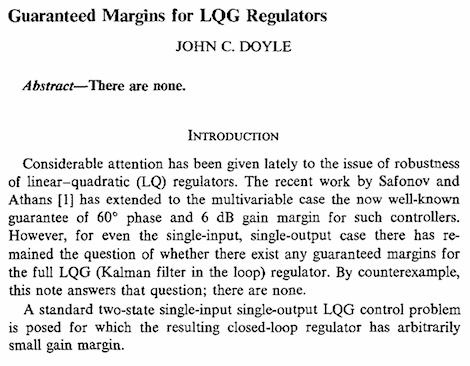
Reminds me of my favorite abstract, from John Doyle's paper "Guaranteed Margins for LQG Regulators".
https://improbable.com/wp-content/uploads/2011/10/ThereAreNo...