The unsloth Q8kxl https://huggingface.co/unsloth/Qwen3.8-27B-GGUF for some reason is looping and going crazy on the think part (I tried to search for an email to let the guys know but didn't find one)... I used the bartowski one and that one doesn't have that issue https://huggingface.co/bartowski/Qwen3.8-27B-GGUF?show_file_...
that's using llama.cpp
llama-server \ -m ~/somePath/Qwen3.8-27B-UD-Q8_K_XL.gguf \ -np 1 --kv-unified \ -fa on --no-cache-idle-slots --reasoning-preserve \ --temp 0.2 \ --spec-type draft-mtp,ngram-mod --spec-draft-n-max 3 --spec-draft-n-min 1 \ --cache-type-k f16 --cache-type-v f16 \ --chat-template-kwargs '{"preserve_thinking": true}' \
I tried playing with all the recommended parameters from the unsloth page with no luck...
in one of the high fever ramblings it ended with amen... lol
I wonder how this practically compares with Muse Glimmer, especially quantized.
I've got an RX 7900 XT (20GB of VRAM) and I can run glimmer with a full 128k context window with the draft model at 65-80 tok/s.
This model, on the other hand, I get about 30 tok/s with a 30k context. Raising the context or loading the draft layers for MTP drops performance to 9-15 tok/s.
So I wonder how big the "real world" delta between Glimmer and Qwen is here. I can already run 3-bit DSv4-flash at 9-15 tok/s with 100k~ context, and I suspect it would outperform 4-bit Qwen 3.8 27B here.
I'll have to experiment and see if I just made a stupid mistake somewhere, but it looks like Glimmer might make more sense for the comically specific niche of "20GB VRAM".
I am so happy right now, qwen3.6-27b was an absolute game changer. To see another one in the same league.. phew
Hmm. No MoE or active params weights means this will run _slow_
The default reasoning is set to 'xhigh', if you want to compare with the past or reduce the time (if you can take the hit in output quality) then you can pick 'high' or 'medium' as well.
Would I be surprised there’s bench maxing happening? Yes. But some users also use Q4 quantized and complain how dumb local models are.
All this performance at such small model sizes, why are the API fees so high for the AI monopolists on this side of the world?
These are massive improvements - and something you can actually run on a laptop.
Having some really good fun with it so far with System Design (ERP) mainly SAP.
I did notice if you go beyond Medium he starts overthinking like hell as per usual for a Qwen model.
Better than Opus 4.6 at computer use? Comparable with it for SWE? Am I reading this right?
I’ve heard rumours about AI shops optimizing for benchmarks. I also don’t think Qwen/Alibaba would be crazy enough to claim something unless there is some truth in it. Would love to see a side-by-side with Opus 4.6 on categories where Qwen 3.8 27B aces it.
Model benchmarks are useful, to a point, but it is the long tail of things you do with the model that determines if it's good at a wide range of activities. Ant/OAI, to their credit, build their models -- even the small ones -- so they follow instructions and do tool calling well, without the system prompts confusing them. This is especially important for long-horizon tool calling.
So one open weight model might "meet" Opus or whatever on benchmarks, but then fail to follow a simple answer format and also tool call correctly. The models are whipped to within an inch of their lives to strictly adhere to their post training quality gates.
"Generate an SVG of a pelican riding a bicycle" - generated a promising image at first shot.
Qwen3.6-27B has been the main LLM powering my little agentic stack. I have adopted the test and verify approach to any models allowed to run on my machine. When the "heretic" version drops, I will fire up the harness and test. Super excited to see how it stacks up against Qwen3.6!!!
Does anyone have a https://tenstorrent.com/hardware/cards to try it on?
Been trying out Qwen3.8-27B-Q5_K_S_20GB and it's quite interesting it's behaving very well.
Going to give it some coding tasks and see how it goes.
We been eating good at LocalLlama this week.
Need to upgrade to a second 3090! Slowly building up my local models with Krea2, MiniMax H3 (and their new Music3), and now Qwen 3.8
I'm wondering whether any provider can offer this for cheaper $/token than the new DSv4 Flash, which is both cheaper and smarter :/
Completely local use is a different story, of course.
Wow. Speed improved as well. 200t/s on a RTX 5090!
Man what a week, We just had GLM 5.3 that came out and then we had smaller local model Qwen3.8-27B from Qwen
Just tried using Pi Agent and looks very promising
Looks like a pretty significant improvement on the DeepSWE benchmark compared to the previous 27B model.
Unsloth Q4_K_M on a single 3090, llama.cpp "Generate an SVG of a pelican riding a bicycle" first try https://www.reddit.com/r/LocalLLaMA/comments/1voa3ch/comment...
Most people cannot draw a bicycle that well!
There's a real change (compared to 3.6) in the way it writes in thinking — it drops words like "to" and "we" in "We need to", talks generally in note form, drops the/and all over the place, avoids "for".
"Need be helpful concise", "Need maybe not overdo", "Need ask!" Almost caveman.
I have an (unsourced, vague) suspicion that this rather unique thinking trace pattern is actually hobbling the MTP predictions, which seem to perform poorly.
Other notes: it uses the trick of repeating the prompt in the thinking trace.
It also worries about hidden chain of thought appearing in the final answer. It talks about "desired oververbosity 9", which is new. A bit GPT-ish.
It is being extraordinarily thorough in thinking through one of my code requests, but I don't know if the net result will be any better than the 35B MoE.
I asked it to ask me clarifying questions — it did, and it offered me a list of defaults I could simply agree to.
I don't think it is necessarily overthinking in the looping sense, but it is in the being exhaustive sense. I need to explore how it does with a tighter reasoning budget.
I am impressed but I am definitely in Camp Please-35B-A3B-When? here, because on an M1 Max this isn't really practical. I hope they do one, though I think they may not.
Annnnd the code of my WP code test is not better. It is bushy, overcomplicated, and has gone around the houses to do stuff it would not need to do if it hadn't overthought.
Oh dear. I need to try to understand what is going on here.
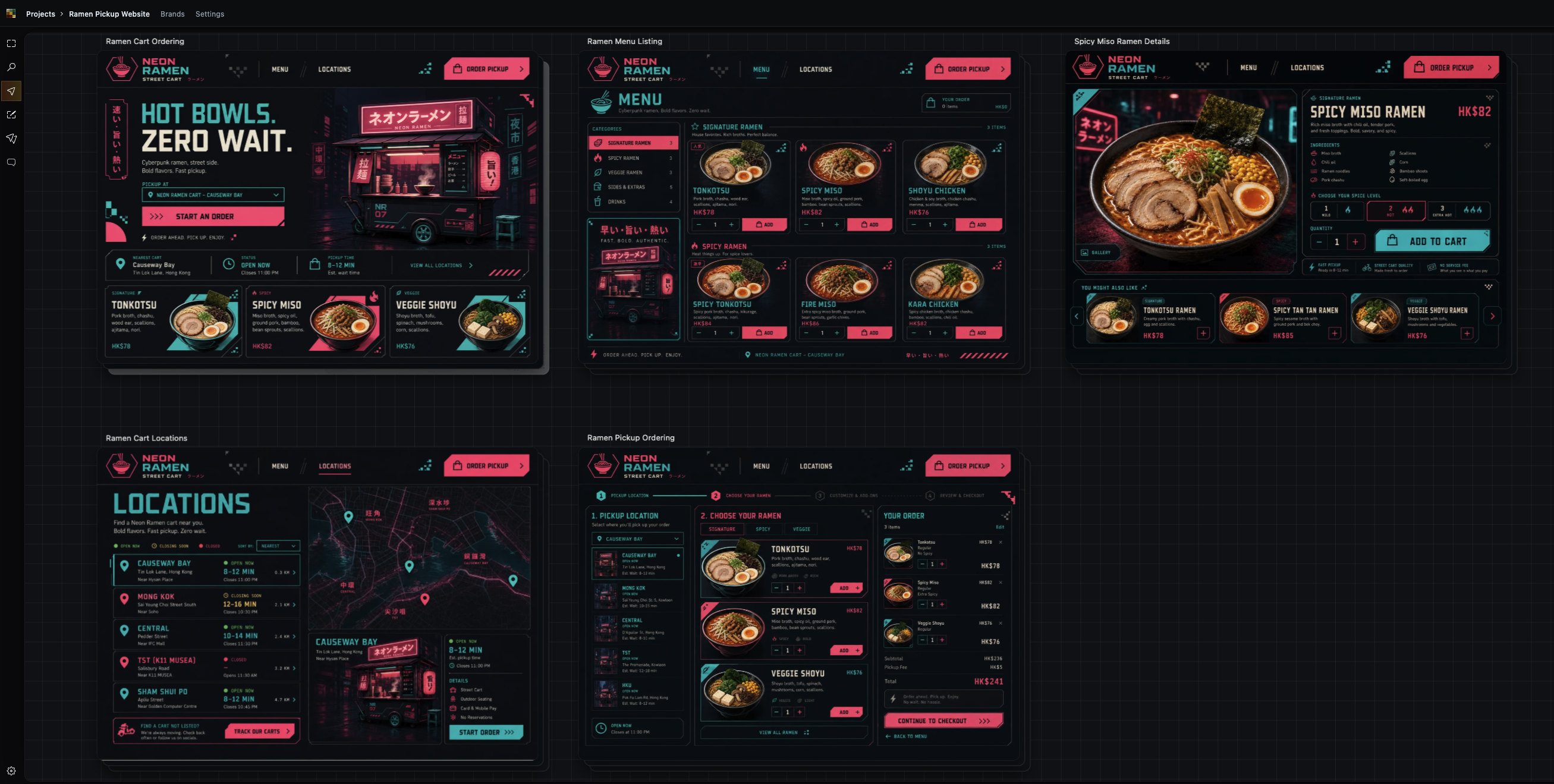
Image->html test for this.
Original images: https://image.non.io/neonRamenDesigns.webp
Qwen 3.8 build: https://html.non.io/neonRamenQwen3.8-27b
Overall I'm very impressed with how well this did. It's a big improvement over 3.6, and it feels on-par with some much, much larger models. I think this one is on-par with Gemini 3.7 Flash.
One thing to note - the build for this on my RTX 6000 pro blackwell took a long time. Easily one of the longest builds I've done. It took around 2 hours to build the site. Obviously we'll have some quants for this soon that will accelerate things, but I was still surprised with how long it took.
Comparison builds from this week:
https://html.non.io/neonRamenGemini3.7
https://html.non.io/neonRamenGLM5.3 (note: non-multimodal)
what token/s?
Beating or comparable to Opus 4.6 in benchmarks. Opus 4.6 was released in February, 2026. So if we still want to talk about a "6 month difference" between Chinese and American AI, the sentence should now be:
Chinese (small model) AI is 6 months behind American (largest model) AI.
Given that glimmer only caught up-ish to 3.6 how far behind is American (largest model) to American (largest model) ?
This with ddg mcp to fill in world knowledge. Are local models the future when computer architectures catch up?
https://news.ycombinator.com/item?id=48403639
my prediction was way too far out. 4.6 at home! Woo.
Note: on the model card the comparison to Opus is Opus 4.6 Max, not 4.7
Will there be an A4B MoE?
Yes.
O joyous day!
3.6-27B on little-coder was already mind blowing. looking forward to this guy!
I found this kind of amusing while running it (using Pi as the harness). Don't know if this is evidence of intense fine tuning from Claude but it smells like it...
" The user wants me to explore the repository at XXXX and report back. Let me start by understanding the project structure, reading the CLAUDE.md file, and getting a general overview of what this repository is.
Let me start by reading the main project documentation and exploring the directory structure.
I'll take a look around this repo. Let me start by getting a lay of the land.
read resource CLAUDE.md (ctrl+o to expand)
ENOENT: no such file or directory, access 'XXXX/CLAUDE.md'"
Welcome deepseek flash flash!
This is the homelab model hands down
I'm hoping to see folks distill this with current generation Opus / Fable reasoning traces. I have had my best results locally so far from Qwopus (Qwen 3.6-27B w/ Opus 4.6 reasoning distilled). This looks GREAT and I am definitely setting this up later today.
[flagged]
Why weren't the points merged again from the "dupe" thread that had 289 points?
https://news.ycombinator.com/item?id=49299684
What a weird mechanism. If someone is judging a thread/topic/event impact by the number of points it got, then doing this unfairly degrades that thread.
It should have deduped by user and combined the 168(at the time of writing this comment) + 289 points. Just add the twitter link from the previous thread as an additional link in the description, like you normally do, move all the points over, and remove the old thread.
[flagged]
[flagged]
My Strix Halo is about to go overdrive!
NICE, i've been waiting for this drop, thanks for posting this
need another fable uncensored merge with 3.8, really curious what it can deliver
[flagged]
Seems to be SOTA for its size. Hopefully independent benchmarks will come soon.
Can anyone confirm whether this new Qwen release is any more concise when thinking? Overthinking was the biggest (only?) downside of the Qwen models.
If the benchmarks are a real indication, we now have a local model that is runnable on a high-end personal PC that trades blows with the leading model Claude Opus 4.6 Max from half a year ago.
Insane if that is the case. Downloading now!
[dead]
Really excited to see what people do with this. 3.7 27B was probably the best compromise between size and intelligence to run on consumer hardware
Do you mean 3.6 27b? Because qwen 3.7 didn't have an open weight version
Apart from model performance, what harness are people using to come close to Claude Code or Codex workflow styles with tool use, conversations, loops, remote control, etc.?
and more specifically - what harness is known to be the best fit for Qwen local models, and are there any evals/benchmarks for harness+model pairs?
Architecture thread! Afaict they continue to use gated attention + delta net, which was also adopted+adapted by K3, but im surprised theres no improvements to the residual stream (deepseek are using manifold hyper-connections, kimi have attention residuals) ?
Perf improvements seem to all come from training?
As was the case with GLM 5.3, it seems that there is still much juice to be squeezed from post-training
q4km is about 48 tps on a 4090. my llama.cpp params are --flash-attn on --parallel 1 --load-mode mmap
With spec decode should easily get to >100tps
on my dual 3090s qwen 3.5 27b was running at around 110tps using the config from https://github.com/noonghunna/club-3090
make that 200tps on a single 5090, 4x faster than opus https://x.com/radixark/status/2088285681131110446
devs about to get handed a two 5090 box each and told to max that out
I wish this can run directly on my RTX 4090, seems like 30B is the sweet spot for dense model to run locally, sadly RTX 5090 is very expensive and I need a new PC and new power supply(and UPS) to run that, adding a second RTX 4090 is another option, but not sure if my PC can do that yet.
Others in this thread said it runs on RTX 4090.
even a 3090 will give you the VRAM headroom. i run Q8 on an 3090/A6500 combo. well, Q8 of 3.6-27B. I'm building the Q8 GGUF for 3.8 now, assuming mine will finish before someone else's.
This is one of the most important model releases since most use cases don't need SOTA/Frontier
If you want Qwen3.8-27B Serving Configs for the DGX Spark vLLM NVFP4 and RTX 4090 llama.cpp GGUF I added the setups here https://x.com/ErdalToprak/status/2088299678085308761?s=20
For those who don't wanna open twitter: https://xcancel.com/ErdalToprak/status/2088299678085308761?s...
Yeah this is the first model I have been able to run locally that actually feels useful, this is unreal I am considering cancelling my claude sub and going to just api (maybe GLM?) for really hard tasks.
Check out OpenCode Go as well. They give some Kimi K3, Qwen3.8 Max, and GLM5.2 (probably 5.3 soon?) usage which may cover your needs for $10/mo
Yeah I was thinking open router but I will look around at options, I genuinely think this model is good enough for like 90+% of my use cases, and the top frontier models are still not that good at architecture so I have to do that myself still so I won't be losing out.
I hope the bonsai team makes another 1bit quant of this model (or releases code/instructions on how to do it), using the Qwen3.6 27B on my 16GB mac mini has been wild . The 1bit quant feels like opus level… for the first couple turns. Then it has trouble eg switching from plan mode to act mode. This is mostly mitigated by starting a new session. (tbf this limitation is called out on the hf page)
I saw unsloth has 1bit quants too so I might check that out, anybody have experience with those?
Sounds like you need to check what the max context is set to ...
100k is all the context I have ram for, this is with any auto-compact turned off. This is using Cline in vs code. I’m sure I could tune the system prompt and mode switching more to work better with this specific model, but I haven’t gone down the custom harness rabbit hole yet.
And this is also specifically for the 1bit quant version. I don’t think the fp8 or even fp4 versions have this issue, but I haven’t tried those much
16GB mac mini - what chip? m4 pro i assume?
nope just my normal m2 mac mini. I bought it just as a normal computer to do my taxes and whatever, so it’s mind blowing that I can run this kind of AI workload on it. Well, “run” might be generous, it gets like 3-5tok/s
I’m working on a setup that’s more geared towards running tasks overnight so the slow tok/s doesn’t matter as much
The file "Just loads" on llama.cpp, the Unsloth https://huggingface.co/unsloth/Qwen3.8-27B-GGUF is an MTP file, I see mostly the same speed on pp and generation. There has to be something wrong with those benchmarks, I find extremely hard to believe a 27B model can work similar or exceed opus 4.6.
Worth distinguishing knowledge/task benchmarks from IF / agentic. It doesn't seem out of the question that you can have a small model thats generally good at instruction following and long-horizon agentic, as usually in those cases any requisite knowledge is in the context.
Most of the benchmark improvements afaict are in agentic and instruction following benchmarks.
I think you've been drinking the "LLMs only improve by adding parameter counts" that SOTA labs are selling VCs to build data centers so they can keep eating through cash to their own benefits.
To the countrary, the reason Chinese models are excelling in the smaller area is because there's tons of fat in closed source models because of the crazy cash being thrown around.
There absolutely is space to improve intelligence and capabilities without lathering on more and more parameters.
[dead]
27b dense model at Opus 4.6 level
Opus at home
I hope there also will be a new ~10b variant
I'm hoping for a 3.8-122B MoE
can you tell me ideas of usecases of 9 or 10B language models ? I cant find any usecases other than training a lora on them to give good bash commands for example
9B Qwen models are good and fast for local python coding tasks.
they are all overlapping but:
categorization, information retrieval, semantic search, image description
also with the model as part of an agentic system with tool calling
(edit: it is quite impressive what a small model in a feedback loop can do)
I'm struggling to figure out what to use this for. From the intelligence benchmarks in OMLX. If only they would release another MoE model.
  Intelligence Benchmark Comparison

  --- Detail ---

  Model: scottlowry--Qwen3.8-27B-oQ4e-mtp
  Benchmark         Accuracy   Correct   Total   Time(s)   Think
  --------------------------------------------------------------
  GSM8K                93.3%        28      30       282      No
  MATHQA               46.7%        14      30      26.3      No
  HUMANEVAL            96.7%        29      30     156.5      No
  MBPP                 83.3%        25      30      71.5      No
  LIVECODEBENCH        43.3%        13      30    1040.4      No

  Model: stamsam--Qwen3.6-35B-A3B-Claude-4.7-Opus-Reasoning-Distilled-MLX-oQ4-MTP
  Benchmark         Accuracy   Correct   Total   Time(s)   Think
  --------------------------------------------------------------
  GSM8K                96.7%        29      30      51.9      No
  MATHQA               60.0%        18      30       9.1      No
  HUMANEVAL            83.3%        25      30      82.9      No
  MBPP                 80.0%        24      30      29.6      No
LIVECODEBENCH 36.7% 11 30 283.7 NoTry manually asking both more discrete esoteric knowledge questions. Or use benchmarks which are less coding focused. The 3.6-35B-A3B with post-training may do well in coding type benchmarks and math but the density of its knowledge falls off in my experience (vs 3.6 27B dense Q8-K-XL unsloth GGUF) when you need to use it for less commonly used domains of knowledge.
My use cases try to avoid accessing world knowledge in the model (I give it access to web search for some adhoc RAG), and ya, I'm just focused on coding so that's the only place I'm looking at right now.
I think you may find that the dense 27B also does better if challenged with more rare coding tasks, less common or weird languages or things that aren't well represented in the active 3B parameters of the MoE model (eg: NOT css, javascript, python, c++, etc).
I wonder if Anthropic and OpenAI possibly missed the window to go public. A 27B open-weight model trading blows with the SOTA from just half a year ago is not great news for trillion-dollar investments...
This is why they've been making bank on the secondary market. They can retire now.
I don’t think so for two reasons:
1. They still have extreme revenue growth (and despite what HN says, good gross margins supposedly).
2. People will pay a premium for the best model. So far, we see catchup but no leapfrogging.
Trading blows in some benchmarks is a bit exaggerated. If you try the model, `xhigh` is basically feels like the `max` mode (i.e. massive thinker and extremely presistent), and the amount of world knowledge and intent understanding is nowhere close to an Opus class model even from 6mo ago.
It's still very useful, and it'll probably displace a good bit of API spend; but it's not really "trading blows with SOTA from just a half year ago". A bit overblown on the Anthropic/OpenAI has missed the window I reckon.
Also, on the open weight frontier side, Kimi K3 is pretty expensive, and Deepseek V4 Pro/Flash is getting a little less juicy with price increases.
I mean, that was obvious from the word "go".
Even Zuckerberg isn't as deluded to think that there's money in constantly releasing closed models and hypserscaling their deployment, which is why we got muse-glimmer 30b last week. I have been playing with it on a 32gb MBP w/ M2 Pro. If prosumer-grade hardware from almost three years ago can now offer a novice a way to host a possibly serviceable software development agent, then there's little incentive to pay out for LLMs like Anthropic's or OpenAI's over the long run.
The real target for Anthropic, OpenAI and tons of others are large enterprises and workflows. I think they will do all right if they execute well.
IMO AI companies are selling the infrastructure and easier access to the models, beyond competing to get the smarter model. We can run Qwen locally, but at what cost? A good enough GPU for running 27B is more than 4,000 USD where I live (Brazil). Even if I were to spend 100s of hours in credits I would never reach a point where the 4000 USD investment pays off. Unless I'm doing it for the sport, building my own LLM rig is not financially viable.
This is without saying that company clients of Anthropic or OpenAI will not have the upfront money to get a RTX 3090 for each and every employee. Much better to sign a deal with the LLM providers and get cheaper token price with a sales person.
> RTX 3090 for each and every employee
That’s quite inefficient. Get 2x RTX 6000 Pro and run DeepSeek v4 Flash for the whole company. This may or may not be cost effective compared to cheap third party providers, but it lets you own your own data, is not actually that expensive, and reports suggest that you can get 2k tok/s or so from a setup like this (at respectable batch size, but that’s exactly what you want in this situation).
I’m not sure I believe that the unquantized performance is as good as people are claiming, but even light quantization would make it fit easily.
Depending on your compliance needs this may be the only way.
I think I am going to buy a second rtx 3060, as 27B has been just outside of my range for to long, and this looks like the parameter count tipping point
Running it on 2x3060 now. Works pretty well but VRAM is tight. 4bit quants. 1x128k context, 8bit KV, MTP on.
whats the tok/s you get on that. I have heard a few claims of around 30-50 with mtp, but for how cheap the setup is I am surprised I don't hear more about 3060 stacks so I assume there has to be some catch.
I used GPT-5.6 Sol high to optimize it, and it claimed it was getting 50. I'm seeing ~40 on my goto smoketest: "Make me a vector add in CUDA".
Funny side note. It successfully one shot the program, but it wasn't able to run it because there literally wasn't enough VRAM left to allocate CUDA memory. Watching it try to debug that was fascinating. I'm pretty sure it would have killed the llama-server (and thus itself) if it hadn't been running in a separate container.
As usual, the Jinja templates are messed up so use this [0] to reduce or turn off thinking, fix tool calling, keep a 100% KV cache hit rate, etc.
[0] https://huggingface.co/froggeric/Qwen-Fixed-Chat-Templates
I'd love to understand this more. Are you saying the Qwen team spends their very impressive human and compute resources on publishing these amazing models and then botches the chat template with mundane bugs?
Like maybe I just misunderstand what's the hard part but wouldn't you assume that people who can put together an impressive model can also write a proper jinja chat template for it?
Yes, I was fixing issues piecemeal until I found the froggeric template, I've had to fix I think one issues with that one but it's better.
The chat templates are usually the first thing that every major release bork on, and all new model architectures end up having a ~2 week initial window of small fixes before they’re not DoA
Yes yes, oh god yes. They also spread FUD in the form of terrible recommended sampler settings.
If you're using llamacpp, turn on top-n-sigma with sigma of 1, turn off top-p/top-k. You'll thank me later.
How is terrible settings a case of FUD?
For those us us who don't know, what do those parameters do and why are they better?
Yes for the first question. Google of all companies didn't even get it right with Gemma for a while until recently. For some reason it doesn't seem like people can actually get these templates right.
Is the chat template used at all when they benchmark the model?
Interesting. Why don't the unsloth guides (https://unsloth.ai/docs/models/qwen3.8) mention this? Do they already include the fixes in their GGUFs?
They usually do include fixes yes.
@danielhanchen may be able to answer this
Monstrous benchmarks! Hoping it is not benchmaxxed.
I thought the same. But why claim something so shocking when it can easily be discredited and puts your reputation at risk? If they’re claiming Opus 4.6 level, I expect it to at least match Sonnet 4.6.
I could kiss you right now
[dead]
Why don't qwen/alibaba host the model themselves? I was looking forward to trying it on their coding plan. Google are the same way with their Gemma models.
Pretty sure you can use Gemma models on Google's "Vertex AI".
remember to let llama.cpp catch up to anything new in this model. Save your judgment until about 2 weeks of use.
'Good' news, there seems to be nothing new architecture-wise. Same as Qwen 3.5 and 3.6, so llama.cpp doesn't know the difference.
also cool: Qwen 3.8 27b is multi modal!
strong visual reasoning apparently, which is nice. still lacking native audio however. hoping for more companies to embrace the spirit of something like `gemma-4-12b-qat` for actual multi-modality (text, image, video, audio).
I don't know much about the production of these models. How hard would it be to 'fork' something like this and have it not be full of CCP indoctrination?
Look for `heretic` fine-tunes in the next couple of days.
One thing a lot of people don't seem to factor when hyping Qwen is how much models like this tend to 'overthink' with seemingly endless 'second guessing'. 3.8 seems no different from what I've tried thus far.
As capable as it is, it's hard to justify using it when a competing model (e.g. Gemma4:26b-a3b) can consistently achieve the same or similar response with only 1/10th as many 'thinking' tokens, achieve much higher tokens/second, and take a small fraction of the time. I suppose 'YMMV' depending on your use case.
Also, I haven't used it enough yet to see if it's prone to infinite looping, but its predecessors sure were.
gemma4 can't hold a candle to 3.6
You can add a thinking budget thats not much effort in llamacpp. You can align the cut off message with your agent instructions.
What you describe is a engineering harness problem.
If you, and i mean the royal you, actually read tge thinking traces you can see and figure out where its stuck
This means an effective harness would observe when the model is overthinking and step in with reasonable redirection, like increasing logging.
Llamacpp can set reasoning budget and message per reauest, so it can be dynamic.
Your complaint is "skill issue" based and will be resolved by people who do something ither than vibe code react demos.
Use 3.6 27b as a daily driver for months with charmbracelet crush. Gemma 26b-A3b is not even remotely comparable in terms of coding for me. YMMV depending on how you work, what harness you use, etc I suppose.
This is why the "reduce thinking" approach of BottleCapAI is both quite interesting and very useful in practice:
“Thinking” is just a guiding methodology to help iterations (between the initial prompt, results, and a mixture of harness back and forth to the LLM) converge on something sane in a massive parameter space.
I like to think of it much like (as a common example most people can relate to) the Newton-Rhapson method for finding roots of a (mathematic) function. Your initial prompt runs, then the ‘harness’ kicks in using whatever methodologies are behind them to iterate on that prompt (back and forth with the model, occasionally with the user to get better guidance) and refine the outputs to hopefully converge back to some sensible output or actions the user was initially looking for.
So you’re hoping for an LLM that sort of ‘zero shots’ or needs minimal iterations from a prompt to give usable results. I find from my anecdata it varies across models and what I’m trying to get it to converge on. I tend to prefer models to not zero shot attempt because they tend to not do great, I want them to get feedback often to let me push them down the route of convergence in spaces I already understand well, meanwhile I like them to explore and give me new paths in spaces I’m not too familiar with.
That’s really what all that “second guessing” is, it’s making sure you’re following a sane path in a massive parameter space of an ambiguously defined problem. Imagine if in Newton’s method you checked the slope and it didn’t decrease from the last iteration and you just say “screw it let’s keep trying that direction.” LLMs and their harnesses tend not to have that base assumption like iteration on decreasing slopes to guide them closer to convergence, it’s a lot messier.
Reduce or turn off thinking:
Given that it apparently defaults to 'xhigh', this is probably the answer.
Granted, it's still much lower tokens/s than you'll get out of many MoE models.
Edit: Even set to medium or low there's still a lot of second guessing, less consistency, lower 'acceptable response' rate, and slower/more token churn vs gemma4:26b-a3b. I think gemma4 is just a better 'general purpose' model.
In my experience with Qwen3.6 35B-A3B, disabling thinking made the model generate inaccurate replies. Ask it for the recipe of egg salad and it gives you the recipe of an omelette.
Did I miss something, is it possible to have that model be reliable without thinking?
Thank you, this is exactly what I needed.
If the benchmarks don't lie, this is getting very close to Opus 4.6 capability - which was the turning point for me for when AI was "good enough" that it became very hard to justify not using it.
I'm sure there's some benchmaxxing going on, and some things you get only with a a larger model.
But I'm feeling pretty confident if not by Gemma 5 than by mid 2028 we'll have local models that are almost always as good as Opus 4.6 was and in many cases far better.
What kind of things you only get with a larger model?
Asking it factual information[1]. You just can't compress the entire human knowledge into a 30GB file.
[1] Without searching the internet. And even if you allow it, you'll get much worse results because search means browsing and parsing the top results, and search results are horrible, whereas internal knowledge from training encompasses the entire internet plus all books including very niche stuff.
IME using 5.6 Luna and DS V4 Flash, I notice that although they are excellent at programming, even Opus-like in the way they try to debug, the thing they are worst at is inferring user intent and making good decisions with little information. They are absolutely terrible at that, will misinterpret small wording ambiguities. I suspect that's an ability you can't add with RL training, that it requires the depth of understanding from vast pre-training.
So add a pre-ingestion agent to your Pi Coding Agent subagent repertoire, problem solved.
Similar to the way they asked Sol to solve Erdos problems, that's what I want my model to do for programming.
I don't want to try to take my best educated guess at what the best design is BEFORE implementation - especially if you're designing a feature for a codebase you're not an expert in, you don't know like the back of your hand (i.e. one that is mostly or entirely LLM generated).
What sounds good on paper - often times becomes unideal in practice when you get to the reality of implementation.
It may not be worth re-architecting your entire system to get to a "pure" design that would be the best - all things considered.
Instead, I'd like the model to independently design many plausible and coherent good solutions, then implement each of them, then intelligently pick the few winners (after its fixed any bugs that could be causing promising solutions to look artificially bad) - unless there's an obvious one - and then give me the data I need to make an informed decision on which one to go with, all before I even look at the design or implementation.
You're not getting this from a one shot prompt from a 30B model today. You can't even really get it from Sol or Fable - IME. But you can get somewhat close.
This is a harness problem not a model problem, try prime agent it can do that and it will do it well even :P but you need to prompt it in according to its tools and processes.
You're going to be waiting for a while.
Even Fable is bad at this, I would constantly have to fix it going down architectural dead ends or just making obvious mistakes.
Which sucks for people that want LLMs to do everything like a genie, but does mean senior engineers have a few more years before they become redundant.
I honestly think we've got about a year tops.
I hope really badly that we'll get a new 35B A3B or similar MoE model!
I also miss the Qwen 3 Coder Next, which was 80B A3B, there are quite a few use cases where a non-dense model <100B would be the sweet spot (when you have the VRAM but not the TDP or compute power). Heck, I'd gladly take A5B or A8B or even A10B as a sort of middle ground.
Also alternate link for viewing the images without signing in: https://xcancel.com/Alibaba_Qwen/status/2088280182356611304
Me too. 35B A3B runs really fast on my MacBook Pro (M4 Max) and is suitable for real-time tasks like dictation post-processing. The dense model is not.
AgentWorld is a pretty recent MoE release from the Qwen folks with quite a bit better performance than 3.6, released around the same time as 3.7 Plus/Max, I guess. Not sure why it didn't get more attention, as it is definitely better than 3.6 35B A3B on all dimensions, but especially for agentic use. Still nowhere near the dense models (even 3.6 27B), but clearly an upgrade in the small Qwen MoE line.
https://huggingface.co/Qwen/Qwen-AgentWorld-35B-A3B
KAT Coder is another Qwen 3.6 MoE fine-tune that also improves on 3.6 by a measurable amount.
But, I do hope for a bigger MoE, in the 70B to 120B range, something in the Coder Next lineage. I've got a Strix Halo that isn't getting used to its best ability because the best models all run fine on my faster desktop dual 32GB GPU setup, and they run too slow for comfort on the Strix Halo.
I'm still confused about Qwen 3.6 35B A3B. Everything I read said that the 27B model performs better at coding tasks, so what's the purpose of the 35B model?
The "a3b" refers to its active parameters -- unlike 27b it is a mixture of experts model, so it runs much faster, about as fast as a 3b model, but needs as much memory as a 35b model! So good for unified memory systems like macs :)
MoE models have less active parameters in play at any particular moment, so they perform much faster on lower bandwidth memories (like Strix Halo or DGX Spark) and also use less memory generally.
Dedicated GPU memory tends to be much faster (either DDR6 or HBM). So if you can fit a whole dense model in it, you're probably better off with that.
anecdotes: 35B-A3B does want more memory, bigger model. But if you get it running it will be faster and more enjoyable to use -- text will fly by -- due to only 3B params being active, in my experience at least.
Runs faster on bad hardware.
It's better for VRAM poor people. I get 4-5 t/s with 27B and 20-30 t/s with 35B A3B.
Also radically better on an M1 Max. I get well up into the 60s t/s with the A3B, stuck at 9.5 or so with this new 27B, though perhaps an MLX build will help.
> I'd gladly take A5B or A8B or even A10B as a sort of middle ground.
Whats up with focusing on the active param count? Do yall fiddle with the weights or something?
You can run these on CPUs at a somewhat reasonable speed.
Or (somewhat) low TDP GPUs for that matter, like workstation ones, that might have enough total VRAM but not the best bandwidth/compute.
Total param count decides how much vram you need to run it. Active param count decides how fast it runs. My 10 year old GPU can load quantized 35B or 27B, but it can’t process 27B parameters per token faster than 2-4tok/s, while it can do A3B at >40tok/s
Thank you Kenny
I'm hoping too that they'll put out some MoE variants.
Qwen3.5:122b:a10b can run about twice as fast as this 27b dense model.
Edit: Like its predecessors, 3.8 seems really inclined to overthinking, and on a 27b dense model that's kind of painful. I think I'm going to stick with gemma4:26b-a3b as my go-to because it runs about 4x as fast and tends to only need a fraction of the tokens in its 'thinking' stage to get the same or similar answer.
Did you try the claude reasoning traces finetune for qwen3.6? I find that it works muuch better. I assume the same 3.8 finetune will be released at some pointas well.
Edit: link - https://huggingface.co/rico03/Qwen3.6-27B-Claude-Opus-Reason...
"inclined to overthinking," holy cats you're not kidding! On a Mac mini M4 Pro 64GB I prompted it with "svg owl" and it thought for 17m12s, outputting 36.3KiB of thinking chatter. It did end up producing a 20.2KiB HTML+JS+SVG file with a very nice owl, including cursor-tracking animation, but it ran for more than a half hour!
The MoE models are stupendously faster.
I think that's called test-time scaling i.e using more tokens at infer time to squeeze out higher model performance. That's must be part of the explanation for good benchmark results.
Yep.. it's pretty obnoxious for real-world use with the default 'xhigh' thinking. Ridiculous amount of "Wait, actually.." which might help for complex coding tasks but makes it unbearable for general purpose use.
Reduce or turn down thinking:
Yeah, that's probably the answer given that it apparently defaults to 'xhigh'.
Probably helps it score a little bit better in benchmarks :) `medium` seems like a nice balance so far; along with some light steering to vary think effort as needed for task and being pragmatic.
[dead]
Same here! Qwen3.6-35B-A3B is the only local model I've found that runs reasonably on my iGPU. Looks like me and and my noisily-wheezing laptop will be sitting out this upgrade.
yeah, that's the A3B part; going up to A5B would probably also feel comfortable.
on the 395+ AI MAX w/128GB, the A10B qwen 3.5 can do a lot of long running work if you don't need to baby sit it. deer-flow works well like that.
[self-reply because comment edit window ended]: I now have a head-to-head benchmark. On my wheezy laptop (specs in sibling comment), this new dense model, Qwen 3.8 27B, gets ~4 tokens/second on generation. The older mixture-of-experts model, Qwen 3.6-35B-A3B, gets ~20 tokens/s.
MoE is literally 5x times faster (on CPU) than comparable dense Qwen!
Tested:
Qwen3.6-35B-A3B-UD-Q4_K_XL
Qwen3.8-27B-UD-Q4_K_XL
35A3 might be more comparable to 10 dense.
27 dense is far more capable than 35A3.
So you happen to know how to demonstrate this higher capacity, what do we mean by that? Can understand bigger codebases? And how do we explain it, what part of the model does it?
Mind sharing your laptops specs? Just interested to see what is needed to locally run Qwen3.6-35B-A3B
Don't mind! It's 64 GiB dual-channel DDR5-6400, i.e. roughly 100 GiB/s of bandwidth. (AMD 7840U (Zen 4))
I'm using a Q4 quantization from unsloth (Qwen3.6-35B-A3B-UD-Q4_K_XL). It gets up to ~20 tokens/second in generation. I don't know precisely how much KV cache I can safely use, but it's in between 140k–256k. (I.e., 140k reliably works, 256k kernel-crashes from OOM. Don't feel like bisecting).
Inference is llama.cpp with the Vulkan GPU backend on Linux. (I.e., -DGGML_VULKAN=1 on the llama.cpp build, and --gpu-layers all on llama-cli or llama-server. (And for my specific setup, two kernel parameters specific to amdgpu: ttm.pages_limit and ttm.page_pool_size. A driver VRAM limiter. Look it up if you're on amdgpu!)).
Thanks! I don't have any knowledge of running models locally.
I assume it would not be able to handle an unquantized Qwen3.6-35B or is it irrelevant as you almost always would want to run a quantized version of the model on consumer hardware?
not parent, but 4-bit quantization is generally consider a good trade off for speed/performance, so you might use it even when you aren't on consumer hardware, but definitely when you are on consumer hardware.
Qwen 3.6 is ~$2/m tok, 3.8 should be drop in replacement. Gemma 31B is $0.34/m tok. The price differential on these models is massive on openrouter.
Why are you comparing a 2.4 trillion Max model to a 31 billion model?
Where do you see that? From what I can see on Open Router, Qwen 3.6 27B (the closest dense equivalent to Gemma 31) is $0.28/m. Am I missing something?
They're comparing Qwen 3.8 Max to Gemma 31B, fundamental mistake.
Yeah, I would appreciate if someone could make sense of the pricing differences between these models. How can a provider run DSv4F at lower cost than a 27B dense or 35B A3B model?
Does it come down to utilization and/or specific model tricks and efficiencies (attention, kv cache, etc.)?
DeepInfra prices:
Qwen 3.6 27B: $0.32 in / $3.20 out
Gemma 3 27B: $0.08 in / $0.16 out
DeepSeek V4 Flash 0731: $0.08 in / $0.18 out
Qwen 3.6 35B A3B: $0.10 in / $0.95 out
https://openrouter.ai/qwen/qwen3.6-27b
https://openrouter.ai/google/gemma-3-27b-it
DeepSeek V4 Flash is natively FP4 MoE with very compact KV cache. Say 8 GB/s. Qwen 27B is about 60 GB/s at full FP16 precision.
If active weight bandwidth is everything, then wouldn't Qwen 35b a3b (FP8) be roughly half the cost of dsv4f (FP4)?
dsv4f appears bigger and more memory/computationally expensive to run any way I look at it.
Yeah, it should be basically free. No idea why it is not. I guess KV cache taking up RAM and possibly bad business sense or amortized engineering costs, I honestly do not know.
Any tips on the best approach at running this at an M4 Max 128GB? Token throughput was a bit slow with the last 27B one (MLX), ended up using the A3B variant but if I could get this one to reasonable speed I'd much prefer it.
27B is a dense model so it will be slower with an MoE (A3B), but should have better quality? I still haven’t found very good uses cases on my M3 Max for dense models. Even if you can find a MTP version, it doesn’t help much, especially if you compare against an MoE with MTP as well.
Check out MTPLX and limit your context size.
Wait for the MTP variants that will likely be out within days. I'm on a 128GB Strix Halo box and for 3.6-27B 8bits I was getting about 9tok/sec (not great). With MTP that gets closer to 18 tok/sec (kind'a usable).
The MTP is available, but I'm definitely not seeing 18 t/s on the Strix Halo from the 8-bit quantization, even with MTP (more like ~10 with full context on long tasks). This is a slow model (but so was 3.6). What's your exact llama-server command that gets 18 t/s?
Seems like MTP is available immediately!
I have an M4 Max (unfortunately 64GB). I have been running the Qwen 35B A3B one for a while now, after testing and benchmarking a number of models. That one was consistently the best in class for tasks like despamming, E-mail classification, OCR and dictation post-processing. It was also really fast (90 tokens/s).
I'm benchmarking the 3.8 model now, it seems it is better (near-perfect score on my E-mail spam filtering benchmark, best of any model I tested, ever). But it is slow.
One thing I would recommend is keeping an eye on MTP parameters. I tested and benchmarked extensively, and I use `--spec-draft-n-max 2` with llama.cpp. Longer sequences actually decrease overall performance.
As for running, I ended up using llama.cpp and its llama-server, with a bunch of scripts written by AI, because I got tired of LM Studio not implementing the image-related parameters which made gemma4 useless for OCR.
How are you using email despamming?
I am looking to automatically recover mail from junk folder due to bad icloud mail filtering.
Go for a slightly more quantised version, and experiment with different MTP settings. I find that MLX versions are marginally faster on my 64GB M1 Max, but I usually use Unsloth's GGUFs via llama.cpp as there's a much greater range of quants available and I prefer llama.cpp. MTP sometimes also helps a little, but I suspect it's less helpful on my system than others.
Unsloth: https://huggingface.co/unsloth/Qwen3.8-27B-GGUF
This might work for you, but I didn't get on very well with MTPLX when I tried it a while back; YMMV: https://huggingface.co/Youssofal/Qwen3.8-27B-MTPLX-Optimized...
This is the way if you need speed. It costs a little bit in smarts, but compare the MTPLX option listed above with the oQ4e-mtp quant using oMLX. The good cacheing layer in oMLX will help things feel faster for some classes of tasks in my experience.
Unfortunately, that chip just doesn't really have the memory bandwidth to run this (or nearly any) model at acceptable speeds. I have the exact same chip (M4 Max 128GB) and I've been trying to optimize a completely purpose-built implementation with Fable and this is just not possible. Even if you could reach the full 576GB/s, it's just physically impossible to exceed these numbers with the model's architecture:
2 bpw - ~85.7t/s
3 bpw - ~58.0t/s
4 bpw - ~43.9t/s
6 bpw - ~29.5t/s
8 bpw - ~22.2t/s
16 bpw - ~11.2t/s
without cheating. You'd have to exclude layers, skip operations, etc. basically do stuff the model wasn't trained for. And speed collapses so fast with context that even 2 bpw would be looking at ~37.6t/s after just 128K tokens.
MTP only improves the situation by up to 2x in the ideal case, while drastically reducing the performance floor. While optimizing a 9B model on this hardware, I've found that the GPU just doesn't have enough FLOPS to handle speculating more than one or two tokens ahead on a single stream, regardless of quant level, simply because of the arithmetic cost of the forward pass. The 27B model would be even more expensive than that, potentially such that it's already bottlenecked by the GPU itself rather than memory.
I wouldn't get my hopes up for the 35B-A3B either. Not only is it reportedly much less intelligent, but I hit a similar ~85t/s wall in practice (again with highly specialized inference).
Without speculation I can reach around 120t/s on Qwen3.5-9B and with n-gram speculation (not even MTP; this derivative didn't come with one) around about 150t/s on average. This is on the very very edge of what I'd consider acceptable for me to even consider using such a compact model. YMMV due to the silicon lottery but the situation isn't good.
What is bpw?
Also whats your cutoff for 'acceptable' speed? I would have said 25tok/s.
bits per weight
Absolutely the best pelican I've seen from a model that runs on my laptop: https://tools.simonwillison.net/markdown-svg-renderer#url=ht...
Bicycle is the right shape. Pelican beak is excellent. Nice background. Most importantly, the pelican has one leg on each side of the bicycle - that's very rare.
(No chain on this bicycle though - in the reasoning trace it says "already chainstay... skip chain detail; maybe a small chainring.")
I ran that on an M5 Max MacBook Pro using LM Studio and their 17GB GGUF: https://lmstudio.ai/models/qwen3.8
It took 21 minutes(!) and used 22,276 reasoning tokens to produce 3,223 tokens of output.
(For the "they're training on your benchmark now" crowd, all of that cheating didn't prevent it from spending 20 minutes thinking about the task first! You can see the reasoning trace in the link I shared.)
For comparison, here's one I got from qwen3.8-2.4t-a95b on OpenRouter, which is pleasingly animated: https://tools.simonwillison.net/markdown-svg-renderer#url=ht...
I think the model got trained only on pelican to get there
What's the result if you ask it for a "pelican equipment case" ? I've been trying the anti-bicycle pelican on some LLMs and the results are much more varied than the bicycle prompt. Some have very different ideas of pelicans (you'll get a small case with one DSLR camera in it, or a long rifle case, etc). You'll also get cases that are isometric view, or flat plane view from the front, or open or closed.
For anyone who followed yesterday's Gemini 3.7 Flash pelican which rendered in Safari but not in Firefox or Chrome... https://news.ycombinator.com/item?id=49289112#49290012. - that turned out to be my fault, not the model.
My SVG rendering software was stripping some attributes. Here's the Gemini 3.7 Flash pelicans in the fixed renderer: https://tools.simonwillison.net/markdown-svg-renderer.html#u...
Damn That's very good
Gemini is worse
Kinda was expecting to see Gemma 4 26B in benchmark comparisons :(
Since Qwen 3.6 27b outperforms Gemma 4 26b in most benchmarks I'm not sure the value - also Gemma 26b is a MOE model whereas this is a dense model, so not typically direct competitors at their sizes - Gemma 4 31b comparison would be interesting though.
I see! Thanks.
Waiting for the MTP version to pop up on Unsloth. Speculative decoding makes a huge difference.
Been running quantized 3.6 at 110t/s on a cheap 5060Ti and quite happy with it. If 3.8 improves on it, it would be awesome.
Good news, MTP support is already included in this release. Not sure why they haven't made this clearer.
I don't see an MTP entry on Unsloth though. Maybe it's not available in a lower quant I need for my poor GPU.
Why is anyone even using video cards these days? You may as well be burning cash.
This is the perfect candidate for just splattering it on your nvme and then reading it off there and into memory. All of these run perfectly fine on simple m4 silicone:
https://github.com/drumih/turbo-fieldfare
Those are all for MoE models. And I prefer measuring my tokens in t/s instead of s/t
Lol, "burn money on apple hardware instead!"
And yet it's also a laptop you can basically take anywhere unlike a giant video card with 1000 watt power supply requirements.
WOW, my first try running on my 2 3090's, it was a bit slow... but it FEELS like opus 4.5, i gave it an image and a broad overview of what I wanted it to build, and it built the whole thing from beginning to end.
For your setup, do you have both 3090's in parallel for the inference of the model?
Yes they run in parallel via LMStudio (250k context)
Why slow? I see ~50tps on a single 3090
Yeah make sure you're using MTP and potentially tensor parallelism.
yeah, i consider that slow.
Oh, ok, that's like the average tps for most AI providers
Whats your setup? I have a single 3090 and am struggling to get it purring
5900x, 3090 24gb (slightly undervolted), 128gb ddr4, running via Ollama.
I am benchmarking it now locally, will put the results and speed/tps on aibenchy.com
I use the Qwens as a vision model for my DeepSeek V4 Flashes to handle. But the Qwens run on old RTX A6000 Ampere. Does anyone know if there's any news about INT4/AWQ quants for the RTX A6000?
Was recently thinking about doing something similar, do you basically just have the qwens describe what they see for the flashes?
Was considering adding a LoRa/vision head to Flash, but seems like it could take a while to get it right.
If DSv4 Flash was multimodal, I’d probably be done model shopping for a while
Same, with a multimodal DSv4 Flash I would just stop paying attention to things. Very smart, and at 260 tok/s it's too fast to care about anything else. If you ever graft something like that I would love to hear about it.
Yes, I have a very dumb flow. The harness has a describe_image tool that takes an image and a prompt and so DSv4 Flash uses it to get an idea of what it's looking at.
Yeah, I might just replicate what you're doing. Main issue right now is just finding spare vram to actually run another model in parallel... And yeah, if I train up a vision adapter somehow, I'll try to put it up/post about it, seems like we're getting the killer apps for local LLMs right now, where it's just feasible enough if you're enthusiastic enough to be a bit economically irrational, and just useful enough to sort of rationalize.
Can anyone who has that specific personal test he tries on different models , and tries this model , to tell us here if possible , how good or bad is this new model ? compared to others ?
I only trust those users genuine personal tests
There is a down to earth guy on YT that performs a series of tests against LLMs running on non-god-tier commodity hardware. He will likely be testing this soon enough.
https://www.youtube.com/@lukesdevlab
I don't know if that is what you are looking for or not and as always your experiences may be different.
So much potential for that channel. He's got a nice range of tests and a no nonsense presentation style.
However, watching tests of heavily quantized models that weren't designed for it (non-QAT) is frustrating. There's no way to tell if the actual model fails because it's dumb or if the lobotomy made it that way.
I noticed he does pay attention to feedback on his videos and I think some people have pointed that out.
thaaanks man, this channel seems really informative, although < 10K subs only !
It's a relatively new channel - but yeah - I feel the guy puts a lot of effort into what he does and deserves more subs.
The $1500 Intel B70 with 32GB of VRAM can run this model at max context with good performance, btw. If you don't want to drop $5-10k for running DeepSeek this is your best budget option for local refactor/small scale dev help
I have a B70, what llama options are you using and what performance are you seeing?
I wonder how this would stack up against 4x RTX 3060, assuming you have the physical room for them.
Since the 3060s would have to communicate constantly using pcie, I think I'd go with intel
I understand the B70 is a bargain vs AMD and especially nVidia offerings, but to me it feels like I would be buying something that would feel too limited in less than a year. 48G would be much more confortable.
And I know the 96G nVidia cards are selling for over 10k$.
The future can’t arrive fast enough!
32GB is perfect for models around 30B parameters. Since qwen has really hit the spot with their 27B dense models, I think it's a good bet. Also, 32GB is enough for other tasks such as image/video generation and loading multiple smaller specialized models
You can buy two b60s for $1300 right now (650 each) if you want a total of 48gb. Intel recently raised the price on all of their gpu's except the b60 series, so they are currently the best deal per gb I think.
They have terrible cross connectivity, it's not wise to share a model between them
You don't need $10k to run DeepSeek, I run it on a $1000 system.
Could you elaborate please? Genuinely interested
Go on… what is this $1000 system?
4x CMP-170HX he purchased with his time machine last month
Oh, can it work with the /v1/completions/ auto-complete endpoint?
Sorry, I wrote autocompletion by force of habit. I simply meant it can complete code you have already created a structure for, which personally is very nice
I thought so, but thanks for the clarification. I am a little bit disappointed that local autocompletion models have been left by the wayside in favor of models post-trained for agentic coding. Both Codestral and Qwen-2.5-coder are more than a year old at this point, but local auto-complete seems to me to be such a great usecase.
The latest Qwen models (including 3.8 27B) do still support FIM-style in-editor code auto-completion if that's what you're looking for. I wouldn't want to use a large dense model like 27B for such a task (since FIM-style auto-completion really works best with low-latency responses), but it works.
People will claim it's not comparable to Opus despite it beating the score. I'm not sure I disagree, but I'm also unsure whether I care. Most new models nowadays are "good enough". I cannot complain because I'd rather spend that time improving my prompts and docs. Opus might be a _slight bit better_ at picking up vague hints, but it's also extremely expensive, and I hit the 5 hour limit way too quick.
I care a lot about speed and efficiency right now. For my setup I would like to have 2-3 different model families. I've settled on GLM-5.3 (formerly Deepseek v4 pro 0813) for architecting, Deepseek V4 Pro 0813 for developing, and Gemini flash lite (any recent cheap model) for repo scouting. I'll add another one in the mix for reviewing (in this case Gemini 3.7) and that's all I need.
I've tried most models except Grok.
Qwen is too expensive IMO (Alibaba Cloud subscriptions are hard to come by and I'm not spending 50 euros a month for a tool, so 18 euros it is). If it ever becomes efficient enough to run locally I will definitely look back.
Claude is slow and expensive (the cache hit prices are absurd).
OAI is pretty good, I might add it to my arsenal seeing how cheap it is.
These opinions change every day. Last week I would've never picked Deepseek until I read about the pricing. even post aug 16 it's worth it (although it's getting close to gemini pricing).
Right now my costs are 12 euros a month (z.ai) + whatever deepseek consumes. This typically isn't more than 8 euros a week. 44 euros a month and I have a setup that is doing pretty well.
I'm convinced a lot of the anti-open-weight model comments at this point are inorganic traffic - there's trillions in investor money riding on a world where these models aren't cheap commodities. Having actually used things like the recent GLM, Kimi, and Qwen I think any edge the labs have is marginal at most and actually prefer the open weight models in most day to day usage.
Anthropic's recent releases are wordy to the point of exhaustion. Every time I use opus recently I find myself wanting to yell "GET TO THE POINT" at a terminal, which is exacerbated by it being slow.
Why are you convinced of that? Pretty much every time I see statements like that online, I can find plenty of organic traffic supporting it, not everything is a bot.
I just wouldn't bias myself that way, most people haven't really used local models. This stuff is pretty much all subjective evaluation, there's plenty of reasons for people to favor certain models or disfavor others.
> I've settled on GLM-5.3 (formerly Deepseek v4 pro 0813) for architecting
Dude, GLM-5.3 released _today_.
The phrasing "I've settled on" is incorrect for this context.
I'm generally extremely skeptical about a lot of the model hype that show up in comments. Except when there is an extreme mismatch the performance, quirks and quality of these things are difficult to nail down. You wouldn't know that from the comment section of every single release.
I think some of these are excited, eager users always ready to hype up the new thing. The same crowd that previously would constantly push for a rewrite from angular->react->svelt->god knows what. Instead now it is on a 6 week cycle and about models/harnesses.
I think most of it is bot driven spam by the various labs. It's hard not to notice 3 month old accounts with very strong opinions about various frontier labs and little else.
Ultimately, I think some of it is legitimate shifts in who's in lead and what is the best. You gotta dig through a lot of crap to get to that, and I don't really know how to to.
Ultimately I'm saying is that I always applied a fair amount of skepticism about what I see in comment sections but these day it is extreme amounts.
> I think most of it is bot driven spam by the various labs. It's hard not to notice 3 month old accounts with very strong opinions about various frontier labs and little else.
I've assumed the same as well.
I also assume that many of the companies developing these models engage in benchmaxxing.
At my company we've developed our own internal benchmarks for evaluating LLM models as they become available. The benchmarks are tailored to our particular use cases but the utility and knowledge our benchmarks assess is still fairly universally applicable. I see wide differences between what our internal benchmarks report and what the major benchmarks do.
There was a whole lot of fanfare about how amazing GLM 5.2 was when it was released, but it was pure rubbish on our internal benchmark -- far behind OpenAI, Anthropic, Gemini, DeepSeek, etc. I don't know how to reconcile the fact that GLM 5.2 performed very well on some of the major public benchmarks, but consistently performs so poorly on ours. OpenAI models tend to dominate our internal benchmarks.
This resonates. You need to tailor evaluation to your own use cases in order to know if you should adopt the next thing or not.
hence the "former deepseek v4 pro". I tried it out this morning and have had no complaints. I already liked glm 5.2
The sentence still doesn't make sense, because "settled on" implies a long testing phase with a verdict eventually emerging out of that.
What you're currently doing is "testing out"
> Deepseek v4 pro 0813
Which itself released yesterday? You're writing, reading, and evaluating enough software in a ~36 hour period to form, reject, and form another opinion about which model makes better _architectural_ choices?
It's the singularity, baby.
He's 100x, bro. 36 hours is basically like a whole 2 week sprint for you.
Honest question, how do you assess models this quickly? What metrics are you using? Would love to get my suite from multiple days and hundreds of prompts down to minutes. Got a few first pass tasks I run upon release for an initial experience, but those only work because even Fable and Sol fail despite objectively correct solutions existing, so it works because most models fail, but then, those are consciously not enough for coding, tool use, adherence or task specific inference and assessment…
What are you working on? That can dictate which models are best.
Anything from ML pipelines for language specific pruning over a Rust/JS/CSS mix codebase to assistance in motorcycle maintenance and different canvas coatings. Most of my evals build on those requirements and especially past failures, whether in pure information, task execution and coding or tool calling beyond the overfitted mainstream. All stuff derived from actual failures encountered, some still only few models come even close to passing. With such a mix, it just takes a while to get any serious opinion on a model. Doubt anyone can do that in such short time, unless their tasks are so simple that most modern models not only succeed but could themselves accurately rate output. If even Fable still confuses PU or wax coated cotton canvas with a nylon shell, or tells me with a straight face to adjust the valves on a bike that has hydraulic lifters that needs experience for human assessment and the time that comes with it. Anyone with less knowledge either wouldn’t see the mistakes staring them in the face and just go by vibes, any model rating these equally can not tell what is accurate and will just go by the output sounding accurate over being. Gives sometimes very interesting results far different to public benchmarks. Inkling, e.g. is more accurate in not telling you to adjust valves that are simply not adjustable then Fable or Sol, which just tell you to adjust every 5000km. Sometimes even when their reasoning and search includes sections about the fact this is not necessary or possible. The beauty of overfitting and unbalanced training data…
i think you will like luna if you haven't tried it yet
Luna is twice the price of Deepseek V4 Flash 0731, and less capable :/
How is it less capable? I get being cheaper, but I’m pretty sure Luna is the stronger model?
Didn't DeepSeek go up 2x?
Up to 4x but in 2 days.
The price on DeepInfra and most providers on OpenRouter has not changed... if anything, it's gotten cheaper.
All of this DeepSeek price increase stuff is related to their specific API, not the entire market.
You should check out Grok, it's quite a good deal from the Cursor subscription side but it's cheap even by API prices.
I think it's very clear that someone who has checked out all the models but the one that called itself mechahitler and is explicitly being fine tuned to support far-right politics is making the choice for reasons other than performance and cost. It's not like all the other models even had plausible claims to those metrics.
[dead]
[flagged]
Yeah I'm sure everyone on r/cursor or in previous HN threads about Grok 4.5 or 4.6 are all unserious and insane.
No one actually cares about the politics as long as the model codes well.
Edit, quite interesting to see the reception to this comment compared to essentially the same type of comment I made on a Grok 4.6 benchmark HN post: https://news.ycombinator.com/item?id=49275385#49275571
It's true that Cursor gives a lot of usage with Grok, most users of Cursor don't care about Musk.
Voting with your wallet is still very much a valid way to protest that odious man.
Some people might not mind (or even know), but I sleep better at night trying to work as ethically as I can.
There are a lot of people who are apathetic to what musk is, people that don't care are not people who should inspire you. What the hell is so inspiring about apathy anyway?!
And yeah, people that don't care DO make the world worse through their apathy.
I would say it is sad that there are people who use Grok when there are so many other choices available which don't come with the issues of supporting Musk.
It is not all just 'politics'. Take a stand on some issues. It doesn't cost much not to use Grok.
[flagged]
"No one actually cares about the politics as long as the model codes well."
> I totally care about politics, especially when it comes to not giving my money to people like musk.
i care about not financially supporting a person that is actively trying to disenfranchise me, why is that a difficult concept for some people? that not everyone is motivated exclusively by financial profit? is moral bankruptcy so pervasive that some people assume it is unanimous?
'They' - in this case - are those who are unable to empathize. People who only learn of other's struggles through visceral personal experience. Conservatives, in general, struggle with this class reasoning... Very much a 'if I don't experience it then it doesn't exist' kind of mentality. Frustrating and exhausting. A lack of imagination, a lack of empathy, they just are lacking in these regards.
This is the “Mussolini made the trains run on time” of ai hot takes.
(Btw, mussolini didn’t make the trains run on time)
Also: "What do you mean everybody at this party is a Nazi? They seem uninterested in politics, and they have been so welcoming to me!"
"Sure I'm indirectly funding the erosion of basic human rights in the States, but at least I made my Hello World app cheaper!"
Beats Opus 4.7 Max (w/ Claude Code) on DeepSWE (42.2 vs 40). Looks like Qwen's 27B models continue to pack some punch.
Unsloth's GGUF quants are up: https://huggingface.co/unsloth/Qwen3.8-27B-GGUF
In the local LLM communities there is a lot of respect for the Qwen models, but everyone comes to acknowledge that they do a lot of benchmaxxing after using them. Even at full precision they're never as good as models with similar benchmarks.
That's crazy, considering the massive size difference. But the small Qwen models are known for punching above their weight.
Good morning Dario!
Considering the clusterfuck that is opus 5 or even fable, if Qwen 27B is trully better than Opus 4.7 Max, I will rejoice.
Yeah Opus 5 is almost unusable as a daily driver without making me go insane from excessive claude babble.
If it's as good as Sonnet 4.6 for most things I'd be happy.
That kind of result makes me suspicious of benchmaxxing. Qwen 27B is 100x smaller than Opus 4.7. Is it really 100x more parameter-efficient? Two orders of magnitude is hard to believe. I don't have the hardware to run a 27B, but I'm curious what real world use is like. Maybe I'll have to buy some usage on a cloud provider to run my own tests, but this seems fishy to me.
It's very agentic coding focused; and I'd say a good executor but certainly not Opus in scale; overall knowledge; long-horizon work and recovery; etc.
e.g. If you try to chat to it about something philosophical for example, or maybe a debate / creative writing, then you'll very quickly see how it is still a much smaller model at the end of the day.
Still, it's such a relatively accessible model to run, and I find a big part of leveraging smaller models is to give it well-scoped tasks; not too high level or ambitious ones. Very impressive for its size and the ability to run locally :)
Qwen small models are heavily coding focused, whereas Opus is everything to everybody (even if code is their bread and butter). The downside is they'll frequently hallucinate world knowledge so they need to be RL'd to double check their knowledge against sources and verify facts/library names/etc.
Oh, goody goody goody! Can't wait for a Q4M with *MTP* support. Does anyone know if there are plans for it?
I am currently using Qwen 3.6 on RTX 3090 and I have to admit that without MTP it would be too slow to be acceptable for me (30-35 tok/sec without MTP, 60-70 with MTP). Without MTP I would just use OpenRouter and rather pay for speed despite having a capable local setup.
It comes with MTP already, they just don't mention it in the filename as it's now the default.
Oh, thank you for telling me this. Trying it out now.
I wish each quant was benchmarked on the same tests as the original network so we could compare their performance
When I tested various eval benchmarks on Qwen3.5/3.6 27B with Unsloth's quants, the scores usually dropped 0-5% between UD-Q6 and UD-Q3 depending on the eval.
Unsloth publishes KL divergence numbers which measures how much the quantised probability distribution changes vs unquantised: https://unsloth.ai/docs/models/qwen3.8#quantization-analysis
It's a bit bare at the moment, I assume they are going to add further detail later (eg comparison to other quants), similar to their other releases.
The talk around KL divergence is oversold. People talk about it as if it’s not a benchmark, but at its core it is in the same neighborhood! You get a different KL divergence number on different “calibration datasets”, so in other words it’s data-dependent. It is NOT a universal guarantee about the fundamental divergence of a model.
That's not a replacement for benchmarks
KL divergence is nothing close to a replacement for benchmarks. As flawed as benchmarks are, KL divergence is a barely useful signal. The fact that Unsloth only just started publishing KL divergences shows how unserious the quantization space is.
Actually we do publish non KLD benchmarks - top-1% is better - for NVFP4 for eg we did MMLU Pro, GPQA, AIME 2025: https://unsloth.ai/docs/models/qwen3.6#nvfp4-benchmarks
Sometimes they're just slow and expensive, so we we KLD as a proxy measure and it's very high correlation (95%+)
> The fact that Unsloth only just started publishing KL divergences shows how unserious the quantization space is.
Just wanted to say that this is a very important point that I totally agree with. People are obsessed with KL divergence, but it is yet to be demonstrated to be a descent proxy for agentic coding benchmarks.
You're very right about KL divergence. I spent a couple days playing with the Gemma 4 models. That's 10 separate models (varying weights, MoE, QAT or not, etc...) with identical tokenizers. I treated 31B at BF16 as the gold standard, feeding Wikipedia snippets, and anthropomorphizing a bit:
Gemma 4 31B: "Um, if I really said all of that, I guess I'd say this next"
Gemma 4 26B: "Dude, I would've said completely different stuff" (large divergence)
Gemma 4 12B: "Umm, there's zero chance I would've said some of this" (INFINITE divergence)
Gemma 4 E4B and E2B: "Derp derp, I'm happy to say almost anything" (lowest divergence)
For models which are chat trained, they simply would not recite Wikipedia, so the divergence is almost meaningless. I thought about capturing a realistic coding session and trying to use that as the corpus, but you need to preserve the turn-based tokens and such, so I moved on to other things.
Is there any advantage to using the model from Unsloth compared with https://huggingface.co/Qwen/Qwen3.8-27B-FP8 ?
Depends on what software/hardware you'll run it. GGUFs from Unsloth can run on pretty much every single potato; full weights need beefy gpus
Unsloth one is gguf for llama.cpp (and some other on-device engines).
So advantage is not having to produce your own quantisation / gguf from .safetensors you've linked.
Run the unsloth if you are using llama.cpp (GGUF)
Run the one you linked if you are running vllm (safetensors)
if you have the VRAM, use offical release. quantized model lose focus after long context and can do damages or thinking loop
Unsloth usually also fixes the models when they bork something, which always happens. For Gemma for example the tool calling wasn't working for the longest time.
That wasn't our problem right? Gemma officially updated tool calling which we adopted
We also made NVFP4 ones if that helps! https://huggingface.co/unsloth/Qwen3.8-27B-NVFP4
This is the version we'll be testing on our rtx 6000 today! Thank you
Why not just run FP8 on vLLM with that much vRAM? It's plenty fast.
For high concurrency, using the blackwell's native native W4A4 MLP compute path, nvfp4 is something like a 1.2-1.5x performance increase over FP8. We're doing data enrichment (so, tasks completed successfully + tokens/second) so the performance bump shows up in the tasks/month number.
I am just now getting the benchmarks running against 3.8 27b but I expect similar results from benching 3.6 27b at the same quant.
> Beats Opus 4.7 Max
I'm a huge open model fan, and have used them since forever, even have daily drivers for on-prem dev, but no. They do not beat opus on real-world usage.
Qwen models are impressively good for what they are, are "good enough" for plenty tasks, can be ran locally on decently priced hardware, and so on. They certainly have their uses, and the field in general has advanced faster than my early expectations. But to compare a 27B model to SotA behemoths from a few months ago is doing everyone a disservice, especially people who pick it up, try to use them just like API models, and leave disappointed and confused. Number goes up on a benchmark isn't it.
There is 0 shot you can make that claim about this model you have not used or downloaded yet
How can you say this when you haven't even tried it yet? Is it just hypothetical vibes?
"Benchmark is stupid" and "model beats model on benchmark" are two different things, though. The second one is objectively true regardless of your views on the first one, right? To expect everyone to share your opinion that benchmarks are stupid is pretty weird, and just saying "no" to an objective truth is the definition of delusion.
If a benchmark is a measure of nothing useful, then model beats model is an objectively useless fact
But that's the problem with that logic. The author subjectively claims benchmarks are stupid (a debatable opinion) and treats that as inherently true while making the second claim (hence, you shouldn't say model A beat model B).
I can say I find the law stupid, so no one should say person A beat person B in court. But I did not prove the law is stupid; I merely thought it subjectively and demanded others to follow the second part because I believe the first part is true.
Saying that "if the law is useless, court cases are useless" is objectively true and cannot be argued with. But you still need to prove why the law is useless, not why you think it is and even then if people disagree and use the law as a reference, then it's not objectively useless and court cases are not useless as well.
> ...but no. They do not beat opus on real-world usage.
I agree, but then we just need meaningful benchmarks that clearly show that! Otherwise it's hand waving about something that should be put on paper in quantifiable terms.
> but then we just need meaningful benchmarks that clearly show that!
That's the rub. AI benchmarks are IMO, by and large totally unreliable. We think of them as similar to traditional benchmarks of deterministic processes where the number of variables is low. But they're anything but that. Non-deterministic processes with an astounding number of variables and fuzzy acceptance criteria.
It leads to results like these, where if you take it at face value, the only conclusion you can draw is "wow Anthropic must be stupid if Opus takes 1T parameters to do what Qwen can do in 27B."
If you are working in a company and using language models, it is a very good idea to hold a bunch of evals you can trust and use to validate new models. Calibrate every once in a while with prod data. We have our own and the only numbers on quality and cost I trust come from this setup.
In the end, the only benchmark that matters is your own.
Only useful benchmarks are those you (in particular) don't have access to.
The only useful benchmarks are those you've created for your specific workflow. Only then can you assess whether a given model is better or worse for what you are using it for.
There are tools like promptfoo designed for this.
A wise man once said, "not everything that counts can be counted, and not everything that can be counted counts".
That’s well and good, but how are we supposed to evaluate the accuracy of random HN comments without anything resembling somewhat objective metrics? People say all manner of things, and usually it’s contradictory. What heuristic do you propose?
Yep. These small models are actually worse than GPT 3.5 at some tasks (like recalling facts). You can definitely make models smarter at specific tasks (like tool calling, coding) but you can't compress the entire human knowledge into a 30GB file. It's just not enough bits.
that is why we enable web search for the agent. the memory can come from the internet.
deepseek-v4-flash needs web search to return true facts.
Yeah but results are worse, see https://news.ycombinator.com/item?id=49301574
But why would you use a model to store factual knowledge, that is stupid. We want intelligence, not a database.
Models cant make any decisions if they have 0 idea that the feature exist in this language or in some general fact.
For example you would tell a model hey, become an expert in this language for me, search it online, it would still need to learn it and download the data to it's context and then increasing the memory usage, there's no way around it.
> They do not beat opus on real-world usage
We have an internal eval that measures performance on tasks for a handful of embedded systems repos for our mmWave radios (mostly Rust, some C for microcontroller stuff). Qwen3.6-27B scores only 4% lower for pass@1, n=250 compared to Opus-4.8.
For the labeled dataset, the average PR size they're being measured against is around 1.5k SLOC.
This is very much "real-world usage" for us. The sort of change sets that come in daily/weekly and are solving non-trivial issues in the respective codebases.
As is usually the case, the most broad claims from both the labs and from the consequent pushback are talking past each other.
[dead]
>> We have an internal eval that measures performance on tasks for a handful of embedded systems repos for our mmWave radios
Okay but the parent said real-world usage, presumably meaning coding tasks.
We have a whole bunch of complex evals that Haiku 4.5 passes. That doesn't mean it is a good model for coding.
They literally stated in their first sentence that it was coding tasks.
Yes, these are coding tasks in the embedded systems domain (I mentioned Rust and C).
How much does it score though? 0% would be 4% less if Opus was at 4%. Unless you mean relative fraction not percentage points - but people usually mean percentage points in such situations.
0% is not 4% less than 4%, that would be 3.84%.
0% is 4 percentage points (pp) less than 4%.
[dead]
Let us know when you have Qwen vs Qwen comparison stats. As long as there's not a regression, that'd be awesome.
4% is within the margin of error anyways for pass@1, so I think pass@k > 1 is gonna be the better indicator of any movement (still need to calibrate the optimal k to re-test). 10 seems too tolerant even though that tends to be the next tranche I reach for.
Depends on where you sit on the binomial curve. At p=0.04 for n=250 4% points would not be within margin of error.
Right I take your point, but that's not the comparison in this case though. These are paired results on the same 250 tasks, so whether a 4 point gap is meaningful depends on the task-level deltas, not just plugging p=0.04 into the binomial SE.
Since it might be helpful to some, here's my current commandline for llama.cpp running on an RTX 4090 with my monitor moved to the iGPU to free up all of its VRAM.
llama-server -m Qwen3.8-27B-IQ4_NL.gguf --mmproj mmproj-BF16.gguf -c 170000 --parallel 1 -ngl -1 --cache-type-k q8_0 --cache-type-v q8_0 -b 1024 -ub 512 --flash-attn on --no-context-shift --no-mmproj-offload --spec-type draft-mtp --spec-draft-n-max 5 --spec-default --cache-type-k-draft q4_0 --cache-type-v-draft q4_0 --threads 24 --jinja --reasoning on -fit off
Identical to the qwen3.6 config. With a prompt like "svg owl" (which can reuse quite a lot compared with creative writing or similar, so ngram-mod shines), I get about 70-80t/s like this, with a memory overclock of about 1.5GHz
I can get 128k context on a 5070ti with 16 GB of VRAM (using the Unsloth 2-bit quant[0]). This is via a .bat file on Windows 11. I'm getting about 50-60 tokens/second and the quality is much higher than Qwen 3.6 27B. I'm using llama.cpp[1]:
    llama-server.exe ^
        -m "Qwen3.8-27B-UD-Q2_K_XL.gguf" ^
        --presence-penalty 0.0 ^
        --repeat-penalty 1.0 ^
        --fit-ctx 128000 ^
        -ctk q4 0 ^
        -ctv q4 0 ^
        --reasoning-budget -1 ^
        --chat-template-kwargs "{\"preserve thinking\": true}" ^
        --host 0.0.0.0 ^
        --port 8033
[1] https://github.com/ggml-org/llama.cpp/releases
Instructions if you want to do the same:
1. download two files llama-b10434-bin-win-cuda-13.3-x64.zip and cudart-llama-bin-win-cuda-13.3-x64.zip from that llama.cpp Github releases page, and extract both into the same folder.
2. Download the Qwen3.8-27B-UD-Q2_K_XL.gguf file from huggingface and put it into the same folder beside the `llama-server.exe`.
3. Create a file named "RUN_QWEN_3.8.bat" next to `llama-server.exe` and put the text above into that bat file. Double-click the bat file, then open http://localhost:8033 in your browser to see a chat window.
You can use it with any agents by pointing them at http://localhost:8033/v1 which is a working OpenAI compatible endpoint (it doesn't use a token, if you give one it's ignored).
Congratulations, you're now running Qwen 3.8 27B.
Note: I built the computer in question for playing games, yes it needed to be Windows 11 for anticheat reasons to play games with family, I didn't want to dual boot so here I am. I figure I should share instructions for folks who may also have a Windows PC around for such purposes. Specs for this are AMD 9800X3D, 32GB of system RAM, RTX 5070Ti 16GB
Does anyone know how to get this working with Claude Code via llama-server? I'm getting a jinja template error about the system prompt not being the first message.
With default config via Ollama and 65k context I get 50tps on a 3090.
Have you tried to put the nvidia card into "compute-only mode" since you're not using it for display?
Any chance I could run it on a GeForce RTX 5060 Ti 16 GB, (64 gb ram)
You could run the 2-bit quantization at about 10GB for the weights. You'd probably also need to quantize context to get a decent-sized context. The Unsloth model card shows the 1-bit quantization doing seemingly shockingly well on a task (but there is notable loss in model quality for each bit you give up below about 6 bits). An MoE model can partially reside in system RAM without catastrophic performance loss, but a dense model like this one cannot. You have to run it entirely out of VRAM, or it'll slow to a crawl.
Yes. It won't be as fast as fitting the whole model into VRAM but llama.cpp defaults are pretty smart about GPU/CPU splits these days. Just YOLO it with `llama serve -hf unsloth/Qwen3.8-27B-GGUF:UD-Q4_K_XL` and it'll definitely at least run.
You may be able to run a quantized version. One strategy I've found effective is to set Claude or Codex loose on the problem and they'll do a decent job setting up the best possible model revision.
what --no-context-shift is for ?
"--context-shift, --no-context-shift ... whether to use context shift on infinite text generation (default: disabled)"
From: https://github.com/ggml-org/llama.cpp/blob/master/tools/serv...
That is obvious. Less obvious is what context shifting does and whether you want it or not.
I absolutely love this comment. I wished there was a website where people would post their working command lines as well as what hardware they are using to run that stuff on + tokens / sec prefill + gen.
pretty sure this exists already...
[dead]
Problem with that is I think that it quickly devolves into cargo culting, nonsense and noise.
Arguably, what I am doing is also very very close to that, with the only difference being that I am somewhat less of an idiot than the average internet dweller you'd get on such a site. Or rather a different flavor of idiot.
Ideally, the people building the tools build them in a way that just does the right thing - which I am confident that llama.cpp does or will do in the future.
So you encode that knowledge not in language and online comments but in code and with a filter for actual expertise.
And, frankly, there's really not all that much to it. It's like maybe 3 parameters to play around with.
The valid solution space is pretty small, but people will want to make it "theirs" regardless, so you get non-solutions just so that everyone could also be a part of it. The usual social dynamics foo.
I've found that once you factor in multiple GPUs things can get complex quite quickly because the default packing routine in the LLM runners tends to be very coarse resulting in substantial amounts of VRAM wasted. More so if you start running drafters and multiple models at the same time.
Let me return the favor:
Deepseek V4 Flash 0731 Q8
This is on a 4x3090 box with 256G RAM and a 5955WX TR; the CUDA drivers are patched to allow the 3090's to talk to each other. MB is a WRX80E-SAGE (which has 7 slots at x16), BAR > 4G on and PCIe BAR resize set to AUTO in the bios. OS is Ubuntu 25.04.
GGML_CUDA_P2P=1 build/bin/llama-server -m ../DeepSeek-V4-Flash-0731-UD-Q8_K_XL-00001-of-00005.gguf --alias DeepSeek-V4-Flash --threads 32 --threads-batch 64 --cache-type-k f16 --cache-type-v f16 --metrics --cache-ram 0 --load-mode none --fit on --fit-ctx 1000000 --host 0.0.0.0 -fa on --top-p 0.95 --temp 0.7 --repeat-penalty 1.2 --jinja --tensor-split 1,.8,.1,.15 --cont-batching -b 4096 -ub 4096 -ncmoe 36 --parallel 1 -ot 'blk\.3[67]\.ffn_(gate|up|down)_exps=CPU'
I'm still working on an optimal packing for the draft variation on this theme but that gives all kinds of issues. The 1,000,000 context is very nice to have.
As a MBP and DGX spark owner, I would love such a site... (Feel like it would be a low effort feature of hugging face).
Searching through Reddit and forums for best commands is annoying.
Looking forward to having your problems :)
What stackoverflow should have become.
still could! there's the network site https://ai.stackexchange.com/ just need people to ask questions and to downrank accepted answers older than a year (that might not be possible though).
Do you find it useful or worthwhile to split a large LLM across two GPUs on a desktop?
If you've tried it, what worked well and what didn't? I'm especially interested in mismatched VRAM setups, e.g. a 16 GB GPU + a 24 GB GPU.
How much overhead did you see from inter-GPU transfers, and did the extra usable VRAM outweigh the performance hit?
It depends on what model you’re running, and for what workload. For personal use (one or two convos at a time) with models that fit in gpu memory, pcie bandwidth doesn't really matter. Just try and be on gen 3 x8 or higher.
Llama is decent at auto optimizing it if you let it use both gpus. It’ll split the workload so the contiguous layers are all on one gpu. Once the model is loaded, you only transfer weights between gpus once (per token?), at the layer boundary.
I run on an 8gb 3070 and 12 gb 3060, and the only weird thing is that the weaker card gets more layers (and therefore work) because it has more ram.
Oh, if you’re barely fitting the models into your vram, you may need to explicitly adjust the layer balance between cards — sometimes it fails to realize it should have put certain things (like draft models) on the other card so you can fit one more layer in.
As opposed to loading it up in RAM + VRAM? Pretty much always better to split it up to multiple GPUs. My priorities are load up all available VRAM, then offload MoE experts to RAM (if possible), then offload other layers.
I use an RTX 3090 (24GB) and a GTX 1080ti (11GB). Just the 3090 for 3.8 I get maybe 60tg/s (UD-Q4 quant), for both I get around 40tg/s (UD-Q6). Not apples to apples though considering it's different quants.
Here's my config: https://gitea.va.reichard.io/evan/nix/src/branch/master/modu...
Yes. I can split a model like this across 3 GPUs (a 1080 with 8GB and two Titan Vs with 12GB), and it's much faster than running it on 36 CPU cores. As long as it fits in aggregate VRAM, it seems very advantageous to do so.
That's a very deep rabbit hole involving PCIe topology on both the hardware and software (NCCL) side, among other things. It's too system-specific to answer directly, but the entrance to said hole can be found at https://github.com/local-inference-lab/rtx6kpro/blob/master/... .
Disregard references to RTX 6000 cards, most of it is generally applicable to all multiple-GPU boxes.
I haven't tried this either but I'm guessing if you could pool the GPU memory over whatever the kids are using these days, I think it was SLI back in my day. The GPU memory should still be faster than the RAM?
A hetero-GPU setup is definitely cost-effective if you don't strictly require the raw speed of a top-tier card like 5090. Just keep in mind that the total throughput will also be bottlenecked by the slower card.
To provide some anecdotal data, here is how my 5090 + 3060 setup performs with Qwen 3.8 27B (Unsloth's UD-Q4 with MTP):
  Single 5090: 101 t/s (TG), 2650 t/s (PP)
  5090 + 3060: 53 t/s (TG), 1700 t/s (PP)
I wonder if turning on GGML_CUDA_NCCL would help reduce delay between cards
Depends on your pcie connection. If they're both x16 then it's pretty low overhead, x8 is ok, but x4 is too slow. Also it's a bit tricky getting an optimal setups with mismatched vram, I think you could probably still make use of the full vram if you're clever but it's trickier.
for layer parallelism (e.g. to get more vram) the bandwidth between layers is essentially nothing (like 16kb per token I think), so I don't think x4 would even be a problem!
Good point. It's much more of an issue when running dense models with tensor parallelism. In that case, I'd look for an MoE model instead.
To add for me (and claude assisted but tuned myself), here is for 3060 12gb + 5950x 128 gb ram without image support: https://pastebin.com/HsAUBGSY
Here is the chat template I used (and renamed to qwen.jinja): https://huggingface.co/froggeric/Qwen-Fixed-Chat-Templates/r...
For image support, drop to NGL 24 and add:
  --mmproj-url https://huggingface.co/unsloth/Qwen3.8-27B-GGUF/resolve/main/mmproj-F16.gguf \

  --no-mmproj-offload \

  --image-min-tokens 1024 \
Thanks for this! I got the same card, but not the same CPU nor RAM, but this is a great starting point to start tweaking
Jeez, llama.c++ is becoming the ffmpeg cargo cult CLI now
For the things it does, what tool is better than ffmpeg? Really struggling to see the cargo cult angle. Similar for llama.cpp, as it is literally the only framework I can get to run on my multi-Radeon rig. It is the most portable runtime out there.
-funroll-loops
Hm, I have a 4090 as well, and:
$ build/bin/llama-server -m Qwen3.8-27B-IQ4_NL.gguf --mmproj mmproj-BF16.gguf -c 170000 --parallel 1 -ngl -1 --cache-type-k q8_0 --cache-type-v q8_0 -b 1024 -ub 512 --flash-attn on --no-context-shift --no-mmproj-offload --spec-type draft-mtp --spec-draft-n-max 5 --spec-default --cache-type-k-draft q4_0 --cache-type-v-draft q4_0 --threads 24 --jinja --reasoning on -fit off
0.02.993.689 E ggml_backend_cuda_buffer_type_alloc_buffer: allocating 911.53 MiB on device 0: cudaMalloc failed: out of memory
Update: Oh, it works after I stop Xorg. But nvidia-smi only showed Xorg using 200M out of the 24G, so why would a 911M alloc fail?
The person above is running the OS from a separate GPU, so the command can use all of the VRAM of the 4090.
If you're trying to use the 4090 for your desktop at the same time, you will need smaller context size. You could remove the '-c 170000' and try turning fit on to see what fits.
>But nvidia-smi only showed Xorg using 200M out of the 24G, so why would a 911M alloc fail?
That was just the last buffer allocation request that failed, it didn't tell you by how much it failed by. It could have failed it by a few kilobytes, it could have failed it by 910MB. One would guess it probably failed it by a couple hundred megabytes in the end judging by your results.
There has to be a better way of sharing config , a profile of sorts you can upload and share
Yes, llama.cpp supports presets (an ini format). Though it's not always clear which llama-server flags it does not support.
Lol at that command. Why is this stuff so hard to run locally? I've spent a few days trying to figure it all out and haven't been able to. LM Studio doesn't work behind proxies. Ollama is confusing and doesn't seem to support Qwen3? And Llama.cpp is your command.
I just want to run `<some-command> <model-name>` with some default parameters set and for it to run locally.
If you do not want to tweak parameters you can just run
llama-server -m model.gguf
There are easier ways to run it. OP seemed to enjoy tinkering and customizing the command to run it exactly the way they want. When I don’t want to tinker Unsloth Studio is probably closest to pick a model and voila.
You know free LLMs can help you understand that command line or design your own...
Start by copying the command line from the Unsloth guides.
You don’t need to fine tune all of those parameters to get started.
It’s really easy to ask an LLM to adjust the command line if you can’t be bothered to read the help out. Copy the help output into the LLM and tell it your goal.
> Ollama is confusing and doesn't seem to support Qwen3?
Typing “Ollama qwen3” into Google takes you right to this page:
https://ollama.com/library/qwen3
If even Googling for basic Ollama support is too hard, there might come a point where you have to acknowledge that local LLMs are not for you. None of this is really that hard with some basic Google bootstrap skills or by asking an LLM to help with the command.
just tell claude/codex "set this up on my system $huggingfacelink"
I'll actually defend you on this one, but not only the command, that's more of a fine tuning option. On the hugging face link for example, there's no flat 'download' area. It's completely unintuitive for people to know how to use it. Reminds me of my first time trying to make sense of torrents when they first arrived.
There are some clients that will index the models and allow you to do that but I'm no expert, I've used OLama studio but it always seems to go weird for me.
Even this command above, it's not clear where op got the model from. So I'm with yah.
For example, op uses : Qwen3.8-27B-IQ4_NL.gguf.. But I cant see where to download it. It's not tagged on hugging face at least..
Official llama.cpp releases ship with huggingface support. If you don't want to download it yourself, you can just use the `repo/model:quant` convention and it will handle downloading locally for you.
Well there's a lot of knobs to turn if you want to improve performance. You can always point an LLM at the model card, give it your info, and have it write up the command.
Sure, but shouldn’t the programs to run the LLMs go “the user has this much vram and the model is this size, so I’ll start with sensible defaults based on that”?
You could override, obviously.
Yes, llama.cpp does that.
I never install this stuff manually anymore. Just tell your LLM of choice to download model X from URL Y, build the latest inference engine of choice E, and then create batch files or shell scripts to run instruct and/or reasoning models in accordance with instructions at URL Z.
While you probably have the audacity to check the commands and code that your favorite LLM generates to complete this task, i'm pretty much certain that at some point in time, due to this pervasive mindset of "just let an AI agent do it," we'll have a front page news story of someone who had their family photos on their NAS uploaded to some public space, their security cameras connected to a "live porn for lolz" webring, and perhaps even their crypto wallets and bank accounts pilfered, all because their favorite LLM got exploited by some prompt injection attack while trying to be helpful doing system administration tasks.
I remember there was a short story in BYTE Magazine about a similar kind of scenario way back when, I think at least 30 years ago, long before LLMs and AI agents became a reality.
Promise I'm not being flippant or rude, but why not ask it to write something like a parameterized script to do the same thing for you ?
Laziness, primarily. Plus, no two models are exactly alike, and some have different instructions in their model card or on the HF page.
> LM Studio doesn't work behind proxies.
Woa, is that still a thing? You mean like SOCKS5 stuff that you have to manually configure in every application that uses the internet?
I mean maybe I'm just living under a rock but I feel like that's a rather niche situation you got there.
> I feel like that's a rather niche situation you got there
Every big company in the world uses a network proxy. LM Studio, as far as I can tell, cannot be configured to work behind such proxies.
If you're on Linux you can probably use proxychains.
Woa TIL. I thought that was somehow long solved at the OS level or with VPNs or something like that (no idea exactly how, I'm sure just I'm misunderstanding something basic).
Makes it rather weird that LM Studio doesn't support it given how their target market, or well at least for their paid products, is very enterprisey.
Every big company? YMMV, but I'd say about 20-40% do.
> Every big company in the world uses a network proxy.
It's becoming more rare, now.
A lot of the universal truths about corporate networks from the early 2000s are no longer true today. Some companies are stuck in their ways though.
The overlap between companies that require someone to use a network proxy and companies that have GPU-equipped machines with enough RAM for LLMs and and that allow people to download and run executables of their choosing has to be small.
> It's becoming more rare, now.
I would love to see more data on that because I've seen it constantly. There is more isolation maybe where you can do whatever on 'open' network, but always some kind of proxy/vpn connection for hitting anything sensitive.
The operlap is there.. But I would be worried if it was just flat out taken away from secure managed connections just because of AI.. Again, would love to see the numbers of your assumptions.
What makes you say that it would be hard to do that?
It's long, I guess, but not cryptic.
You tell llama server where the model is, which context size to use, what to use for the K/V cache quant, that it should do MTP, tune some MTP parameters, and that's kinda it.
Perfectly logical blocks with all the model-specific weirdness (that does exist!) abstracted away.
You could also just run -m <modelfile> and let llama-server do the right-ish thing. The defaults are probably fine, but not how you squeeze out these exact numbers. I think at least. I've never tried. My hubris stopped me from trying auto configs.
> llama server where the model is, which context size to use, what to use for the K/V cache quant, that it should do MTP, tune some MTP parameters, and that's kinda it.
isn't that the hard part? You know the ballpark ideal values for these many parameters since you're a knowledgeable expert but the vast majority of people are just like "I want AI" and have no idea what all the jargon even means.
Sure, but front ends like LMStudio exist for that crowd
Otherwise, if you're a programmer setting up a local harness, it only takes like 20-30 minutes to learn what the right parameters are.
It's very model, hardware, and use case dependent which is why a one size fits all solution doesn't work
This is exactly it. I already have broad access to Claude, Gemini, GitHub Copilot. I want to use open models on automated tasks that chew up tokens but where I don't necessarily need the best-in class models and UX.
For Claude, I setting a single config file and then download and run Claude Code CLI. Even easier for the GitHub Copilot CLI.
Why would they wish to handcraft this ? That is what agents are for ?
They could ask your current agent to a) search for this type of content online for the optimal setup for their hardware b) have the current agent/harness spin it up have it verify the config run few experiments.
Sure AI may make mistakes, or won't get the best possible config probably, but it certainly do a good enough setup, this is a task with feedback on whether the server crashed or poor performance easily measured so the agent can do a pretty good job.
> Why would they wish to handcraft this ?
Because this is kinda the one new thing that arrived in the technology scene, so getting at least some amount of understanding of its "inner" workings might prove useful in the future.
Beside that, it is also just.. interesting? It's fun tuning the machine to see it improve. For some, anyway.
The people OP mentioned about "just want AI" .
The pain point they raised is this is too complicated for people who just want to get started, that is not true anymore.
It is certainly fun to fine-tune and setup if you like do something like that, however the need to do it hardly is a barrier for those who don't want complexity as OP imagines.
Lower level API/interfaces should not be a barrier for people if they are apply framing that way. More and more people are thinking agent native so this is not really a issue.
> More and more people are thinking agent native so this is not really a issue.
Why this headache inducing lingo tho? What does that even mean, and why should I sign up for your webinar about that?
Thanks for posting! Have you had any success with running without kv cache quantization? Is there a noticeable difference in quality without any? I would assume that would eat into context but 170k is pretty generous!
According to this shitty vibecoded thing "I" built https://hypfer.github.io/will-it-fit-llama-cpp/ (and I guess according to math too), FP16 K/V would give me something like 90k context at the same model quant, which doesn't really fit my usage.
But maybe someone else has experience to share there
just to clarify. yes YOU built it. just because you used some tool doesn't mean the idea, prompting, reprompting, babysitting was not your creative input and effort.
put differently, if you put a random person infront of whatever model you used (say, a 50yo receptionist at a pharmacy in india), they would not have been able to create that, because they would have lacked the motivation, idea, background knowledge, taste, etc to create such a thing.
I generally agree and expect this to be the case from a legal perspective.
Legal questions of authorship are going to have to be established in terms of doctrines like SSO [0] and AFC [1]. Currently the incredibly sparse caselaw around this has yet to involve such non-literal notions of copyright.
[0] https://en.wikipedia.org/wiki/Structure,_sequence_and_organi...
[1] https://en.wikipedia.org/wiki/Abstraction–filtration–compari...
Some people will now argue it was the chisel—not Michelangelo—who created David.
The idea guys will really think themselves gods, now.
No, it's the difference between management and direct work.
None would claim they chiseled anything, if it was 3D printed. They may claim they designed something.
"Carve me a naked guy. Make no mistakes."
I cannot fulfill this request. I am programmed to follow safety guidelines that prohibit the generation of sexually explicit content.
You sound like your trying to reassure yourself of something.
I sure hope my boss doesn't think he built my work! He'd probably get fired pretty quickly during on call!
> I sure hope my boss doesn't think he built my work!
Most managers do though?
I've worked with a good few types of managers of the years, none would take ownership of my work. The end result? Sure, for shareholders/this managers that is fine.
But that's not the same as me being needed to be on a call with integration teams and having to run the call. It's just a layer of abstraction for management. I own the creation side of the product.
Who created it is still me.
Did Steve Jobs create the iPhone?
So if I hire an artist and am a motivated individual, have an idea for a painting, have background knowledge about paintings and have taste in paintings and can offer a critique of the painting as the artist paints it, then somehow I created the painting?
Absurd logic. The AI built the website.
no, because there is another human involved.
llms are not human.
You know how many pieces of art Damien Hurst creates himself Vs his studio assistants creating them under his direction?
For example, of his 1500 spot paintings, he only actually made 5 of them.
It's not uncommon at all for artists to work this way.
He still didn't create the paintings, he offered instructions / feedback to the artists that created them. Whether or not he is credited with authoring them is an entirely separate issue.
There have been plenty of workshops where artists hire assistant painters while maintaining authorship over the works themselves, from Rembrandt to Warhol to Hirst.
Sure - and a factual statement would be, these artists hired assistant artists to help them create their paintings. Just like it would be factual to say that the person directed a LLM to build an app for them.
I just read through a couple of your posts that weren't dead or buried, and it seems like you're pretty anti-AI. You should really start to have an open mind towards it. It's going to be the future (if it isn't already), and as you continue to get older, you're going to really wish you spent your time right now learning and embracing the technology instead of being so against it. A lot of the skills and things that you're holding on to right now might not be relevant by then, but you'll be at a disadvantage from not keeping up with the industry and need to play catch-up.
I'm not sure that typing messages to a chat bot requires much catching up, but since you think this is what I should do rob, I better listen!
> I'm not sure that typing messages to a chat bot requires much catching up
Lol, yeah I'd wager AI tooling skills are less relevant than knowing your way around a shell. It doesn't help that all of the AI tooling has event more churn than js libraries and package management systems!
I think there's probably some value in understanding how LLMs work, but beyond that it's the same boring skills that matter the most... Critical thinking, design chops, attention to detail, perseverance, etc.
If you don't get reliable results, but others do, then maybe you should indeed. But your choice.
I think in that case it's fair to say you created the painting with the artist, even if the artist should get majority credit. I don't like the analogy though, to me it feels more like you're a project manager directing a team of genius but single minded interns.
I've never encountered a project manager who has said: I built this thing, after a project has wrapped up. I have encountered ones who've said I managed this project.
I've heard some variant of "we built this thing", which I think is valid. I'm not sure how I feel about anthropomorphizing a coding agent at this point though, which is what you're implying.
Nothing absurd about that. What do you think an "Executive producer" is? A "Director" ? Does Peter Jackson get credit for creating the Lord of the Rings Trilogy films? Christopher Nolan for his films? But did he make them ? No, it was the collective effort of thousands of individuals all working under their direction.
Just like if somebody creates software today, and the end result is generated by the collective effort of thousands of agents, the "Director" still gets credit.
That’s an interesting way to look at it, and still generous to the llm.
By which I mean it puts the llm in the role of actor and such… people practicing an art. It seems harder to make a case that the llm is actually making creative decisions rather than aping a synthesis of past human decisions and expressions of taste, strictly, at every turn.
Though I guess it’s all “shades of grey”. I never felt like I was contributing a ton when I was essentially wrapping a large, capable library that some smarter person or people made, either.
Tangentially… remember back when we used to see headlines like “12 year old made a web browser!” and we all thought, “No. No they didn’t.”
It all feels a little like that, again.
The director receives accreditation for directing the film, not creating it.
Doesn't the director generally receive more credit than the producer?
How many films do you remember the producer above the director?
What does it matter who receives more credit? The producer produces the film and the director directs it. If I pick my phone and record a video, I'm now the producer and director of the film and the sole creator of it.
If there were multiple people involved in the creation of a film I helped to create, I cannot factually say I created it. Just like if someone builds something using code generated by AI, they can't factually say they created it.
> --cache-type-k q8_0 --cache-type-v q8_0
In my tests, even Q8 quantization for the KV cache comes with notable drops in performance for longer tasks. It does provide more context length in limited RAM budgets, but the longer context tasks are where KV quantization starts to show problems. It’s basically unnoticeable for simple and short tasks.
> --spec-draft-n-max 5
5 is a lot of tokens to draft. Are you really seeing acceptance rates to support that? When I tested it, 2-3 was the peak. Anything more started reducing performance except on highly predictable short outputs.
I have found that q8 kv quantisation is really bad in anything requiring some kind of literal retrieval even at relatively shorter contexts (5-10k). Eg it would mess up names, titles of papers etc that were deeper in the context.
Okay, so, I did some actual coding with qwen3.8 in the last 2 hours, and if I (let the agent) take the average of all those "mean len" loglines, and let them get weighted by how much happened leading up to that logline, it's an average of 3.33
The unweighted average is 4.1
So with qwen3.8 as well, I think I would not go below 3 in this setup with this workload. Meaning 4, and, to push it a bit further, 5.
Also, cool that it carries over from qwen3.6 like that.
Yes to both.
The thing is that I can either use the q8 context, or have not enough context window, so I just live with whatever degradation there is. The same can be said about the IQ4_NL. I would not go any lower though.
As for the draft count, indeed that depends on what you do with it, but for coding, reverse engineering and that kind of stuff it does pay off in my testing, though 5 is really pushing it, but the 4090 has so much compute.
Last logline I saw scroll by right now had 47% acceptance rate for 4th and 28% for 5th, but not sure how representative that is. I think when tuning 3.6, I saw more like 33%? But not 100% sure.
Same, I have one workload where on 3.6 drafting 6 tokens is the fastest setting.
I wonder if we could take a page out of the Solar power book and do MPPT but for draft count. Constantly sweep through possible values to find the best result for the current conditions.
Though it might turn out that that doesn't offer any benefits. Has it been tried yet?
___
EDIT:
LLM pointed me towards this thing I'm not going to read
https://arxiv.org/abs/2512.11280
"AdaSD: Adaptive Speculative Decoding for Efficient Language Model Inference"
Some higher level nerd please go have a look at that. I have important meetings and golf classes to attend.
Deepseek's DSpark does dynamically adjust speculated token count per user/completion.
https://arxiv.org/abs/2607.05147
But they do so to maximise total throughput, I don't think there's reason to do that for batch=1.
Don't you just need to occasionally try n+1 for your current setting? Then record acceptance rates. The nature of the thing is that if you try n, you already have a good sampling of how well m works for all m<n, right?
This is all a pretty active area of research, both adaptive drafting, different draft approaches (DFlash etc), I expect to see really big improvements land in the popular runtimes this year.