The Neo success is heavily about Microsoft grabbing all the data and syncing everything to their servers and using dark patterns. The macbook neo is antiWindows not anti PC. The new Dell is nice, but it runs Windows so all that data grabbing dark pattern privacy ruining crap is under the hood.
Mac Neo is the anti KGB device in a svelte shell. It is a long term strategic play and nothing running Windows will compete against it because Windows is the cancer.
Windows PCs will continue their decline unless Microsoft gives up its privatized KGB aspirations. Active Directory will not carry them forever once enough of the younger generation use Mac for data possession and privacy, meaning all their bits including passwords are not dark pattern snarfed by the OS.
Windows is horrific. Mac Neo is to Windows what Keanu Neo was to the Matrix. It does't even matter how much better PC hardware could be at the same price point since the Windows is basically a conduit to storing all your data and private info on Microsoft's computer instead of yours. Microsoft is even driving that dark pattern crap into the professional space and automatically grabbing passwords etc. via Edge.
They are committing long slow seppuku and do not realize it because Office 365 is letting them bilk enterprise customers, but the IT world knows that dark pattern crap portends a change in vendor eventually.
You can't even stop edge from syncing enterprise admin credentials on the latest versions. It is like getting violated by Microsoft every day where they beat you and take your password book if you are enteprise admin.
Microsoft has gone to the dark side so far they are broom handling their enterprise admin customers with dark pattern credential grabs and no way to know where the data sits.
Bring on the Neos and an alternative to AD. Windows 11 and their new direction of hovering, copying and moving all data is such a betrayal of ethical system administration from when they were young. It will take a decade, but Neo is here now. It has begun.
Intel has already tried this (CPU+GPU+NPU) in partnership with Asus [1]. Big announcement at CES back in January. Not seeing much traction. Let's see how this one is received.
[1] https://www.intel.com/content/www/us/en/ai-pc/overview.html
Wow, this is exciting to me as a Mac user. 2000 nits to Apple's 1600. 262 pixels per inch to Apple's 254. Mini LED vs Apple's XDR (I genuinely don't know enough about display tech to intelligently asses here, but I expect Mini LED to be superior; please correct me if I'm wrong). Unified memory up to 128GB (same).
I was excited about the ARM laptops that came out a couple of years ago because there were a lot of promises about them moving the industry forward. In the end, I think they were mostly nothing all that special. This, however, really appears to rock the boat. I want Apple to have to compete. I want the best Mac I can get and this laptop will challenge Apple to work harder. This is good for everyone.
Thing is: I want macOS, not Windows.
After Windows 11 I'm done with Microsoft.
If Microsoft was really ambitious about building a product truly competing to the Macbook Pro, they would need to ship it with a radically different version of Windows.
Microsoft cannot just throw upgraded hardware after the Surface, and expect it to compete with the Macbook Pro. The Macbook Pro is not primarily popular due to Apple Silicon, but the combination of a focused user experience (although, Liquid Glass was a significant step-down) and high-end hardware.
> Rated for all day battery life
So vibes battery life. I'm going to assume it's like most Windows laptops and somehow only lasts 3 hours.
They can put whatever hardware they want in it, Windows knows know bounds in undermining the overall package. I don't want a faster processor to run user-hostile adware that's constantly trying to upsell me, and uses dark patterns to trick me into switching off my chosen alternatives to their bad products every time there's a minor update. I don't want to run it at all.
As a Nvidia Spark owner I can confirm that Linux is much more performant then Windows on that chip. If the goal is "doing stuff with AI" Windows is the last OS you want to look at.
I found this video [0] recently by Casey Muratori that really helped me understand why Windows is the way that it is.
It's about Conway's law in software development and software architecture, but he explains it with anecdotes about Windows, like how vendor communication challenges lead to 4 different volume sliders.
I would pass on an expensive heavy-partnership Windows device.
Gimme an rtx spark in the new framework 13 pro.
> NVIDIA already commands a legendary reputation for graphics drivers
“Legendary”, not a “great”, or “good” one. Certainly not “excellent” or “spotless” but, definitely, legendary.
Who writes these pieces?
Looking into the Apple counterpart, an M5 Max with 128GB of RAM and 2TB of flash, it comes at around EUR 6K here in Ireland, probably in the $5K range in the US. I am assuming Microsoft will charge a similar premium for it, because this is not a machine that'll help with vendor lock-in for them - it helps mostly Nvidia, so Microsoft and other OEMs will likely get the chips with lower margins.
It's also a way for Nvidia to protect itself (a bit) from the impending doom at the AI datacenter sector.
Could LLM based AI lead to people moving away from Windows? I think UI will increasingly become less important as people switch to voice commands. Just tell your AI what you want to do instead of trying to navigate Windows.
Could LLM based AI prefer Linux since it's more customizable?
One of the key features of the MacBook is a rock-solid Unix operating system. Windows ain’t one, therefore this might, at best, be a nice, thin, fast, Windows ARM computer with a lot of RAM. If you want a Windows computer, this might be it. Otherwise, there are better options: x86, which will not be as fast or light, but can easily run Linux, or a Mac, which is light, fast, and runs Unix.
Game on, I’d say.
I guess it makes sense this is for power users, only amateurs use Page Up/Home/etc. buttons.
The image on the Nvidia announcement tells the story: 6 identical laptops from various manufacturers running the same SoC. The Microsoft one is just one of many.
I had the Surface 3 and it was a good product, really good for note taking in college, quite revolutionary I'd say, to use the same device for the notes and for MATLAB and the likes. It was terrible in terms of maintenance but I think they fixed it in later iterations. The surface 3 had a glued screen that would crack 99 out of 100 times and there was no other way to access components in it. It survived for about 10 years which I think is fair. Shame that such an interesting product is developed by a completely untrustworthy company.
Optimized for multi core.. like windows is out of the box for x86 and ARM already? What did they do manually set cores=20? Such optimal. Many Cores! This will be the third attempt at Windows on ARM.. hopefully this is the one
I know it feels snarky but I didn't ever expect to read that Microsoft was pairing with MediaTek to make an ARM cpu to run Windows. So many years of the WinTel hegemony I guess :-).
I've had several Surface devices over the years, the original SurfaceBook, and a Surface Pro 4 and Surface Pro 6. The Pro 4 was the most reliable and the Pro 6 was prone to overheat. But execution in the mechanical build was quite good.
That said the battery in my SurfaceBook went all Spicy Pillow on me, the Pro 4's power slot ended up dying, and the Pro 6 just stopped responding one day (it was a work laptop so I just gave it back but still). I'm still waiting to see how folks with Macbooks experience the end of life.
If MediaTek would partner with Framework to make a motherboard I'd totally try it out :-).
This sounds very exciting to me, however, the fact that it is a Windows laptop makes me sigh a bit. Why? Because they often seem to lack the fundamental experience that MacBooks have nailed.
I have tried many touchpads, but nothing comes close to MacBooks. The tracking feels incredibly precise and consistent. The same goes for the speakers. It is surprising that no other laptop manufacturer has matched the sound quality Apple delivers. That is frustrating, because I genuinely want that same experience on a different system. I do not want to feel locked into MacBooks. I know the Youtube channel Dave2D did a video on this experience as well [1][2].
Another issue is how Windows laptops degrade over time. No matter how many I have tried, they eventually end up in a state where the fans spin up for no clear reason, the battery drains quickly, and I start getting notifications about low disk space even though I have not installed much.
When I check the “Uninstall or remove apps” section, it does not clearly show what is actually taking up space. I often have to use tools like WinDirStat to discover leftover files from applications I already removed. These remnants build up and contribute to the system feeling bloated.
I also start noticing small but frustrating delays, like the lag between pressing the Windows key and the Start menu appearing.
BUT I do have an idea though, Nvidia will hopefully support Linux kernel, so if I have the opportunity to switch to one of these new machines, I might just swap out Windows with a Linux distro instead. Linux Mint perhaps. I am open for suggestions on good distros, specifically for daily use as home computer for both office use and browsing the web, maybe even play indie-games.
A Spark-like machine in a laptop form factor is certainly exciting and interesting competition for Apple. I wonder about Linux compatibility, given NVidia's history with proprietary drives. I am absolutely not willing to go back to Windows, though.
Everything's absolutely fine until you see it runs Windoze
The deal breaker is, can only run Windows.
I don't know about anyone else, but I don't use a Macbook because of some marginal gain in the hardware.
Oh thank god it has a co-pilot button
i've only ever owned a 'Surface Laptop 2' and for the time it was excellent, the keyboard and trackpad were both superior to my macbook pro of the time, the screen was great in both brightness and the 3:2 ratio. it was great value.
from all the comments on here it seems like that model was an anomaly and the rest of the product lineup is often pretty lacking.
I used a surface book II for years all the while hoping it would die. It didn’t, which says something I guess. What sucked: the hinge, the split battery, mysterious problems with screen detach, the magnetic power connector, glossy screen. What didn’t: screen ratio.
Again?
Seen this a few dozen times before, they're just not capable.
Surface devices last 6 months in tropical climate like Singapore and then something breaks.
> the answer to Macbook Pro > runs Windows 11
It is not too far fetched to see NVIDIA acquiring Microsoft for the vertically integrated advantages Apple enjoys.
[edit:typo]
Microsoft has one long building. In the north wing, they build to last, hardware, kernel, software (.NET) - the problem is, in the south-wing, they built to embrace, extend and enshittify. Can microsoft north build performance faster, then the south can enshittify. Place your bets ladies and mentalgen.
I have had the 15" Surface Laptop 6 as my daily driver and love it. Very reliable. The new one has a lot more ports so I am happy to see that.
These machines are total garbage in my experience.
> And with all-day battery life[ii]
If they managed to get anywhere near Apple, they'd have confidently published some kind of actual hour figure without a scare citation.
I guess that if I have to ask for the price, it’s not for me.
is this based on ARM? or x64
at a time when they are speculating with 1TB of ram for the new macs, they release new hardware with max 128GB addressable ram.
crazy.
strix halo was released more than a year ago.
> Hardware of that caliber requires a highly optimized operating system to function properly.
But unfortunately, you get Windows
Microsoft is the guarantee that it will fail.
I'm starting to have a sour taste in my mouth whenever I read microsoft and nvidia
It's a shame that, outside of garish "gaming" laptops, 17" screens are very rare.
That sounds great! Does it run Linux?
This will be nowhere near MSRP to Macbook Pro,and you won't be able to buy it for less than 2x MSRP for a while, just because people will buy those to put into rack to do local LLM
I don’t trust Microsoft after how they abandoned the Surface Book
Does the unified memory work in WSL2?
Macbook Pro rival running ..... Windows?! I'd take a bottom of the line Macbook over anything running 'doze.
Windows…
This might actually be cool hardware! I'm just wondering why anyone would waste all the overhead for the Windows OS. There's probably only 48 Gigs of unified memory left when your log-on completes...
If it doesn’t have the repairability of a framework. I’m out.
Here's a forum dedicated to the new Surface Laptop Ultra as well: https://www.surfaceforums.net/forums/microsoft-surface-lapto...
Surface Laptop Ultra Ripoff: Made for World(-Class) Suckers.
PCs still have USB-A ports? USB-A is old enough to drink.
So... nvidia agreed to pull a qualcom... well, enjoy the failure. people that would be early adopters want a real operation system that would actually allow them to leverage the hw, not a pathetic web-ui-based vibe coded operation system that requires wsl to make anything useful.
I had the original surface and later a surface book from my employer. Both devices were horrible the digitizer for pen input was horrific. The software support was on a standstill for 6 months at a time with minimal updates later on. I won't touch first gen Microsoft hardware anymore except maybe their mice.
You would have to pay me to get one and I would still not use it.
There is something about Microsoft's reverse Midas touch.
you actually can run 120B (see Nemotron-3-Super) model in NVFP4 on DGXSpark, so I'd imagine it'll run here as well
[dead]
[flagged]
[dead]
I wonder what kind of brightness that 2000 nit screen will actually deliver? Everyone rates their screens on peak, but then SDR is the same 250-350 nit range for most systems.
What's the actual connectivity? USB4? with or without PCIe tunneling? How many ports?
How much is it going to weigh? Battery life? Battery capacity?
DGX Spark desktops idle close to 20w on Linux: that's a lot for a laptop. I'm expecting Nvidia+Microsoft stepped up their driver game some for this release, but it's wild how few creature comforts or nicities DGX Spark came with. Launched with and still has almost no power monitoring or power management capabilities. If you turn on the highspeed NIC it turns into a 40W hotbox even at idle. Nvidia has such a weird mix of supporting what they want to support well, but doing absolutely nothing else. The way Shield TV is still occasionally getting some updates is impressive for example, but it's stayed on an ancient Android version & went a good fraction of a decade without update. Similarly, keeping folks locked on rickety old Linux4Tegra and now DGX Spark heavily modified Linux OSes has been brutal. It's hard to believe this system is going to be much better than a fantastically expensive bag of barely managed idiosyncratic quirks.
Too bad linux x86 on arm story is still terrible. Fex is great in a sense but getting it run is a herculean feat, with pagesize mismatched requiring a VM.
[dead]
[flagged]
You know what, MS? Go to hell with the architecture and CPU vendor-lock.
We need and want an open, modular architecture, and currently it's not ARM, it's x86/64. Because I can't go buy CPU retail and replace it at home.
Edit: oh cool, CPU is MediaTek. No-no, I would stay as far as possible from it.
Thank you, but no, thanks.
Isn’t this effectively a mediocre MediaTek SoC glued with an over priced GPU with an OS that’s barely usable and I guess the ask is $5k? What a deal!
[dead]
I'm on my third Surface Pro (an 11 this time) and basically love it. Tablet form factor, lightweight, multitouch, with a real desktop OS (I mean not ipad's iOS). Decent battery life. True, it's not perfect: slow to wake, the touchpad stops working once in a while & needs to be reset. Missing a GPS chip. But it runs Adobe, Resolve, Chrome of course, msys2, and Linux (WSL2) quite well. I love the absolutely gorgeous HiDPI screen. The software emulator system is a little weird (arm64/arm64EC/arm64X, with no true universal x64/arm64 binary) for software developers, but it basically works fine from a user perspective. I say all this as someone whose daily driver is an Arm M1 Macbook Pro, also nice but not a tablet and quite heavier. I don't use a dock, just a simple USBC hub with a magnetic USBC connector.
> slow to wake, the touchpad stops working once in a while & needs to be reset
I was eyeing SP for several generations and could never commit to it just because of issue like that. I want a fast device that's 100% reliable. SP felt sluggish whenever I picked it up in a store.
This is the story of being a tech giant where you can't stop running a creepy digital surveillance business model that depends on expensive but poor performing hardware vendors so you partner with an ungodly expensive hardware vendor that can perform well but doesn't solve the underlying problem of being a creepy digital surveillance business that snoops on your customers and sells ads to show them. Friends don't let friends or family they care about use Windows 11.
Very disappointed that MS didn't stick with the watchband hinge. My wife's 10 year old Surface Book has had toddlers stand on it and the thing still works like new.
What happens if you vibe code an entire hardware product?
Perhaps this will end up being the mythical MacBook-like hardware that I can install Linux on (Asahi notwithstanding).
doa
[flagged]
Surfaces are great devices. My Pro 3 still gets 7 hours of battery life.
We use newer Surface laptops at work, even the artists, developers, and executives (note we are not a tech company). The laptops aren't very fast but they can take a lot of physical abuse and the batteries last all day. We don't need the top of the line, and forcing our developers to use lower powered computers actually improves the quality of the apps because they get to experience how our apps work for most of our customers and take performance into account from the beginning.
If it runs Windows then it's dead on arrival.
[dead]
> Made for a kind of work that does not fit in a standard laptop.
Yeah, sure... And that kind of work is...???
The only device I'm still happy to own from them is the Classic IntelliMouse.
For me, anything else, be hardware or software, I stay very far away from them.
Microsoft mice were always of exceptional quality...
... until the Surface era, when they either had bizarre designs that didn't work well (like Arc) or else were of cheap build quality and had problematic Bluetooth chipsets.
The first Bluetooth mouse I got was Microsoft's circa 2002, which was an amazing piece of tech back then.
What is the CPU/GPU architecture of this and how could a collaboration between whoever made it and Nvidia possibly outperform Apple Silicon?
MediaTek designed X925 + A725 CPU. It's already been benchmarked in the GB10 products. It is not even close. Like 0.75x SPECint 2017 of the M5.
It's not a rival. It could be the greatest computer ever made and I'm still not using Windows.
At this point I don't know what the performance delta would need to be between "fastest I can get that lets me run linux" and "fastest I can get with windows" other than massive.
I genuinely do not want to deal with windows that much.
Fortunately since my computing needs are met by a fast x86/GPU I don't have to make that choice.
Too late, even the MacBook Pros are mostly pointless now.
I switched from a M2 Pro with 24gb ram to the new 8gb Neo and I kid you not, they perform just the same 99.5% of the time.
Either your model needs 20+GB or it doesn't. This whole hardware race is about local AI, little else.
This thing is going to cost north of $15k possibly even $30k.
Nah, $5k
Cool
…but never buy v1 hardware folks! Especially for limited runs like high end laptops.
Apple quality comes from scale. A narrow product line means they have literally hundreds or thousands times more testing than PC ultra books. (And still — don’t buy a first iteration of a new Apple chassis.)
That is the opposite of my rule for game consoles. Always buy v1. It is most likely to have unfixable hardware exploits allowing for homebrew use later in its life.
Unusable website. Can’t get past the full screen consent dialog (iPhone)
You need an adblocker
https://apps.apple.com/us/app/adguard-pro-safari-ad-blocker/...
Hey, I'm the managing editor of the site. The issue has been fixed; it was due to how we tried to render local fonts on iPhone, which conflicted with the CMP (consent pop-up for privacy/cookie in the EU). Please try loading the site again and let me know if it works for you.
Too bad it runs Windows.
Who knows maybe it runs Microsoft’s version of aluminium os or something :D
Does it run Linux well? That's the only reason not to get a MBP.
Personally, I got a HP Zbook G1A, which is HP's take on an MBP based on (x86, but unified memory!) Strix Halo.
Battery life could be better, but pretty happy otherwise. Local LLM perf is great and I get to run an OS that doesn't drive me crazy.
CUDA support is another reason, if you have a particular need for that.
TFA has a few more tidbits than I've seen elsewhere but it's mostly LLM-induced, hype-driven marketing bilge.
A slightly more sober announcement is available at https://news.ycombinator.com/item?id=48352627.
"world makers", quite sober ;)
> Microsoft explicitly tuned Windows 11 to extract the absolute best performance from the new silicon architecture.
My lie detector is going off.
> The containment features sandbox local agents like Hermes and OpenClaw so they cannot interfere with your core operating system.
Wait, isn't that kind of the point of using local agents like OpenClaw? I thought people wanted the agents accessing all kinds of applications, files, etc.?
> Legacy application compatibility is equally crucial. Microsoft optimized the Prism emulation layer specifically for the new microarchitecture. Prism utilizes the raw power of the silicon and recent AVX and AVX2 instruction set extensions to run older x86 applications smoothly under emulation.
Okay, this is pretty nice. I'll give Microsoft credit for this one. It might save my company a lot of heartache one day in the near future.
All in all, this rig is going to be quite expensive. In a lot of ways, it probably is better than a MacBook Pro. However, as a diehard Apple fanboy, it is not enough for me to consider the jump.
I sometimes wonder if the "Corporate VP" (whatever that means) believes his own jerk-off marketing
I have no doubt that huffing their own farts until euphoria hits is considered a critical skill.
why are they showing off the fans? how hot does this thing run?
They say GPU performance of mobile 5070 RTX and that GPU alone is 50W.
Obviously it only hot under load.
I'm surprised they released this thing. Brand perception is probably a lot more important to Nvidia than whatever sales they could get from this thing, and if it's basically just DGX Spark, it's likely to underwhelm.
I've heard there's still a large backlog of both software problems, and hardware problems with the platform. The software problems could be fixed with time, but they'll still give a shitty first impression. I'd have thought Nvidia would just bury this and try again with a successor run of silicon with a new design.
This thing seems practically destined to just be a repeat of the Snapdragon laptop debacle.
A lot of enterprise customers still buy windows workstations. When I worked in an IT dept, Dell XPS and Windows Surfaces were given to C levels who asked for Macs but were told they wouldn’t be supported into the windows ecosystem (exchange, office, Active Directory etc). Sadly after all these years the MDM story for macs is still trash.
Just because enterprise customers buy windows workstations, does not mean they'd be interested in buying these windows workstations.
They brag about the Nvidia superchip:
>The custom NVIDIA superchip challenges both Qualcomm and Apple
But it seems NVIDIA didn't have enough in house know how and they needed MediaTek to develop the chip.
>20-core NVIDIA Grace CPU (Arm architecture, co-developed with MediaTek)
The only reason for someone to buy any of the laptops with this chip is the NVIDIA GPU.
The CPU is decent, but it does not have any advantage over much cheaper and also faster x86 CPUs.
Similar NVIDIA GPUs can be obtained in laptops with discrete NVIDIA GPUs, but there the GPU has access only to a very small memory.
If you really want an NVIDIA GPU with up to 128 GB DRAM, and you are willing to pay a lot to fulfill this wish, then such a laptop can be a solution for you.
The successor of Strix Halo has been announced recently. The CPU is the same as before, just a little faster, but it is significantly faster than this NVIDIA/Mediatek CPU. What has changed is that it supports up to 192 GB of memory, 50% more than these NVIDIA computers.
However, the GPU of AMD is much smaller, with 2560 FP32 execution units, while this NVIDIA GPU will be available with up to 6144 FP32 execution units, but presumably at a much higher price than the AMD systems.
Whatever they all do, they can never, ever match the quality of Apple! I've bought many Macs so far, and many Windows machines (Dell, Sony, 1st and 2nd Gen of Surface) as well. All of those Windows machines died within less than 2 years, while the Macs, which were bought more than 10 years ago, are still working fine. So, I'm not going to buy a new Windows machine anytime soon.
> Whatever they all do, they can never, ever match the quality of Apple!
It's a pretty low bar to meet.
Every Mac I've owned has had a hardware failure. Keyboard (x3). Dead trackpad. Display backlight. Logic board. LCD failure. Multiple drive failures. One Apple TV that shit the bed. Many within warranty, some not.
Apple's warranty service is pretty good, but to gloat about "quality"... it's more like when Sonny Corleone throws money at the guy's feet after he smashes his camera.
You must be treating your hardware extremely poorly because all the Windows laptops that have used have lasted many years and were retired before they stopped working due to a hardware defect. In every case however, Linux replaced Windows after the first boot.
I've had surface devices for a long time, originally for work to test HTML Canvas with the touchscreen. Unlike a lot of the other comments, I've had a nice time with them. The screens are a great quality, the keyboard especially in later versions is quite good. Drawing on them is nice. Battery life is middling, though.
Same experience. I still have one of the Snaprdagon X1 Elite surface laptops for the few times i need a windows machine, it's nice. It's about the closest you'll get to a MacBook in Windows land.
Also unlike the rest of HN, I don't have complete hatred of Windows. I wouldn't mind picking up one of these, but I'm almost certain the price is going to be somewhere between unaffordable and completely ridiculous.
It feels hard to be excited by a DGX Spark stuffed into a laptop. It's still slow RAM (much slower than a Mac) and arbitrarily limited to 128GB. Can't they at least offer a higher end model with faster RAM and more of it? Sure it would cost a bundle, but there are still people who'd buy it for the local AI capability.
I wonder if this is just a way to recycle the chips that did not bin good enough to used for DGX Spark?
I've used one of the flagship Surface Books two jobs ago, really beefy, could run Cyberpunk(don't ask how I know). Insanely bad machine, the overall finish was terrible, hinges broke often, charging port broke often(like every 3rd-4th person in the office), it overheated with basic office work, fans went rocket level loud when compiling basic things, after a while it was stuttering even with casual use. Had a really good Dell XPS at home too that was dying when compiling big Typescript codebase. I bought an MBP M3Pro 1.5y ago and I could never go back. It's insane how far ahead Apple is when it comes to performance. Noone seems to grasp that until they actually try to work on M-series. Three of my ex colleagues also switched to Macbooks after I told them, they also are never coming back.
Yeah, I think I'd rather die than go back to the current iteration of Windows for dev work.
I've had about 4 generations of surface devices. Never again. The frustration of that SP4 where every bodies screen would jitter and they would just stoiclly send me a replacement with the same problem. Until warranty expired.
Or every model after that just slowed down to a crawl after a year. Or the keyboard connection not working reliably.
No thank you very much.
I have only had three and they have been very good. Still using one as my daily driver.
First one had a battery bulge and got a free replacement to the current version. I think that went from 2016 to 2017. That one actually lost a battery bank and I got another upgrade to the 2018 version. The keyboard died on that one for some reason and they just replaced it for free.
I could understand if platform decay has occurred since 2018 though. But for a while, it was excellent.
As awesome as this laptop could be, it is going to be $5000+ right? The DGX Spark, which has no display, touchpad, webcam, etc, is $4700.
They implied it might have options with < 128G of memory. That could significantly reduce the price of components. There's also the very real possibility that the whole venture is being subsidized by Microsoft - or even NVIDIA itself - as a bid to get into a different space. Even with that, though, I doubt it will be cheap.
It would be a steal at $5k tbh, with todays RAM prices.
The biggest downside of this product is Windows
The second biggest is Microsoft's track record with hardware
IIUC this is using lower bandwidth RAM than macs, and will run windows, with uncertain linux support (it's spotty even on the dedicated linux boxes that this chip is based on). So less of a "rival" and more "metoobutworse"...
Apparently 300 GB/sec so basically on par with the M5 Pro but half the M5 Max.
It'd be alright with Linux, probably better than a MBP if you're working heavily with AI (but no other reason to buy it TBH).
Microsoft has always made great hardware, often with partners or acquisitions. If they don't run (traditional) Windows - like the phones - they are really good; if they do run desktop Windows we've gone from useable-but-handicapped to completely unacceptable IMO. They also tend to be side projects within MS; I'd suspect this thing saw the light of day because it was sold as a way to pump more AI at their mostly captive audience.
The primary reason to buy Macs isn't the hardware, it's macOS.
I'm sure people want this to be true. But it's simply not true. People are learning to accept MacOS to use the hardware. People are buying the Neo because it's cheap. People are buying the Air because it's better hardware than similarly priced computers.
Worse than all of that, long-time Mac users are abandoning the OS.
Microsoft doesn't get it. People don't buy MacBooks because they're powerful. People buy MacBooks because they love macOS.
Eh, I like MacBooks because they've been bulletproof. Any PC I suspect it might just go kaput whenever it feels like it, except for maybe a ThinkPad, but they cost more than a MacBook.
People buy Windows Laptops because they need to run windows.
But everyone saw the M1 and realized that local AI basically made integrated memory the future. People can't choose between "A computer that is good at local AI" and "A computer that runs the OS that I need".
This is the answer to that. I _must_ run Windows, and I _want_ to have a computer with integrated memory.
Agree to disagree. I am enthusiastically waiting for Asahi to sort out its display and power management issues, after which I am instantly switching. I'd even take Win 11 over the dumpster fire that is MacOS Tahoe and I am not the only one who uses is begrudgingly amongst my colleagues.
Wondering about Linux support. Would it take Asahi-level community commitment? For Windows, ~no one will switch from their macs for some (seemingly) single-year-generational gains. It would need some distinctive feature, not only performance. For me, the 2in1/tablet aspect was that, which they drop now.
Asahi is possible because Apple actively supported booting unsigned OS.
Chances for Microsoft and Nvidia combo doing the same are questionable. Better look for other non-Microsoft laptops on the same platform.
No price? I guess over 3k for 128GB ram and Nvidia spark.
Also RAM was still quite a bit cheaper when the DGX was announced back in early '25.
I read somewhere, $4k for 64gb ram
The current Surface Pro is >$3600 for 64 GB of RAM. This number sounds completely reasonable. One year ago this month I bought 128 GB of DDR5 RAM for $300. I can't help but feeling annoyed by the state of the market.
Is it possible to be cheaper than the DGX Spark? Because that's $4,700. I would think Spark + Laptop would be necessarily more expensive.
Imagine thinking the rivalry is about hardware and not software... Same for IOS vs Android.
I mean, it's both. PC OEM laptops have sucked for 6+ years that Apple silicon has been out. Apple makes the best laptops on the market.
I'm glad the PC industry is hopefully waking up, finally. I'd like to see some good hardware with Linux support. That's all I've wanted, a macbook pro experience on Linux.
yeah fair. in the end, more competition is great
> Built on Windows
aaaaand... scene!
No thank you, and goodbye
Yeah what bizarro world is their marketing team living in where that's something to tout?
Most people who use this won't have a choice. It will be forced on them by employers.
I don't think many employers (that still issue Windows laptops to people) are going to be dropping $4.5k+ for their users at scale.
There's companies out there still handing out cheap 8GB Dells with 1080p screens.
Will this help strengthen the ARM Linux ecosystem?
Most commenters here are focused on the Microsoft hardware, but the article mentions systems from several other manufacturers using the same hardware. Some of them, Dell and Lenovo in particular, have good Linux support.
Nvidia has also supported Linux well in general, so let's hope there's an attractive Linux option soon!
Personally I'd be just as happy with a small form factor desktop with the same hardware.
Nvidia has also supported Linux well in general
I don't really know, maybe in recent times. All I'm reminded of is Linus giving Nvidia the finger.
"Copilot, write me a drivel article which could have been a 3-line press release, but instead use every unnecessary superlative you can conjure. Ignore any possible criticism and pretend this device is the second coming of Computer Christ"
Yeah I feel like I just read an advertisement someone adapted from marketing materials.
Because that’s exactly what it is.
While I somehow like the fact that Microsoft is trying to compete, their problem stays the same: There are too many people involved.
  - Nvidia
  - Mediatek
  - Microsoft
    - Windows team
    - Surface team
    - Marketing team
  - ...
That's the reason Framework has an advantage over all these Ad driven companies. They are working together with the Linux / Kernel developers to make their products fit - however it is still lacking the completely cohesive nature of the product, because they still loosely depend on Intel / AMD and other Hardware manufacturers.
An example: Every Apple device with a headphone jack since 2013 (probably long before) including iPods, iPhones and MacBooks has that little proprietary chip with ultrasonic chirp authentication integrated to control playback and volume by the EarPods headphone remote. Now there is a USB-C to 3.5mm Adapter as well as USB-C EarPods that still support this... No Windows Laptop has ever had this. The funny thing is, that Linux now supports these USB-C Apple thingies because they register as input and output devices and that the Apple 3.5mm Adapters now also support other brands headphones with Android.
> ultrasonic chirp authentication
Source? Can't find any good source on this.
https://tinymicros.com/wiki/Apple_iPod_Remote_Protocol
My guess is, that Apple did not invent this to prevent others from implementing it or have something proprietary, but just because the iPod Shuffle used the same connector for Headphones and USB (see page 8 in [1]), so they somehow had to ensure, what type of cable is connected to prevent damage to the iPod.
Another interesting fact:
The iPod classic 2009 does support some of the features (play/pause, next, previous), but lacks support for fast forward and rewind (click + hold, 2 clicks + hold).
1: https://cdsassets.apple.com/live/6GJYWVAV/user/locale/de-de/...
Wow, very interesting example.
Yeah, apple, they can be huge a-holes simply because they can. Your integration story is nice, but same company does this actively: If you have airpods pro (2nd gen in this case) that kept working fine with apple phone, but then you got tired/annoyed/disgusted by their OS and ecosystem and migrated to Samsung S24 (my wife' story), those plugs effectively stop working via bluetooth.
Disconnects, no good ANC, pairing is beyond miserable. Use them again with another iphone and they work fine. Now somebody could claim apple engineers are so incompetent they can't implement basic bluetooth connection that plugs from china for 10 bucks can do better but I have problem believing that.
So that tight integration you praise so much can be absolute curse for arrogant behavior that apple is definitely not stranger to. Open standards and competition forces companies to behave nicely and ie buy bluetooth plugs without worry if any source device will work with it, not some wishful thinking. Main reason I never owned apple device and most probably never will, just insulting behavior towards me as paying customer.
User error? I also have 2nd gen Airpod Pros and they work fine with my S24 Ultra. The only thing that doesn't work is automatic connecting, which is actually a feature I'd like to turn off.
Not a phone, but I use my old first gen AirPods Pro with my Windows laptop for work just fine using Bluetooth. I haven’t had any problems at all with them.
One thing I did was completely remove them from my Apple account and factory reset them, so they didn’t try to join my iPhone or my personal laptop. Maybe try that to see if it helps with your issues?
I think we have a misunderstanding here...
I'm done with Apple for years, probably forever. It is hard to look at the MacBook knowing it's the best hardware and still not buy it, but I chose Openness and right to repair and will buy a framework 13 pro as soon as I can afford it.
Your story is exactly the reason I'm not buying Apple any more. However, knowing that Google does prevent the headphones longpress / hold from being handled in any audio app at the OS level is not really better and I simply have to admit, Apple does some things really well.
That said, the problem stays the same: Microsoft trying to release a notebook that can compete with Apples much smaller and tightly integrated portfolio is probably prone to fail.
I'm still glad for every alternative out there. Although I don't believe that Intel + NVidia will have a much better integration than amd strix halo in the HP Zbook G1a
is this a story you hallucinated or something you actually experienced?
Yeah, but I hear that bluetooth is a bad massive standard and there are multiple versions of bluetooth, so one bluetooth earpiece not working with a rival device is believable.
> It’s well known that the Surface trackpads are among the best in the industry, surpassing even MacBooks in several aspects
What aspects are these?
solid glass haptic trackpad instead of a clicky, mechanical piece of junk one?
The only MacBook sold with a mechanical trackpad in the past eight years is the MacBook Neo.
Right, I meant most PC OEMs are still shipping janky mechanical trackpads in all but the highest end models.
Windows is such offensive trash now that it doesn't matter what you run it on. NO WAY.
"Offensive trash" is a bit much, most organizations use it without too many issues. I think it's pretty good!
I prefer windows over others because I'm used to it, but "offensive trash" is pretty fitting with the direction they're going. Windows has been severily enshittified in the past few years. I remember the windows search bar used to work nicely, but nowadays it just shoves Bing into your face on the smallest of typos. My expectation on a search bar like this is that it gracefully handles minor typos or missing letters (like vscode does), but windows search is incentivized by forcing Bing onto you, so they stopped doing a proper search.
Would love to see many more manufacturers read this as the slight taht it is from Microsoft and to follow Lenovos lead in making windows a paid add-on, going with a big Linux distro as the default.
Maybe instead of hardware they should just stick to the knitting and deal with their quality issues around both the OS and the Office suite right now.
The whole forum here is bashing Windows for being thermal / performance disaster compared to apple products. I do not see how a laptop running Linux will evade the same fate (at least the bashing :).
If it helps clarify, Apple have also let their OS quality go too. Years of under investment just shiny new veneer.
Linux has continues to improve and in my opinion is ready to be “the free default” OS on PC’s and standard laptops.
When I switched my desktop from Windows 10 -> Debian, I noticed the fans ran less (until video games). And I pretty much ran the same apps. 1/2 of the complaining is a lack of being able to choose/clean up that is running!
My first thought on seeing this was that it could be great for Linux. If the hardware is a little more standard than Apple's, it wouldn't need all the tricks Asahi has figure out. Finally you could have the best performance without compromising on fine details.
Nvidia is only slightly better than Apple when its come to providing hardware documentation.
And their hardware is much more locked down. E.g it cant be reverse engineered as easy as Apple Silicone because Nvidia GPUs basically run own OS inside themself.
So practically only Nvidia able to build open source drivers for this, but so far it looks like it will take them another decade with current rate.
My thought as well. As a Linux or BSD machine, this is a portable beast
Honestly I was ready to mock this thing out of existence, but I think you're on to something as there is a contingent that wants the Macbook Pro style laptop to run Linux and I think they'd be happy to settle with a copycat.
Alas, it is a laptop from Microsoft so hardware support in Linux is probably going to be painful as always.
Hard to say whether you'll get the Macbook Pro experience though.
That's me. The PC OEMs have been woefully lacking ever since the M1 came out, and even prior to then. Still shipping crappy 1080p panels and garbage trackpads today.
I just want the Macbook Pro experience, but Linux. Good, high rez, high quality and accurate display, nice trackpad, keyboard, nice speakers, quiet and cool.
Apple's the only one making good laptops now and it sucks (I say as I type from my macbook). I tolerate macOS, I don't love it.
I'm pretty happy to see someone else making a serious play in the ultra-premium notebook market. For way too long Apple has basically only been in competition with the much heavier "desktop replacement"/gaming laptops, or the flimsy/plasticky likes of Dell and LG with questionable trackpads. Real competition in this space could be a great thing for consumers
That's what the Surface was supposed to be. It's Microsoft's example design for the other OEMs to strive for.
I’d wait for some actual reviews before celebrating. Because I just doubt this is as good as they are hyping. And it will still run the same windows ad ridden broken OS.
With 128gb memory this thing is going to cost a fortune.
But they pretty much just copied the MBP (and added USB-A)
Heh, I mean, for the last few years, most PC manufacturers haven't been able to accomplish that much
Prominent dual fans?
Hell no. Who would think that’s a good idea?
One of the absolutely best things about the MacBook Pro is that it’s silent when you’re not really pushing it. It’s incredibly rare for me to hear them on my M4 Pro. Normal work, including compiling, using docker, my IDE, etc. almost never does it unless I do something big over and over and over.
I’m not sure I’ve ever heard a single sound out of my M3 Air. I think it has a fan. I know my M1 didn’t.
Make the coolest computer you want. If noise is a prominent feature I will never go within 10 feet of it.
The M3 air has no fan either, which is a big reason I bought it, as I record acoustic music and having no fan is the best.
Didn’t they add one to one of the errors? Maybe the M4?
Now looking online they didn’t. Or M5.
Well I got SOMETHING confused I just don’t know what. Thank you.
That copy reeks of AI generated text... for a premium, luxury laptop. What a shame.
They probably just don't have any humans left in marketing that can write original copy. They've all been fired or has their brains turned to mush from using copilot all day every day
Or their souls eviscerated by receiving nothing but criticism for any attempt to think or apply their creative passion.
This is obviously intended for running local AI, but the memory bandwidth of 300 GB/sec seems a limiting factor, since this is what limits single user LLM inference tokens/sec. For comparison the M2 Ultra does up to 800 GB/sec, thanks to having a 1024-bit bus vs the RTX Spark's 256-bit bus.
Where did you find the 300GB/s? That's indeed disappointing if true.
Seriously?
Will it be as silent as a MacBook Pro? Will you be able to throw it into a backpack without shutting it down?
At a quick glance it sounds like they're competing on specs and obviously missing everything else.
Also, Windows is probably significantly less secure than MacOS and Apple definitely has the best hardware security in the industry.
If that translates to you can install whatever you want on the hardware you paid for, maybe it’s a plus. Let’s see where Apple is going with that first.
I get that they're pushing AI really hard, but the article bearing so many of the hallmarks of being AI-generated almost feels crass, like there are no humans at the company who feel strongly enough about this device to author 5-6 enthusiastic paragraphs about its features, they had to outsource to something that can somewhat convincingly mimic enthusiasm. Yet I'm supposed to care...
It's also shockingly twitter-nerd-coded. "The cure for token anxiety", it advertises. To be honest it's hard to see why anyone would buy this product so maybe they decided to take a wild swing with the marketing. The only use is people who really, really, want to run models locally vs getting a much cheaper and higher performance result from a cloud host.
Higher performance, I agree, but cheaper?
I didn’t check how much this costs, but if you use AI locally a lot, it’s going to be amortised pretty quickly. Burning 100$ a month on tokens has become insanely easy. I remember when it was unimaginable for me…
Speculation is it’ll cost at least $6k for 128GB
You top out at 20 tokens per second on hardware with memory bandwidth this low for any local model actually worth using. Doing the maths, it’s not financially worth it. Only worth it for privacy and control reasons.
I do love my GB10 Asus Spark-like though still!
I don’t understand your calculation, can you elaborate? At 25USD/Mtk output, assuming your 20tk/s, I generated/saved (minus power costs) ~15k$ in a year.
Granted, it won’t run 24/7, but over a couple of years, this is definitely cheaper.
Call me a hater, but the problem is Windows, not necessarily the hardware. I get it they want to stop the MacBook Pro, but: Windows is slow for no reason; it collects everything it can about the user; takes screenshots of whatever the user is doing; has ads - even though you pay for the OS; drivers are still a mess; hardware is made by different companies and no actual proper integration like Apple does. I could go on, but like someone here said: you have to pay me a hefty sum to use a Windows portable device ever again.
> hardware is made by different companies and no actual proper integration like Apple does
This is literally a Microsoft made hardware product which is extra integrated with Windows.
It's a bit of column A and a bit of column B. Of laptops I'd like to run Windows on, I'd definitely choose the latest MacBook. Of reasons I don't run Windows on all of my desktop hardware, it's mostly because it's loaded with bullshit.
> Call me a hater, but the problem is Windows...
You're not a hater, windows is hot garbage.
Windows is so damaged a this point, both in terms of rep and functionality, that microsoft might as well start form scratch with linux as the kernel. I am not even joking. And fire every mba that ever influenced the product.
> Call me a hater, but the problem is Windows, not necessarily the hardware.
Thing is, MacOS was heading the same way until the new chips saved it. The last few versions that were still running on Intel shouldn't have been as slow as they were.
Software is going to shit everywhere, it's just there's now M* equivalent for Windows and Intel.
All that to say: yes, I think you're spot on, the problem is sowftware, not hardware.
More specifically, the problem is software that the user has less and less control of every year. We have no control over the bloat Apple and Microsoft perpetually add to their operating systems. We just have to take it, or hardware and ecosystem leave us behind.
I wouldn't mind Windows if it were easy to rein it in, if I had granular control over what updates get applied and what gets trashed, and the ability to opt-out of updates. I wouldn't mind macOS if I could more easily control the UI bloat, preinstalled apps, and hundreds of background daemons/processes that are running that I never asked for.
I want to take my Operating Systems back to 2009 and have a version of Windows 7 and OSX Snow Leopard that runs on my modern computers and have all 3rd party apps work on those operating systems.
Or, just install Linux.
Similarly on the higher end, I want to run linux on Apple Macbook laptops.
Leave the drivers/power management to the optimized OS and do your work in VM ?
This will not save you from things like this:
macOS unable to open any non-Apple application (twitter.com/lapcatsoftware)
2603 points by mattsolle on Nov 12, 2020 | 1292 comments
Isn't there Asahi Linux that boots on Apple Silicon? Never tried it, but people here on HN mention it from time to time.
There is but it lags behind the latest apple hardware.
Asahi only supports M1, M2, and alpha support for M3.
Not that I blame them for the lag, there's a lot of reversing work because apple doesn't document this stuff.
I do this nonstop using the UTM app in Apple Silicon virtualization, not QEMU, mode. I've done this from M2, M2 Max, and M5 machines, it basically wraps the hypervisor.framework (or the current name) and i had used Asahi on an M1 before that.
With UTM wrapping hypervisor.framework, i have a complete fullscreen desktop running Linux (i use fedora earlier but Arch the last several months) with full graphics as if it were on a dedicated host.
Because it's running in an Apple Silicon hypervisor, i have macos tahoe running concurrently on separate desktops: no dual booting unlike when i was using Asahi.
I haven't looked to see if i can access graphics hardware directly or if it's hidden behind a virtio layer in UTM's wrapping of the hypervisor.framewirk.
Are you able to play Steam games?
I've stopped using Windows as a Microsoft fanboy (I use C# to put bread on my table). I loved Windows, I think it peaked at 8 (yeah I know, unpopular take!) because 10 started out niceish, but went downhill and has been going downhill since, and Windows 11 is similar, just downhill to the max.
I wish Microsoft would separate their marketing shenanigans from Windows more drastically and stop requiring online accounts. My OS should be able to fully install and function without any internet, and continue to do so.
I'll default to buying Macs and Linux first systems instead.
I do hope these new Nvidia laptops see Linux flavors, I'd love to buy one. Maybe System 76 might build one? Not sure.
You're the first person I've seen call out 10 as going downhill. What were your complaints about 10?
I migrated to macOS for development years ago and going back to Windows for development always felt gross, but I never had any issues with windows for entertainment/general productivity workflows. It's only once I tried 11 that I noped out for everything other than use as a Steam launcher.
> I noped out for everything other than use as a Steam launcher.
I definitely recommend you spend a weekend checking out either Ubuntu or EndeavourOS (Arch based) and install Steam, enable Proton for all games, and add the "bypass" for native games to play natively (I forget where this setting was) and you will be shocked how many games play on Linux just as well as they do on Windows, in some cases better.
10 was universally understood to be terrible, we're revising it to be good because we're comparing it with 11.
That was the start of telemetry, it was forced on people with an upgrade pop-over that if uncancelled would just upgrade your PC...
Windows 8 may have got rid of the start menu, and Windows 10 did bring it back, but in a weird hybrid form with "live tiles".
Home users lost the ability to defer or decline Windows Updates.
Windows 10 also shipped with pre-installed apps like Candy Crush, and later versions introduced adverts in the Start Menu...
> Windows 8 may have got rid of the start menu, and Windows 10 did bring it back, but in a weird hybrid form with "live tiles".
Windows 8 eventually caved and added it back in. I'll sound crazy, but I didn't mind it taking up the whole screen. Windows 8 gave me this interesting feeling that my OS was wrapping around an older version of Windows with Metro, and for whatever reason I loved it. I also did have a touch-screen laptop that I loved, hell I still have it... I bought it the week Windows 8 came out... and it runs Linux now.
> I think it peaked at 8
Practically every benchmark agrees with you, aside from the Metro start menu, it was solid.
I am old enough to declare it peaked with Windows 2000, which was mercifully a version of NT that crashed less and had a UI that was intended for serious use, rather than consumer market thrills.
Which is why it was on the market so briefly. Every commit since has been for the bottom line, not the user.
NT 4.0 did not crash that often if you rebooted it weekly (not uncommon at the time). And it had a simpler menu.
But I agree about W2000 being peak Windows.
What's conspicuously absent, is the CPU that's going to power this thing. Yes, it's got an Nvidia GPU, but does it have an Intel CPU, an AMD CPU, an Nvidia ARM CPU, or someone else's ARM CPU?
Completely garden-variety normal ARM-designed cores:
Cortex-X925 and Cortex-A725
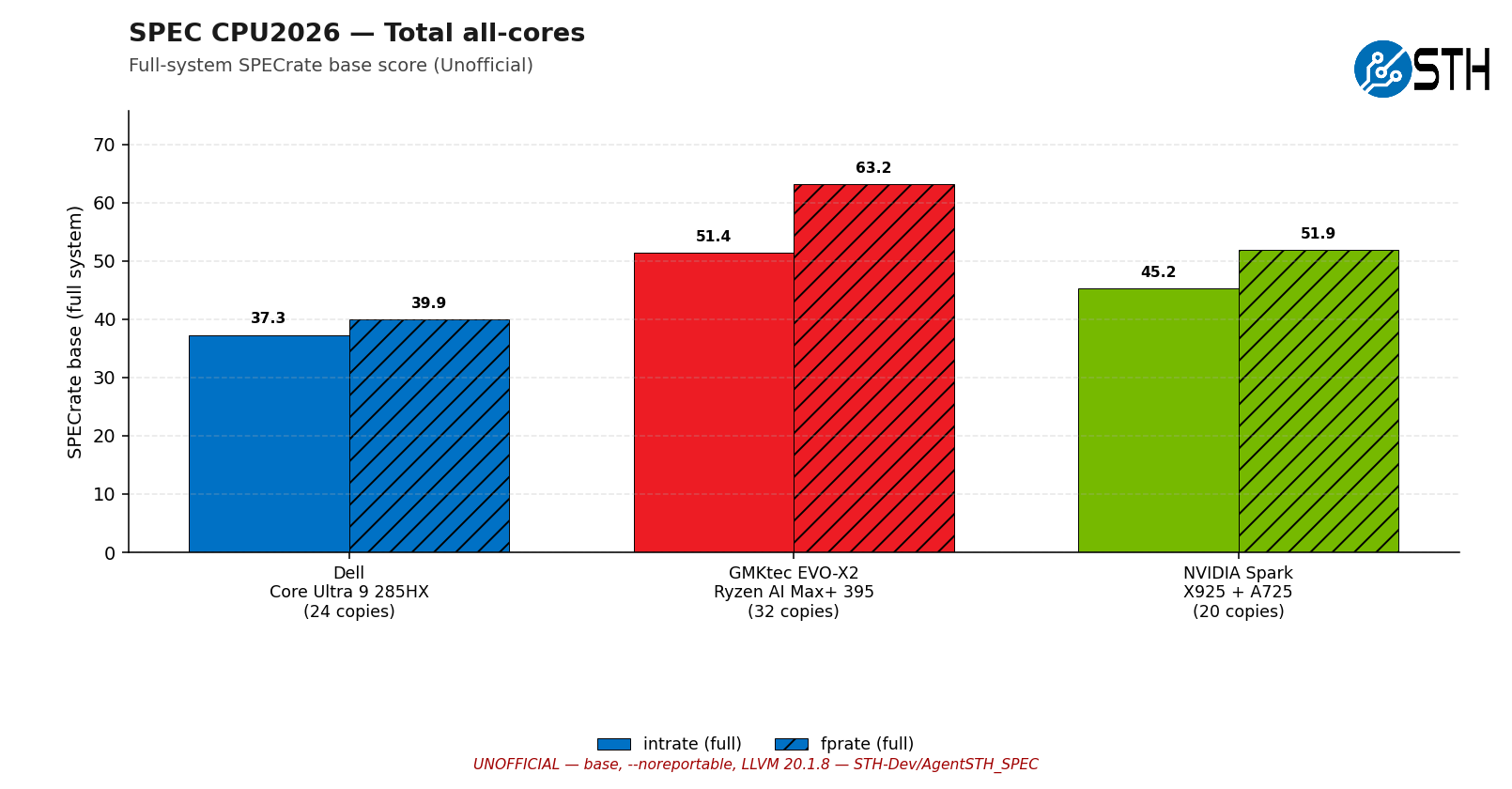
It's the same configuration as GB10. 20 core MediaTek 3nm part which is competitive with a AMD's 2025 16 core 4nm part with similar power draw.
https://www.servethehome.com/wp-content/uploads/2026/05/cpu2...
"Competitive" as in "slower".
The SPEC benchmark is useful to estimate the performance of computers that will run programs that are not optimized for their specific architecture.
The Ryzen was already faster in SPEC, but when running programs that use AVX-512 the difference in speed between the Ryzen CPU and this NVIDIA/Mediatek CPU will be much greater than in the SPEC benchmark.
My understanding is that it’s got a bespoke 20 core Nvidia Vera CPU - unified RTX Vera Rubin Spark chip. Seems like Nvidia trying to copy Apple M-series chip
It's the same chip that is in DGX Spark (it was delayed by 1-2 years). Blackwell GPU on one chiplet and Mediatek cpu with off the shelf cores
Isn't it a mediatek CPU with an Nvidia GPU on the same package? At least thats what most of the reporting for nvidia laptop chips has been saying.
I could be wrong but I don't think there are any arm machines with nvidia GPU yet, I think that would be a first.
So it's probably Intel
Nvidia's current flagship product is Nvidia GB200 NVL72, which is a super computer the size of however many racks you can afford, with 72 Blackwell CPUs and 36 Grace ARM CPUs to a rack. At the other end of the spectrum, is the Nvidia Jetson series, which is a GPU attached to an Nvidia Grace ARM CPU.
Nevermind, it's totally this chip/board.
https://www.techtimes.com/articles/317428/20260530/nvidia-ar...
Yeah that's definitely it. So that makes this an arm device with nvidia GPU. It's not the first as you pointed out, but it would be a more consumer shaped example - a laptop that normal people might be able to afford
I don't know if it's on purpose, but I've seen a few images and videos and I can't figure out what the laptop looks like.
Why are all the pictures so dark? You can't see it!
I bet it will be something like a MacBook Pro but with a windows logo. I wouldn’t expect much different considering the other surfaces look practically the same including the keyboard . Not that that is a bad thing .
The keyboard is pretty much the only thing you can see, and I see that they're still doing that horrible arrow layout.
Car manufacturers did this but it was usually when the car was going to be a bit of a minger.
100%. Viz, Ferrari Luce: https://www.ferrari.com/en-EN/auto/ferrari-luce
Ironically, "luce" means light in Italian
What's this nonsensical video on the product page that allegedly shows an "all new thermal system"? https://videos.ctfassets.net/jy9s7k22hbg4/44R1LH71xb8uO4c9dD...
Could it be that new tech that passes air over the board without a fan? Was announced last year, I forget what it was called
You're likely thinking of a Piezo fan or solid state fan. It uses a thin membrane that vibrates and moves air though small spaces. Frore Systems had their Airjet Mini make the rounds in reviews and demos a couple years ago (2?).
Demo from 12 years ago:
If it's still based on the chip in the DGX Spark, idle power draw remains a problem to be solved. My Spark pulls down 40W when doing nothing under Ubuntu.
It might be more of a Linux problem than a chip problem…
For the DGX Spark and OEM variants a big issue is that the ConnectX-7 is just not designed to have low power idle but instead to be efficient when loaded.
NVIDIA already lowered power draw at idle by 18W with a currently out of tree driver leveraging PCIe hotplug for the NIC earlier this year.
I think that quite a bit more people bought those to use them without the ConnectX than what NVIDIA expected.
I’m pretty sure 400 gig nics aren’t in the cards for these thin and lights…
Surface has seen so many iterations, some terrible, some nice. Still rocking the discontinued surface laptop studio as Wacom on the go, smallish footprint (14”) creative development machine. I just love its quirkiness and the fact that I can jump on photoshop to touch up an image, use it as tablet for movies, or vs code for (not great nowadays) 6h on battery. It is an odd intersection.
My surface book 2 has the best feeling keyboard I ever used on a laptop. And I still really like the overall unique form factor and 3:4 display with touch support.
But it didn't age too well, the battery is giving up and the SSD is pretty slow. Plus windows being a real slug doesn't make the experience that great anymore
>Wacom on the go
?!?
https://surfacetip.com/surface-laptop-studio/
notes:
>Supports Microsoft Pen Protocol (MPP)
which is NTrig --- or do you use a Wacom AES stylus? (bought a Bamboo AES stylus, but it wouldn't work w/ my Toshiba Encore 2 Write 10)
Or are you genericizing "Wacom" as "active digitizer stylus"?
Exactly that, same basic functionality as a Wacom, active digitizer stylus.
And I have one that I use as thin client for my desktop, Linux made it usable! 10 year old surface pro 3, 8 to 9hr battery life, takes less than 20s to boot up to Gnome, no issues browsing on Firefox, it's a solid device on the go. And to my total surprise, it retained charge even after almost a month of no usage.
That is great battery life! I also wanted to try Linux, but I think I’ll lose the wacom feature. I also use it as a thin client for my Linux machines, and jointly with my Mac means I have access to all platforms.
I believe Linux supports Wacom tablets pretty well, I have one which worked without any issues, and buttons can be fully customized. The pen broke though, so it's now collecting dust, and I'm not in situation to replace it.
Unfortunately for Surface pro, some parts of the touch screen was damaged during battery replacement. But the parts that works, works well.
The Surface line is, HW-wise, very good IMHO.
Too bad the software is awful. Thankfully the Linux Surface community is pretty strong. Proprietary Microsoft drivers don't make it easy, but we're getting there...
https://github.com/linux-surface/surface-pro-x
I'll buy another one if there's some commitment from Microsoft to be more open source friendly, but since this will never happen, they can keep their HW.
I really hope for competition’s sake that Microsoft makes some reforms and cleans up Windows.
Because us nerds like to say “the software is awful,” but really, the bones of Windows are not awful at all. It generally works well, it just takes a lot of work to get all of the BS out of your way.
If you’re looking for open source friendly, just buy a Framework 13 Pro and be done with it.
By the way, the other news from Computex is Dell and HP’s Macbook Neo competition, and they really look legit. So, Apple is waking up the PC industry a bit, showing them that they are endangered. Hopefully Microsoft gets the memo.
No, Windows is awful. Closed source , buggy and filled with performance bottlenecks. Let's not even talk about the whole requirement for a Microsoft account, TPM or the fact that it's basically a spyware with ads. Why the hell would I want a Candy Crush Soda ad in my OS?!!!
And you lost me at proprietary Microsoft drivers.
No way I am spending any money on this future brick.
I mean, between Qualcomm proprietary drivers and Microsoft, I don't know what's worse.
Thanks god reverse engineering with AI is a thing now, so the path forward looks nicer. But still...
Anyways, the Surface Pro X is such a nice HW. Too bad the company who built it is so bad.
> Too bad the software is awful. Thankfully the Linux Surface community is pretty strong.
And how Linux fix the software problem?
Running Linux on Surface works. It's not perfect, but it solves the problem. Windows is gone from my Surface Pro X since roughly 2 months after buying it.
I get it’s not what you’re asking for, but WSL on windows is a lot more friendly than anything Apple has done in the last decade to assist in Linux support.
WSL is 90% of a good product. They just quit improving it too early. Managing file permissions between Windows and WSL is a nightmare, it does horrific things to your filesystem if it ever runs out of memory, at least once every day a teammate is hitting a readonly filesystem issue. A team of some of the smartest people I know tried to smooth it over enough to be useful and we couldn’t do it.
At my bigco, we have all but given up on it and moved everyone to EC2 or Macs for non-Windows workloads.
No. I *don't want Windows*. WSL is not an option for me. In fact, Linux is the only option, and it's what I chose.
Thankfully AI nowadays does an amazing job in issue diagnostic and resolution, and even patches the kernel to make stuff work, so this is the viable solution.
What are you talking about? The Mac platform is so much more friendly for doing Linux related work. First of all it’s Unix so most tooling has MacOS variants, and secondly you have a miriad way to install WSL like VMs with shared disk.
But what is the point of WSL if you can get run the real thing, without performance penalty, bloatware and spyware? WinBoat makes more sense if there is the odd program that does not have a substitute.
> without performance penalty, bloatware and spyware?
And then you install multiple Electron apps.
Apple doesn't have to do anything because it's already unix
It's usually enough but not always. Sometimes it happened that my customers using MacOS or WSL were not able to pass some tests or reproduce some bugs. That was due to some differences between the userland of the Linux servers, which are our build and deployment targets, and what they have on their Macs. I work on a Debian laptop (it used to be Ubuntu) and I can always run on it whatever sw runs on the servers. The languages are Python and Ruby, some bash.
The developers on WSL (the Python project, Django) tend to have a simplified environment. For example they don't run Celery (I never investigated why) and run all the background jobs synchronously or they don't run those jobs at all.
The ones on Macs (the Ruby project, Rails) have the full environment but I remember that they skipped some integration tests because they always failed on their Macs (Capybara and Chromedriver, I don't remember the details.) I was the one running the full test suite. By the way: all the CI services I used in the last 10 years are particularly bad at running those kind of tests. Maybe it's the amount of memory or the timing of the operations and those CI VMs (or containers?) don't play well with the assumptions of the test frameworks. Any language, any framework.
Which doesn’t make it Linux, which is what op wants. It’s based on a BSD-based mach kernel. You might as well say someone asking for Linux should just run Irix, because hey, it’s UNIX!
well it's a hell of a lot closer than wsl
Who cares about the kernel? That only matters for hardware support, which is going to be much better with macOS on mac hardware. Macs can easily run 99%+ of the software that people use linux for, because *nix. The only real reasons to require linux in this situation are ideological (free software/GPL vs proprietary Apple) and aesthetic (you're used to X/wayland/systemd/whatever system software and don't like Apple's solution). It would definitely be nice if Apple helped people out by documenting and releasing source for the bootloader and firmware to make it easier to install third-party OSes on their hardware... but they're not a hacker-hobbyist nonprofit doing it for the love, so why would they?
WSL is inside Windows. I haven't found the need for anything like this on macOS, as it's Unix and I can just install stuff with Homebrew. When the Unix version of some package didn't do what something else I was running expected, I was able to install coreutils in just a few seconds and carry on.
It seems the issue on Apple hardware is the fight to get Linux booting on bare metal with full support (what Apple supplied for Windows with Bootcamp when moving to Intel), which is the fight Asahi Linux is waging. Is WSL aiding in getting Linux booting from bare metal on proprietary hardware?
WSL for me was literally a gateway drug to switching fully to Linux. It did work, but took extra system memory, drained battery life, and caused intermittent suspend/resume issues. Just not worth dealing with compared to running native Linux.
WSL provides a seamless filesystem experience between windows and Linux which is more than I can say for MacOS. And it’s supported by MS, not a community add-on.
People downvoting me because Microsoft are just silly. It is literally undeniable that Microsoft has done more to provide Linux support in the windows ecosystem than Apple has with MacOS. The closest thing Apple has done to “support” Linux is add a hypervisor without a GUI that they’ll tolerate you using but don’t really support. Try opening up a case with Apple about a Linux issue running a hypervisor.framework Linux vm and let me know how it goes…
Microsoft will absolutely support issues you run into with WSl.
> WSL provides a seamless filesystem experience between windows and Linux which is more than I can say for MacOS.
They must have made major improvements since the last time I used it then, because filesystem issues was the #1 reason I moved away from WSL
Depending on how easy it is to run Linux on this as opposed to the new MacBooks may make this attractive for Linux users.
Anyway, the whole trend to change from x86 to Arm on laptops is bad news for compatibility. It might be that the era where you can download an iso and expect Linux to run on a random laptop is over, and Linux users will have to stick to only a couple of devices with well known support. Did Valve release a laptop yet?
> Depending on how easy it is to run Linux on this as opposed to the new MacBooks may make this attractive for Linux users.
Why? Just to get ARM? Buy a brand that actually works with the kernel and distros to get their hardware working with linux. Get your money to the people that actually help the software ecosystem.
When you spent premium, put your money where it makes a difference.
I recently spent an equivalent of MacBook Air M4 price + import tax to get a linux laptop called Starlabs Horizon that advertises up to 14 hours of battery life. Maybe in a TTY it could do that, but in practice, I haven't yet seen any x86 laptops from any company, linux or not, to match even 50% of a macbook's battery. Realistically it's 4-5 hours like the rest of them. Not to mention that for that money I got a cpu that is a power equivalent of pre-M1 chip mac. Also they put speaker grills at the bottom (what were they thinking??)
For laptops, what I had in mind is excellent power management and efficiency, it seems to correlate with ARM but I think most people don’t really care for the details of architecture.
the new intel ultra whatevername 3 series seems to come a bit closer there, so the framework pro with its explicit linux support might be an option
One concern I've heard about the move to ARM cores is that it is done in order to lock down the devices more so they're more like a phone rather than a computer.
Recent Surface ARM laptops do not seem to be locked in any way.
What does locking down the device have to do with the CPU architecture?
ARM based devices don't have boot anything you want like x86 platform - in practice.
Adding to this.
x86 Most random Linuix ISOs will boot on anything. I've seen software compiled before the hardware had finished being designed boot just fine. (in the latest case lstopo was very confused, but everything still worked!)
ARM, I go looking for a build for my chip/device in particular.
x86 I just buy hardware and it works, ARM I check for OS builds before buying, and wonder if the builds will continue to get updates.....
>Too bad the software is awful.
I swear, people just live in their echochambers these days. Win 11 pro + WSL2 is literally the best, do it all OS you can get these days.
Most peoples experience is with Windows home, which ironically is about as intrusive as Mac OS. When you get Windows Pro, you can disable all the annoying AI/Advertising shit that comes with Windows, and at that point, you get a system that is cleaner than Mac OS.
Then you install WSL2, which is a full linux environment down to being able to run graphical apps, use gpus natively, and even talk to usb ports.
Ive been on Win11 Pro for 4 years. The only major things that are installed under windows for me are VPN Software, Steam (with games), Ollama, and Browser. Everything else, I run under WSL2.
I agree. I'm running Windows 11 Arm on an Asus Zenbook A16 right now. Lighting fast. I'm typing this comment while I'm compiling code and having Claude analyze packets coming from Wireshark that's on this machine. It's got 18 cores and 48GB of integrated memory, great battery life, and an OLED screen for $1699
I run Linux in a VM and Docker on it, and WSL2. No problems with anything.
I don't see any ads. I turn a number of "intrusive" features off, but nothing is hacked; these are just settings you can switch off.
(I am running Pro, though.)
[dead]
W11 Pro is awesome. I think currently it is the best OS.
Professional softwares, WSL2 and awesome native apps (Dopus, AHK2...)
I always try Linux but the fragmented nature just is not for me for desktop usage.
[flagged]
> you can disable all the annoying AI/Advertising shit
What Stockholm Syndrome is this? Why should you have to do this in the first place?
Are you pretending that Apple doesn't spam you with endless advertisements?
Wouldn't know.
They don't. Anyone who says otherwise doesn't use a Mac.
Well, they keep pushing the Creator Bundle when I open up the Numbers.app I bought bundled with the system. Perhaps they are implying creative bookkeeping?
I open settings on my iPhone (settings!) and it says "Don't Miss 3 Free Months of Arcade" and a misleading notification red circle icon.
„Built on Windows”. That’s like anti-ad these days. Maybe, maybe worth looking at if you can run other OS than Windows on it, but that will probably take some time.
Ya, i dont know of anyone wanting to run very large AI models in a windows environment. Or, frankly, on a laptop. Why not just VPN into a dedicated server?
No one is doing serious work on Windows anymore, those who are have yet to realise the clownshow they are collectively a part of.
With BUILD happening tomorrow, I suspect Microsoft is going to have some stuff about local AI there with MS Foundry on Windows/Foundry Local. The timing of this announcement a day before BUILD is obviously intentional.
Suddenly all the Windows K2 stuff makes sense, but I doubt it'll be enough. Its too little too late for Microsoft.
They've spent more than a decade cratering their OS. I doubt they will be able to turn it around with one code-named project.
How much does a dedicated server with 128GB vram cost a month.
I mean not that much? You buy the hardware once and then it’s just running for many years
Less than this laptop.
How well will the local LLM run when your laptop is in your bag while you're walking around?
You can get an H200 (141GB) here for $2,700/mo: https://deploybase.ai/articles/h200-price
I could be wrong but my understanding is that 24/7 dedicated servers are wildly economically unviable. The reason cloud tends to cost less than local today (other than the subsidization) is because you aren't running models 24/7. So like 6 hours of cloud per weekday might beat the yearly cost of building local machines, but it's not in the same universe if you're running 24/7, as evidenced by two months of H200 rental costing more than the DGX Spark this Laptop is built out of.
I do. I can take my laptop anywhere I want, for example to a coffee shop and run a coding model while eating a croissant without worrying about an internet connection, as the term local model implies.
And you can warm up the croissant by just placing it on the trackpad while you wait for the LLM to finish
The coffee shop doesn't have wifi?
It's not very good and SSH is blocked.
I always use a VPN (to my own home server) for this reason (and other reasons) when connecting to public WiFi.
The emphasis on the fans kicking off also had a bit of a turn-off.
Can't believe they led with that in the promo video. They potentially have whats finally a competitor to an apple silicon MBP, and they lead with fans?? I love my macbooks precisely because they are silent (among other things, obviously).
When I clicked, I thought that it was going to smash the turbine blades from the animation to suggest something like "all the performance without the thermals," but nope, they just became laptop fans. And seconds later, it started blowing heat/steam out of them!
That's the most uncanny marketing for an ARM laptop I've ever seen.
they had competitor also in the Snapdragon X. however the OS is ruined beyond recognition, so no matter what they do, the combo will be bad.
Yes the MBP is very quiet when doing easy stuff but run games and heavy duty software and those fans are required to get work done.
They are. But the experience of using a MacBook Pro for pretty much any purpose other than gaming is that they’re entirely silent. To the point that it’s an exceptional circumstance when a build job is so intense and so long running that fans kick in.
As such, when you’re marketing your competing product, maybe don’t lead with the fans.
fwiw, I have a snapdragon X laptop running with windows. It basically never runs the fans (at least at audible levels), and I sometimes sit with it on a blanket in bed
Some of us like our hardware to last, we don't go out and buy the latest and greatest unrepairable MBP for the sole reason of flexing on our friends and peers while making a big deal about how its silent and can run large local llms at 0.5 tok/sec.
Understandable. But if you were attempting to do the same thing as the RTX Spark on a MacBook (i.e. run local models), you would also definitely be hearing those fans. Perhaps not the best marketing play, but it is true to the real experience of using the product for this use case.
"The world is full of makers. Only a few make the world."
What does this mean ? How can you make the world ?
> The world is full of makers. Only a few make the world.
Reminds me of all that "Lions. Not Sheep." gear I see people rockin'. LOL
>> What does this mean ? How can you make the world ?
Ask Shakti, Shiva's creative sister.
so, they made a device that targets only a handful of people? They should stop letting copilot write their ad copy.
In FreeBSD it was `make world` in /usr/src.
Bloody cperciva put an end to that.
Be a creator instead of a consumer.
But it implies it's not for ordinary makers. Only for the "world makers".
"It belongs in the hands of world makers."
They are targeting the kind of makers that use Excel and Teams more than make.
$$$
It means nothing. The LLM thought it was edgy.
LLMs are not yet capable of generating the level of marketing wankery seen here.
What do you mean, that's pretty much everything LLMs generate
"Nothing wasted. Everything intentional."
That's the most ChatGPT line ever, where everything has to be a cringy punchline
"A machine like this should not sit still. It should be pushed. Taken to the edge. Used to make real what others call impossible."
I really hope no human would write something like that
> I really hope no human would write something like that
I see you haven't interacted with marketing people. I can 100% believe that some marketing person wrote the copy.
Don't you understand? They fired their marketing copy writers, that's over $550k/year in savings! Imagine how much they can save tomorrow.
> "A machine like this should not sit still. It should be pushed. Taken to the edge."
"Taken to the edge, and pushed off this edge. To garbage bin."
I don't think I've ever seen LLM output as bad as this output. They sometimes write like that, but not every second sentence.
Contrast hooks everywhere.
> I really hope no human would write something like that
Sorry to shatter your hopes but any garbage an LLM writes is mimicry of some human written garbage that came before.
It can only write cringe because we taught it what cringe looks like
I will never buy a Surface device ever again. I've been using an SL4 for the last four years with Linux on it, thanks to the surface-linux kernel.
It's awful. It feels like it's actively refusing to work properly with Linux.
Fair - it's not for Linux, and clearly that is expected with a Microsoft device.
I've recently had to call their support for missing rubber feet. I figured I could get the replacement mailed(that was how it went when it first happened about two years ago). An AI answered, did not understand what I was saying at all, hung up the call. I called again; it told me to check the website and hung up, not even giving me a chance to say anything.
Okay. Guess I'll never buy anything from you ever. Ordered them off of Aliexpress and moved on.
I would be 3d-printing some janky feet in TPU before submitting myself to that process. Even if they "wear-out/fall-off", I can print some more.
I work at an ewaste recycling company. We're inundated with Surfaces often, from Gos and Pros, to Hubs (the TV-sized touchscreens). You haven't played solitare until you've played it on an 84-inch touchscreen.
I use a Surface Go at home (running BlissOS) and a Surface Pro as my work "laptop" (running Debian KDE). I forget which generations they are, but they're probably 8-ish years old, so if they haven't died yet, they're probably good. They both work well for what I use them for, and are better laptops than actual laptops for what I need a laptop to do.
Hilarious, "Designed for serviceability" is one of the headline features about 3/4 down
https://www.microsoft.com/en-us/surface/devices/surface-lapt...
It sounds interesting from a hardware perspective, but yeah, IMO no one other than Apple has the luxury of shipping a PC with second-class Linux support anymore. If the Linux experience is anything less than perfect, it's DOA.
Also, USB-A in 2026? Really? That was already an automatic disqualifier for me at the start of the decade.
I wonder how much Microsoftisms are going to be thrown into the Surface Ultra.
Surface-linux has done a ton of work to get some support, but yeah: they are quite the special devices:
> In contrast to other devices, however, some newer Surface devices route their keyboard and touchpad input via this controller. Unfortunately, every new Surface device requires some (usually small) patch to enable support for it, since devices managed by SAM are generally not auto-discoverable.
There is a huge feature matrix, so at least you sort of know what you are getting. Amazing work from open source folks! https://github.com/linux-surface/linux-surface/wiki/Supporte...
After all, I'm still using it. But I'd have ditched the laptop if it weren't for the linux kernel. Can't thank them enough.
Isn't that a little unfair? You'd have an even worse experience running Linux on a MacBook.
I had no problem with it not supporting Linux, like I said, it was expected and if anything, I'm to blame.
Linux surface is awful, but also not actually Surface Surface. I did it, it sucked. I went back to windows and everything works primo, exempt its windows. So while I agree, I dont. PSA: wayvnc
What made it awful? I have been using a Surface Pro with fedora as my main portable device for the last 2 years and enjoyed it.
When will these companies realize nobody wants to talk to an AI? The reason we begrudgingly pick up the phone is because some problem is not solvable through the website. The last thing we want at that point is an automated system parroting the website back to us, or telling us to go there ourselves
Some percentage of telephone service, service chat etc. is stuff that could be easily found via the website, I know 98% of the time when I call it is just not possible to resolve through reading the documentation on someone's site (the last 2% it is, but the site sucks so much I don't want to try) and I'm sure it's the same for you and probably for most of HN, but having worked at a help and documentation service for a major telephony provider in Denmark I do know there are statistics that in fact show most of the stuff could be found on the site, people just don't want to take the time.
At that point the main problem for a service is to figure out when they are dealing with someone who could solve the problem through the website, and when they are dealing with someone whose problem is too complicated to be solved that way. Although it also seems like many people don't want to spend the money on doing that analysis and serving their customers, as you have pointed out.
I guess if you see customer service as a checkbox you have to have, and also a cost center skimming from your bottom line, you will do whatever to make it as cheap and hostile as possible.
They don't care.
Support call center is operation cost. They did they math and think this will save them more money than losing a few angry or disappointed customer.
And they're right. If terrible support were an obstacle even slightly, they'd have all gone out of business decades ago.
In recent times support is part of what I consider when I buy Apple products. It is by no means the best but I can always get a human at whatever time of day and they will listen to my problem and attempt to address it.
But as for getting rubber feet, I'm sure it's some backwards process with Apple too, if at all possible.
I thought maybe they were available with the new self service repair portal for Apple but nope, you have to order the entire bottom case.
Apple does positive scripting ("I understand that must feel frustrating, I had a similar issue once, I'm going to solve your problem"), but at least I can reach a human, even if that human talks like they've been brainwashed by a cult.
My ISP has actual techies answering the phone, and their approach is more "well that's a bit crap, I can have an engineer there by Thursday". I've only needed them a couple of times in a decade, but I've been left with a mile-wide grin both times. As long as that's true, I'm a customer for life.
Yeah the support is scripted and annoying a lot of the time. There's always a song and dance like having you remove your VPN (mine is split tunnel but they don't care) to verify some failure case, loading profiles, etc. - but at some point when all avenues are exhausted they will escalate to an engineer and make detailed notes, and usually follow ups which might be with another engineer usually has a full understanding of your situation. A few times they've managed to fix these issues but it can take months.
For hardware issues too it's pretty good, though I've only ever dealt with the Genius bar, and never done a mail in of the product in question.
For software I've never really seen this kind of service at scale, e.g. with Microsoft. And for hardware, it's essentially chatbots in a loop these days which I experienced with Lenovo trying to get support for a laptop that wouldn't power on (never managed to get a human to support me and gave up).
>My ISP has actual techies answering the phone
Lucky you. My ISP is so incompetent they connected me to another customer when they wanted to connect me to another support agent (Vodafone).
The last time I called Apple the phone service employee hit me with “I understand your issue as I am also a student” when I replied that I wasn’t a student he then followed it up with “Oh, neither am I”
My phone slipped out of my pocket as I was getting into my car, and I unknowingly ran over it.
When I submitted an AppleCare replacement request for it, the employee said “Oh man, I hate it when that happens!” and approved it.
I figure that’s the script, or maybe he had a chronic issue of running over his own phone.
A former employer of mine, owned by a retired NFL player, purchased Surface devices for the sales staff in addition to their laptops. This was presumably because Microsoft and the NFL had a deal where everyone on the sidelines were using Surfaces and they thought it was a good idea. I say that because no one was asking for them, and when we received them I was inundated with tickets about poor performance: "my surface is slow", "my surface is glitchy". I dreaded working on these things. Everyone just went back to their laptops. Tens of thousands of dollars wasted.
It's a shame, Microsoft could really do something if they created an ARM device that had the battery life of Apple Silicon, yet was a real computer that wasn't locked down, ensured/promoted ARM compatibility with their ecosystem. Heck, I'd even be OK with Windows 11, I know how to remove all the garbage now and could run WSL (though I'd prefer to just boot Linux on it).
Microsoft doesn't have the focus to do hardware as complex as a laptop. They want to be able to provide hardware, but they won't make the required investments, they won't delegate the responsibility to a single manager, nor would they give that person the power to say "fuck off" when marketing, or who ever dreams this up goes "LOL, make it AI".
The margins on good hardware simply isn't there for Microsoft. It also don't look good if Windows works flawlessly and fast on Microsoft hardware, but craps out on the $300 - 400 shitty laptop their partners make.
> This was presumably because Microsoft and the NFL had a deal where everyone on the sidelines were using Surfaces and they thought it was a good idea.
Everyone except Bill Belichick, who famously hurled his Microsoft Surface to the ground when he was first forced to use it:
That's what modern Surfaces are. The consumer models have been Qualcomm SnapDragon based since 2024, they are pretty fast, battery life is pretty good and you can do whatever you want. Although native Linux support isn't quite there but I mean MS isn't exactly making it their priority.
I have a surface Go gen 1 and its quote snappy for such a machine though I rarely use it. I personally would not touch an MS Arm device.
I owned a Surface Book v1 for a couple of days before returning it. It was a garbage device with tons of issues. I will say it had amazing keyboard though.
Skip proprietary Microshit. Go straight to a framework laptop. Load up your favorite distro and never have to worry about poor repairability or non-upgradeable/soldered components
> an ARM device that had the battery life of Apple Silicon, yet was a real computer that wasn't locked down, ensured/promoted ARM compatibility with their ecosystem
Isn’t that what this is? (Or is supposed to be?)
I don't see any real explanation of the CPU in this thing. Is it going to be Grace like on GB200 and Spark?
N1x, Nvidia's laptop ARM GPU cpu board.
https://www.techtimes.com/articles/317428/20260530/nvidia-ar...
> (Or is supposed to be?)
I would be happy to eat my words "later this year" (per their timeline) but past Surface interactions lead me to believe it will be more of the same as in the past. Bad performance, bad battery life, bad build quality, bad compatibility.
For the sake of competition and options, I really hope to be proven wrong... I just wouldn't bet on it.
> bad compatibility
I’m curious what this means. Bad compatibility with Windows software? Or bad compatibility with Linux?
I was referring mainly to Windows software, Adobe Illustrator and InDesign were major pain points on the Windows side. Sure though, add Linux compatibility to the list of things that were an issue too.
This is an ARM device, so presumably compatibility with third-party software.
In some ways.. since Microsoft is known for maintaining backwards compatibility whereas Apple is not, I think 3rd party devs are just not incentivized to care about Windows ARM compatibility.
Further, it doesn't seem like Microsoft made x86 emulation as seamless or performant as Apple did during the various MacOS CPU architecture changes.
Every use case I've looked at has been a minefield of app incompatibility and poor performance under x86 emulation.
For music production for example - https://www.sweetwater.com/sweetcare/articles/windows-on-arm...
Sounds like you aren't familiar with Nvidia's dedication to low-power ARM SOCs. Ever heard of the Nintendo Switch before? The Tegra inside that is a 15w TDP gaming SOC. And it supports CUDA (somehow).
> Sounds like you aren't familiar with Nvidia's dedication to low-power ARM SOCs. Ever heard of the Nintendo Switch before? The Tegra inside that is a 15w TDP gaming SOC. And it supports CUDA (somehow).
I think that GP comment is not intending to throw shade at ARM SOCs (many of which are quite nice, including those from Apple an Qualcomm), but specifically the Microsoft products built on them.
I'm mostly surprised by the insinuation of bad performance or battery life. That's what will be ostensibly solved by putting an Nvidia SOC where a Ryzen or Intel one used to be.
Has this chip actually been used in any real product yet? Nvidia has, er, a bit of a historical problem with overpromising and underdelivering with their mobile chips (in particular see the Tegra 2 and Denver); I would be cautious until there are real benchmarks. It's hard to describe any previous Nvidia general-purpose mobile chip as anything other than a failure.
Haha, if only it were so easy. Hardware is… eh… hard.
Every time I read something like "completely redefines professional computing" I think that somebody in the marketing department didn't do a good enough job to disguise a sponsored content, or at the very least didn't review what the independent author wrote.
Anyway, what I like of this machine is the 15" screen with a keyboard without a numberpad: the center of the body of the user can be aligned with the center of the screen. The screen seems to be particularly bright, which is good. There are claims of good self repairability, we will see when it starts to sell.
I'd wait a few years before buying one machine in this product line. I want to see how Windows on ARM will play out in terms of compatibility. My build targets are all Intel servers (Linux), so I don't want to have surprises. I would have to wait years anyway because I would run Linux and I think that it takes more effort to port Linux to new ARM hardware that to new Intel one (ACPI etc.) WSL is not an option because I still have Windows around it and it's even more unpleasant than having to deal a Mac GUI.
Let's say that if this were an Intel laptop I'd be tempted to buy it, if the hands on reviews will be good.
I just got one of the lighter Snapdragon surface laptops and the software ecosystem is still hit and miss. LuaJIT in particular still has build problems on WoA and that's unfortunately upstream of a lot of stuff I use day-to-day. The NPU is apparently neat if you're into LLMs (it can allegedly run gemma) but that's not my thing.
Though in fairness: Windows on ARM (even ignoring the earlier iteration of it from ~2016) has had a year or two to mature thanks to the Copilot+ PCs. And, this particular chip seems near-identical to the one Nvidia put in the DGX Spark (again, even ignoring earlier ARM CPUs from Nvidia like Tegra in the Nintendo Switch).
> Anyway, what I like of this machine is the 15" screen with a keyboard without a numberpad: the center of the body of the user can be aligned with the center of the screen.
ThinkPad P1 is the machine for you and you can run Linux on it.
I have a ThinkPad P1 (Gen 2) and I run Linux, but I'd hesitate to recommend at least the Nvidia dGPU versions. The battery life is dismal, even with the dGPU disabled in software (can't be HW disabled). It also runs really hot and the suspend is still flakey.
>Anyway, what I like of this machine is the 15" screen with a keyboard without a numberpad: the center of the body of the user can be aligned with the center of the screen. The screen seems to be particularly bright, which is good. There are claims of good self repairability, we will see when it starts to sell.
Oh you mean like the incredible MacBook Pros of the last two generations that have been selling like hotcakes and have a surprisingly similar design to this device? "Redmond, start your photocopiers" never gets old.
No. Surface has superior aspect ratio.
Apple wouldn't ever do something like that. "Good artists copy, great artists steal"
In fact no, not in this “let’s throw some more shit at the wall and see what sticks” way
This quote is terribly misunderstood. "Steal" here means "make it your own", as in, improve it, not "copy slavishly". What it means is that to be great you have to find good ideas and then execute.
Yeah, you are correct: in “good artists copy, great artists steal”, the “steal” doesn’t mean “copy”. But, OTOH, there’s another word in there that does...
I'm curious about the openness of the platform. As long as the openness and standardization of the PC platform is not present, this platform is not a contender of x86 in my eyes. We can see with the highly praised Apple M platform on the example of the Asahi Linux what the lack of openness brings: people are locked in to operating systems by the vendors, and planned obsolescence, even with long support periods. On the other hand the PCs abandoned by Windows 11 support (sometimes even 1 year old models!) had the freedom to choose from a variety of operating systems, all thanks to the openness of the PC platform.
Repairability is important, but why repair something when you can only use terrible, soon out of support operating, which spy on you? (This means practically any OS vendored by large corporations)
For ARM systems openness boils down to the custom boot process, and of course the driver support. Has ARM PC vendors standardized on a boot standard yet? I cal recall the horror on reading articles how Raspberry Pi boot was working, or how M1 Mac bootloader is locked down.
There is ARM SystemReady in a couple of flavours, one of which is UEFI: https://documentation-service.arm.com/static/68512137d12d1a1...
While I'm not exactly enthused about UEFI I prefer this to android's fork-the-kernel-tree-and-abandon model for your pocket-SBC. The last device I used with this booted fedora using arm UEFI no issue, several years ago.
I don't see x86 going away for a long while if at all - too much software is built for it so the inertia is massive.
> I can recall the horror on reading articles how Raspberry Pi boot was working
The bootloader boot/process however is not related to driver support.
Not that I know what's nightmarish about it in the Pi.
The Pi is really a GPU with a CPU added on so the whole system needs to be brought up by the (binary blobs for running the) GPU. Hopefully not the case in these more PC-like systems...
Yes, with 128GB RAM, I guess one could even ignore that it is soldered (and hence "unrepairable"), but if it can't run Linux or *BSD it is a definite no go. We definitely don't need two closed hardware platform duopoly (Apple and Microsoft), as together they will dominate and kill the "open" platforms. But I am pessimistic here as everything seems headed towards that eventuality. We should never have accepted smartphones as closed platforms.
> We should never have accepted smartphones as closed platforms.
I didn't. Sent from my Librem 5.
> But I am pessimistic here as everything seems headed towards that eventuality.
Lots of companies buy average Dell and Lenovo laptops because they are repairable in-house.
That's good to know - but many of their models also have soldered RAM, which is disappointing.
> Yes, with 128GB RAM, I guess one could even ignore that it is soldered
Unless that RAM fails in some way or another, then you have to replace the whole motherboard because of this.
It depends - soldered RAM (LPDDR) on iPads and soldered SSD on Intel Mac Minis can be repaired by replacing the chip. (But obviously it requires skills and specialised tools). So you don't necessarily need to replace the whole board. But if it is some kind of "integrated" non-standard RAM, like Apple uses on its ARM series SoCs, it is near unrepairable. So yeah, one should think many times before buying a computer with soldered RAM. (On the positive side, I've never had to replace any RAM in any computers I've owned so far - the failure point has always been HDDs for me).
in case of macbooks even if something like usb port controller failed is most likely leads to board replacement as well so is high change that even if RAM is fine it could be useless because some $2 component failure
macbooks have modular ports.
https://www.ifixit.com/News/116152/macbook-neo-is-the-most-r...
The biggest problem here is the operating system. If they could fix that, this might be enticing.
Hopefully it will be possible to hackintosh it. You can hackintosh almost any computer these days.
They could fix that but that means losing market share. Microshit shareholders don’t like that
Agreed. I'm trying to buy a laptop right now (Lenovo's checkout refuses to take my card?!?), and I would try one of these if it could run Debian.
Will never buy one if it's Windows only, though.
Indeed. Never buying a windows computer ever again. Every time I use it I get angry.
If they put Linux on it I'd buy it, but with Windows 11, no thanks.
One of the hassles with ARM machines is that you might technically be able to boot Linux on it but your Thunderbolt, display out, wireless, etc. will lack support and not work.
I bought the Snapdragon Elite X over a year ago based on the promises of Qualcomm to bring solid Linux drivers at some point. Fast forward to today, Linux for that SoC is still a hot mess.
Yeah never buy based on future promises.
Maybe I'm being overly hopeful, but given the DGX Spark only runs Linux, and this is apparently a sibling in a laptop form factor, maybe it won't be too difficult to get Linux up and running effectively? Probably (a lot) more easily than Asahi on Apple Silicon, anyway.
I'm sure someone can get the CPU/GPU running but things like wifi/bluetooth/USB ports will be rough since they will presumably integrated with the chip in a non-standardized ARM way. Almost all of the ARM laptops are basically unusable with GNU/Linux.
Which ones have you tried? Right now I'm on an MediaTek Kompanio Ultra 910.and wifi/USB/sleep/hibernate works. DT is going to be the death of ARM, but the real challenge has been to get the GPU to work under Firefox.
They did put linux on it. https://en.wikipedia.org/wiki/Windows_Subsystem_for_Linux
That's not Linux, that's a VM running Linux on Windows. Not very satisfying if you want the real thing, or want a real Linux DE.
>that's a VM running Linux on Windows
While thats true, its not what you think it is. WSL1 was VM in a traditional sense, it ran under windows. When you install WSL2, it basically changes your computer core OS to be a bare metal hypervisor (specialized version of Hyper V). Its the same concept as any cloud provider letting people provision VMs that run at native performance on the actual hardware. So WLS2 can talk to hardware like Graphics cards natively, and request ram on demand.
You can also install windows managers in WSL2. For example https://github.com/Lamarcke/i3-on-wsl. You can also install rainmeter on windows https://www.rainmeter.net/ if you want customizability. You can make windows look exactly like mac os with that.
WSL 1 was not a VM in a traditional sense. WSL 1 was a Windows subsystem which translated Linux syscalls into NT syscalls (e.g. file open). NT has capabilities there from its origins in the 90s supporting in theory user spaces for posix/os2/...
For many, the appeal of a Mac is that it isn't running Windows. I'm not seeing how this won't be a repeat of the OG ARM Surface, just with a higher spec'd GPU.
What do you mean by the OG ARM Surface? The Surface RT from 2012, or the later Qualcomm-powered ones? The Qualcomm-powered ones are vastly more capable than than Surface RT was.
I've been using a Qualcomm ARM laptop for the past year, and pretty much everything I use runs natively on it.
Very true, it’s a shame apple software and OS has gone to shit lately.
I have been leaning more into framework myself. My current devices are aging out but I am in a place where I am fully separated from apples walled in garden so switching is easy
ARM Windows laptops are a pretty different scenario now than when the Surface came out. They have pretty seamless x86/64 emulation built in similar to when Apple started their Mac transition to ARM. In contrast the OG ARM Surface didn't run any existing Windows software.
Most people could pick up a modern Windows ARM laptop and everything they do would work just fine, just potentially with less heat and longer battery life than their older Windows laptop.
The primary annoyances would be Windows itself and its ad and engagement driven UI reminding you about Copilot and Edge every chance it gets.
I wouldn't call it "seamless"; a lot of Windows applications don't work. An example is some software packages common in the construction industry which want to install all kinds of ancient x86-only thing likes old ODBC drivers. So that wipes out one of the compelling reasons to have a Windows laptop. Quickbooks (Enterprise Desktop) is another example of one; not supported on ARM, although with some hacking you can get it to sort of work.
And for many others, the appeal of a Windows PC is that it doesn’t run macOS. But I agree that ARM is still a caveat for those machines, in particular long-term driver support.
this reads to me as a false equivalence. Choosing a Mac is opting into a specific alternative. Choosing Windows is just taking the default.
It's not a valid comparison. Up until this (theoretical) machine, the playing field wasn't equal. Windows laptops in general couldn't really compare in many aspects with Macs since M1 (outside of gaming), batteries were horrible due to bad efficiency, performance wasn't amazing even with the best SKUs, and the distance between the vendor and Microsoft was always impacting different aspects of the finished product. Even with the ARM Surface, the ecosystem still wasn't ready for ARM, the performance was lacking. If this device doesn't cost an arm and a leg, it will offer something that is really the first instance of a Windows device that's a better choice than an M-Macbook in many ways (at least on paper).
I have Surface copilot whatever. The battery life is great. OS is a complete garbage. No amount of HW thrown at windows will fix its issues.
As if the reason people don't like Windows is because the ads on their desktop weren't loading fast enough.
That is a lot of misdirection that doesn’t address the main point of the of OC.
This fancy new device still runs windows. And that is a non starter from many people.
That works both ways: The macs run MacOS which for my work at least is a non-starter. I write win-only apps and sell to win-only customers who run only windows-machines. I do want to run local AI models on my machine though so I really do see the need for shared memory laptops.
Back when Macs were suffering under poor Intel chips there were valid competitors in battery life and size and weight from Dell. Except they ran Windows, and the trackpad was never as good as a Mac, and you'd find yourself searching for driver updates for things like the built in camera, which also wasn't very good because Dell doesn't have an entire division building amazing tiny cameras for phones.
Microsoft maybe had a chance when they decided to build their own Surface tablets/laptops but trying to make an OS that worked for that but also worked for your corporate issue Lenovo laptops is (as Apple seems to know), impossible.
They were only suffering and had great battery life because they were kneecapping their own machines with improper cooling. It's pretty obvious their last few Intel laptops were intentionally designed so that the M1 would look better in almost every way. It was still an incredible chip, but I personally didn't believe that it was a fair comparison.
> Dell. Except they ran Windows,
Dell XPS series have been available with Ubuntu since 2012 at the very least.
I mean, yeah ok? Not sure what your point is? This isn't directly related to this machine though. First Nvidia SoC and a much better vertical integration with now non trivial amount of experience in hardware stands to offer something that wasn't avaliable before.
[dead]
> Up until this (theoretical) machine,
A little earlier than that. With Intel's Lunar Lake / Panther Lake, x86 laptops are again in the same ballpark as a Mac efficiency-wise. There are reputable reviews where people are getting 16-20 hours of battery life out of them doing real work, in both Windows & Linux.
M5 is probably still better, but at least the x86 machines don't embarrass themselves any more.
They still run a bit hotter and louder.
Outside of that though, there's still hit and miss quality on the PC OEM side of things. 1080p screens are still the default for a ton of models, even higher end ones, and the OEMs keep missing the point of why people prefer Apple hardware.
Several are coming out with 8GB machines now at macbook Neo price points with....1920x1200 screens, probably a low quality panel, and questionable trackpad. Again, missing the entire point of the Neo.
Yes. Intel may now finally be producing chips that allow OEM's to build machines that aren't embarassing, yet they still do.
>For many, the appeal of a Mac is that it isn't running Windows
Pretty much. I broke down and finally bought my first Windows machine in over a decade to play Subnautica 2. It was so infuriating to use I returned it a week later. You literally have to hack it with shell commands to bypass Microsoft login now. Never again.
Subnautica 2 runs great on Linux via Steam/Proton. My HTPC/Steam Machine and gaming rig are both running Linux now. ;)
How do you use an Apple device without taking part in their ecosystem?
You can use a Mac just fine without using any services from Apple.
Their ecosystem is, frankly, much better. I won't bother with Windows but I certainly don't mind icloud.
> You literally have to hack it with shell commands
Well on macOS you need to do the same to install and/or run applications so its not that fat ahead.
This is false in my experience. You can use the cli to clear the quarantine bit, or you can take the (admittedly annoying) trip to system preferences to override. This is rarely something I need to do; most software is already signed and notarised.
Also not at all equivalent to being forced into linking an online account before being allowed to use your computer at all.
You can still bypass the login requirement for Win 11 and that annoyance only happens once during install vs. every time you try to run a non-notarized app.
It’s easily in my top 3 most hated things about my MacBook. Plus, knowing Apple and the history of that “feature”, it will only ratchet towards becoming even more of a pain over time (it was actually tolerable back before they removed the hotkey to bypass).
For me, after running Win11debloat one time Win 11 disappears into the background 95% of the time, like an OS should. Unfortunately I don’t the luxury of doing something equivalent on MacOS without completely disabling SIP.
Stop giving Microsoft free passes. The fact that you even need a workaround is the issue.
Local account on Win11 isn't a workaround, its a fully supported option but only on Windows 11 Pro. Its a work around on home edition. The UI to get there on Pro isn't intuitive (Other Options->Domain Join Instead->Create local account), but it's there and 100% supported.
Still unacceptable for home edition users, but Microsoft has been segregating its userbase and features into Home/Pro/Enterprise for decades.
Who is the target market for this?
As an Apple user who can’t make iPad OS work I am always tempted by the surface but..
Every time I contemplate the surface (I like the hardware / concept) it seems the software I might want to use doesn’t support arm..
>Who is the target market for this?
People who actually do real work and are interested in gaming, unlike people who just buy Macbooks to run VsCode and browse the web.
I do windows (Desktop) dev for work, and am interested in running local AI. I'd be really happy to have a machine with 64GB shared memory and a decent x64 emulation.
I remember when they first pivoted from multiperson multitouch tables to tablets. It sounded like a really cool device - even got me to walk into a Microsoft store.
Then I realized that it used the same shitty Windows with the same shitty registry that I had mostly avoided for my whole life to that point. I certainly wasn't jumping in on that tablet.
creative industry/enterprise. similar to Asus ProArt line and high end ThinkPad workstations
It’s in the first line of the article. It’s for people that make the world, obviously
I mean, I used to be - with the disclaimer that I worked at Microsoft for a while (left in 2019), there was a hot minute when Surface devices were good and on an upward trajectory to become great. Microsoft was doing interesting things with new form factors and interface devices-- the Surface Book, Studio and Dial weren't all hits, but they were some of the only noteworthy experiments in PCs-- and they actually cared about build quality in a way pretty much no other PC manufacturer did.
Then Panay left, Windows 11 has been a debacle, and Nadella seems to give zero fucks about anything which isn't Copilot or Azure, so the Surface momentum that they spent so much time building has just coasted to a complete stop. It's sad.
> coasted to a complete stop
I’m not sure how you say that on a release that is literally about new surface hardware
Moreover, the Surface Pro 1 and 2 used Wacom EMR styluses --- still regret not getting one, but then Samsung did the Galaxy Book 12 (which was about perfect), so I was _finally_ able to replace my Fujitsu Stylistic ST-4110 (the Toshiba Encore 2 Write was a necessary stop-gap).
These days I use a Samsung Galaxy Book 3 Pro 360 (w/ a spare which I panick bought when I wasn't sure if they would do a Book 4 --- now they're up to a 5), Kindle Scribe Colorsoft, Samsung Galaxy Note 10+, and have a Wacom One on my MacBook (both of which need upgrading....)
> the software I might want to use doesn’t support arm
Doesn't Windows come with something like Apple's Rosetta to do on the fly translation? I expect it wouldn't work with games, but most other kinds of software should work.
Rosetta worked quite well for Apple so I would expect Microsoft could do something similar.
Yes, its called prism, supposedly Microsoft is making improvements to it also specifically to go along with this release.
It's not as good as Rosetta 2 was, but its still pretty good.
Problem is not everything runs through emulation though. There's still a lot of edge cases for super old enterprise crap.
I kind of find it hard to believe they would use the name prism...
When I read it, the first thing I thought of is the NSA program named PRISM.
Anyway, I was curious so I googled for differences between the Apple and Microsoft programs and Apple included x86 translation circuitry on their CPU. I wonder why Microsoft didn't do the same?
Probably because MS wasn't involved in the silicon at all. The Snapdragon X Elite was entirely Qualcomm/Nuvia. Not sure why they skipped it though.
"Enterprise" people. There's this whole other world of legacy enterprise software where people do things that run companies, write large-scale software with an ancient version of .NET, and run this software on Windows servers.
... who can't run half of their large-scale software with an ancient version of .NET on Arm.
... yet they still struggle to try and port their code to a newer .net version that does run on ARM. And do a bunch of other work tasks that can utilize this hardware.
(But, you bring up a great point, regardless!)
Here is a particularly irritating example. Cabinet Vision, some CAD type of software.
Requires ancient .NET. That actually is available for Arm though.
Required Jet DB driver 2010, which doesn’t exist on Arm, although it’s only needed for the installer.
Requires SQL Server embedded 2012 and 2016, which don’t exist on Arm at all. Yep, both versions.
Also required PowerShell version 2, which was deprecated in 2017, although they magically figured out how to fix that once Windows 10 was EOL’d and Win. 11 doesn’t support v2.
The vendor has zero plans to ever support this on Arm.
They will eventually get their lunch eaten by a new competitor who decides to just release a macOS version.
I try to avoid Microsoft products these days (modern dotnet is pretty nice though), but from my past experience, I believe every bit of this and have run into all of these with other software, including the requiring of multiple versions of MSSQL Embedded, which is just unholy.
Not really Microsoft’s fault, except that their exceptional backwards compatibility means vendors get away with requiring 16-year-old libraries.
My experience with Surfaces and, particularly, the Surface Book and its accompanying dock were such that I'd have to be paid to use one again. For example, the dock would get its own updates silently and brick itself randomly and the proprietary magnetic connector between the dock and the computer was prone to a poor connection. I remember many occasions trying to work and my screens just randomly blinking in and out. To get service we'd have to go to a local Microsoft Store, a sad replica of the aging Apple "shiny glass minimalism" aesthetic, which have since all closed so we'd have to mail the thing today instead.
I remember these issues from earlier Surfaces. I was not impressed. Latest ones are pretty dope tho, IME.
I similarly bought a surface laptop during Covid WFH - better Remote Desktop experience for the windows shop I was working at. Assumed that spending the extra for premium Microsoft hardware, “it just works” - not at all. I ended up using my Mac’s USB-C Ethernet dongle because the dock would just lose the Ethernet driver. Insane for an ecosystem fully owned by one company, but very telling of the company.
Interesting. I've had exactly the opposite experience. The Surfaces I've owned (3 so far, over the last 8 years) have been much more reliable than the other Windows laptops I've used over the same time period (mostly at work). To the point I bought myself one for work and didn't bother trying to expense it because I was so happy to have a laptop I could rely on (and I could use it for personal use once it was "retired"). Not invalidating your experiences, but they've been really solid for me.
I've been managing dozens of Surfaces for work.
Never had any issues with them. Solid hardware and a good alternative to the Lenovo Thinkpads we're also using but "don't look so nice".
[dead]
I only have used the power connector on a Surface Go tablet but have really no complaints. I've never been much of an MS person, but with that thing Windows (10) certainly left on a high note for me.
You have to pay me to use Microsoft. There software has become garbage and alternatives are far more better. I cannot think of a single product they have I will be willing to use personally.
Hardware, Frameworks has replaced any other OEM in the market for me. You have to pay me to use Dell, HP, Microsoft, Asus, Apple, ...
Oh wow. I love mine, so much that I've never been back to the apple laptop eco system since. The two surface laptops I've had are the best laptops I've owned.
The build it rock solid, its trivial to run wsl for a Linux environment and I still get a windows environment for work with excel, etc.
The keys don't come off the keyboard like they do with my old mac chicklet style laptop keys and even my 10 year old can still drive multiple external monitors.
I also had a bad experience, but I'm willing to throw all that out of the window after seeing that it had 128 unified memory on a CUDA enabled device. This is an AI native dream machine from what I can tell. I'm almost obligated to buy one.
Sadly memory bandwidth, which is the bottleneck for AI, is pretty disappointing.
> local Microsoft Store
The backrooms version of an Apple Store… I’ve been to precisely one and it was, indeed, a sad experience.
You’d also need to pay me a lot to use Windows. I even have an assigned Windows virtual desktop at work, but I also have a MacBook for actual work - the VDI is only used for the stuff that doesn’t quite work right on Macs.
They weren't exactly hopping, but having a local store where you could get hardware support was a big deal, for me at least. I stopped buying Surface devices and switched entirely back to Apple for anything mobile when they closed the MS store near me.
Counter-point the Surface Studio was one of the best PCs for drafting and design we've ever owned.
and love the 3:2 monitor aspect ratio
Yeah that was really the cherry on top. Just sublime to use.
I've used surfaces of various kinds for more than 10 years. Overall they've been significantly less troublesome than the laptops from other major brands I've had over the same period. I put this down to the dogfood eating nature of the Surface. Whoever is responsible for the sound interface driver in a Dell laptop is unlikely to be a user of that laptop and even less likely to have the capability to get Dell to ship a fixed version. Microsoft however I suspect uses Surfacen extensively in house. In this respect it makes the Surface products more akin to Apple computers. The same is probably true for high end Chromebooks. I never used a dock, fwiw.
A couple anecdotes from me:
A (quite large) company that I worked for stopped offering surfaces to employees after the average lifetime over the 3 years they offered them was under 1 year. We even had a terrible batch of Dells at the same time that still handily outlived the surfaces.
Small sample size (N=3) but, nobody I know that works at Microsoft uses a surface or any other Microsoft branded laptop.
I have never used any of the Surface products but I do remember how people liked the almost no questions asked replacement policy for them at the Microsoft stores. I knew a guy that worked there and he said it was an all day occurrence.
> Whoever is responsible for the sound interface driver in a Dell laptop is unlikely to be a user of that laptop and even less likely to have the capability to get Dell to ship a fixed version
Oh boy, don't get me started on Dell haha. Sure, they've got a better service model (people come to you), but at least in my experience they contract with service people who service multiple brands who can't help but shit-talk Dell. Not very confidence inspiring, particularly when the cause of the issue ends up being a connector not being fully plugged in from the factory.
[dead]
Thunderbolt docks being absolute dogshit is universal across the market, it's not limited to one manufacturer.
Apple doesn't have this problem because they don't even make docks they're so problematic. Enjoy dongles, Mac users.
Modern docks usually run their own internal OS and require frequent reboots to even attempt to appear stable.
The worst part is most use docks to get Ethernet, but docks nearly universally use low quality USB Ethernet controllers internally (vs PCI) making the whole exercise rather pointless.
> Apple doesn't have this problem because they don't even make docks they're so problematic
There’s a Thunderbolt dock built into every display that they sell
Apple’s displays are docks in that they supply power, usb ports, camera, sound, and recently thunderbolt pass through. They put a big chunk of an old iPad in there to run the thing. Overkill but they own the electronics and software.
Is it too late to point out that what most people call dongles are actually adapters? A dongle doesn’t have any pass through.
I've been super happy with my Caldigit TS3 for my various Macs.
Same here. My TS3 Plus is around 7 years old now and I’m still daily driving it. Haven’t experienced any issues at all and I’ve used it with various Windows/MacOS/Linux computers.
I got my TS3 after it had been out awhile and it's been great for me, also. Wonder how the current (TB5) versions are. They generally seem to take a few (?) years to really get the firmware working properly.
My absolute favorite fact about the Surface is that if the battery runs out, the Surface Dock power is unable to bootstrap it. You have to plug in a charger
Not sure if that's still the case but truly astonishing
https://support.microsoft.com/en-us/surface/surface-dock/tro...
there is a hidden paperclip button you can unlock it with
I had a similar issue with the Nikon Z5 full frame camera. It can be charged via the built-in USB-C socket only if the battery still has some charge.
If the battery is fully dead, you have to remove it and charge it using the separate battery charger.
That means you can't travel with only a USB-C cable.
MacBooks recently had this bug that you had to connect it to LAN in order to initialize it, or return it to the shop. It's not all perfect in Apple world.
Still, Windows is a problem here. I wonder what the monthly fee is to get rid of the ads?
Not sure what you're talking about. Almost no one has Ethernet anymore. This would be national news-level failure.
A bug affecting M5 MBAs & MBPs made it impossible to connect to a WiFi network on the activation screen. The workaround was to use an Ethernet dongle: https://x.com/TheBobPony/status/2033958150936703363
To be fair, my MacBook Pro had the same issue - if the battery was dead, charging via USB-C wouldn't work, it would need the MagSafe charger. Presumably because the USB controller needs power in order to negotiate power delivery.
Same here, M2 MBP. Got it in that state because it woke up after I stored it.
Macs have some of these problems too, just less.
I would have thought that the default 5V coming through the cable should be enough to power on the chip and negotiate power delivery though?
Or was it actually working but charging only on 5V and taking a long time to wake up?
Seems weird. What charger? AT least 60W USBC?
I've owned many MacBooks and have never experienced this. I usually just dump the MagSafe in the attic and use USB-C for everything.
Never had this issue with any of my MBP. I never even have magsafe available, couldn't tell you where a USB-C to magsafe cable is in my house if my life depended on it.
In my specific case, the laptop was already at low (<10%) battery when I closed the lid, and it sat for several days without a top-up.
While not quite what you are saying here, I have found that I like usbc charging on my 15in m3 MacBook Air way more than its magsafe. The magsafe is always falling out as soon as I move the computer on and off my lap and is another cable that I can only use for one purpose. Nowhere near as good as it was back in the early 2010s macbook days...
They are saying they don’t own a MagSafe cable and have never experienced the above anecdote of a MacBook that was too dead to be charged by USBC alone. Likewise, my M1 MacBook Pro has only ever been charged by USBC and I let it die all the way often.
I worked with some of the people responsible for the Surface Book, Surface docks, and specifically the Surface Book's dock. These were hardware people (EEs), not software people, and this was after their time at MS. Unfortunately I don't remember specifics (both because it's been a few years, and because I'd probably have to fuzz details anyway), but... :
Docks are horrifying products. Thunderbolt docks are doubly horrifying. They ordered in every single competing dock they could find, from that era's products, and found that every last one was garbage in some way or other, usually fatally so. The Thunderbolt interface in particular, and the firmware that needed to run on that interface controller, was the source of a lot of issues. None of them were particularly intrinisc to the protocol, but the hardware available was junk and the software available was worse. They couldn't really order up a custom non-garbage IC just for a $100 accessory that sells in limited volume. (Apple, however, could and would; they'd also demand to control the whole stack. This shows.)
They were very proud they got the thing working as well as they did, even though they all knew it was still pretty much trash. It was still better than the competition. Which is sad, but what can you do?
(At least it wasn't the Wi-Fi chip. The Surface Book's Wi-Fi adapter was chosen by higher-ups as the same one used in the XBox, presumably for sourcing reasons. It is trash. Again, much blood, sweat, and tears were spilled making it work as well as it does.)
(I also have the exact circuit for the LED that lights up on the charger cable. Apparently it was a big deal, which I find hilarious.)
clearly they werent mechanical engineers - the dock bent my pro-3 and shattered the screen
the clamp around setup was a very poor choice
I've always suspected Thunderbolt (and USB-C with a thick, inflexible cable attached) is a terrible port for a dock.
This guy tears down and analyzes docks with incredible detail, he might like to hear about your experience
It was not better than a competing dock from Dell or Lenovo etc at the time. Wireless docks worked better.
This is going to come across a flippant, but aren’t they Microsoft? Couldn’t they order whatever parts they wanted to spec? It’s hard to imagine that every fundamental piece is so horrifically useless as you describe, but it’s also not my world. It just seems to me if any company could, M$ could just spend their way through the problem. Grabbing everybody else’s cheap hardware and going “there’s absolutely nothing we can do“ is strange to me, but maybe I misunderstanding what you’re describing. I fully admit I am way out on a limb here so I am curious to learn more because I really don’t know much.
I've been using the Apple USB-C multi port adapter thing since I got one free from a previous job, it seems overpriced since I can see a lot of similar ones much cheaper from competitors, but I've also never had an issue with it in any configuration on any device including non Apple ones. While I regularly see people having issues with the cheaper ones from Dell or Amazon sellers. So maybe you really are getting something extra when you pay for the Apple one.
I’ve had great experiences with OWC as well though I know some people say it can be hit or miss even for the price. I’ve got two major docs from them and so far they’ve been very reliable
The fact they are stuck with the concept of a dock being something the computer needs to physically sit in is just funny to me. I have a "dock" for my MBP that is just a little box that everything connects to that doesn't leave my desk. When I connect my MBP to it, I just plug in the single cable to it. If the cable goes bad, it hasn't in the 3+ years of use, I would just swap out the cable.
I’ve been doing this for about a decade with thunderbolt 2 then 3 (and backwards compat with 4).
I’ve had one cable begin to fray in all that time (a thunderbolt 4 caldigit cable). It swapped it out for an Apple cable and kept going.
I’ve used OWC docks, which aren’t known to be the best, but have worked great for charging, usb, Ethernet, FireWire, display (both over daisychained thunderbolt and display port), and SD cards. The only thing I have used them for extensively is audio. My monitor is a Thunderbolt 2 monitor with USB breakout. In between it and the dock is a two drive SATA enclosure.
I recently threw an extra Thunderbolt 3 dock I had on a USB-4 mini computer running Linux and it worked without any issue.
I’m sure there may be things that don’t work well, but its worked for me. I even wrote an app to have a global hot key to eject all my attached disks (DriveLight). Press the key combo, wait for the eject sound, pull the cable and go.
I haven't seen a dock that the laptop needs to sit in in ~10 years. Afaik those kind of laptops haven't been made for that long either. It's all USB-C now.
There are many windows laptops that have usb-c docks that don't physically dock. They are more accurately called port replicators. My work laptop is a Dell with one.
Yeah parent is out of touch with 2026 reality. I sit now at work, having dell laptop connected to 'dock' via single usb cable to dell monitor. Monitor handles usb mouse, keyboard etc and power delivery.
No boxes laying around, just a single cable.
Not an EE but I'll add an anecdote as a user.
I went through a period of using a Macbook Pro with a dock. At the time the best option seemed to be the Caldigit TS3. It's a sleek device but luckily someone else was footing the bill because:
- 3 of them failed on me. THREE;
- You really learn how bad cables are. I got in the habit of ordering 2-3 at a time because experience taught me that at least 1 of them would be bad or die;
- It exposed just how bad the USB-C situation was (and still is). Is this just a power cable? Or you want data too? How about an alt mode so you can do DisplayPort passthrough? Well good luck with all that. There's no cue that the cable can do any of that. And if a cable can, it's typically 3 feet or less in length, expensive and prone to failure.
A lot of people don't know how complex a modern USB-C or Thunderbolt cable really is. It typically has a chip in each end of the cable. So the failure mode is not just the cable, it's the two chips as well. Bend or twist the cable too much. Gone. Damage the head of the cable. Gone.
Oh and USB-C is made more complex because it can be plugged in either way. The cable and the chips at either end and the controller on either side need to be able to seamlessly handle all 4 combinations (or 2 of the cable is truly symmetric pin-wise; it might be, I'm not sure).
I hope that this tech is more stable now but I honestly doubt that it is.
I'm reminded of an old quote I heard (not sure from who) that said we went from a world where no cables fit but if they did, it worked, to a world where the cable always fit but nothing works. That's USB-C in a nutshell.
Docks have to handle a lot of bandwidth. Even passthrough requires bandwidth. It's a nice idea but it's a hard problem.
I’m a little surprised to see how much trouble people in this thread have had with the Cal Digit TS3.
Mine works pretty well — have used it with three Intel MacBooks in the past and now currently two different Apple Silicon MacBooks.
One of the Intel MBPs did not like it. Would reboot every time I unplugged it from the dock. I blamed that MacBook for that one, since nothing else was ever a problem. I sent every crash report to Apple, along with some choice words that my $2,500 MacBook should be able to handle connecting to a very commonly owned TB Dock. Eventually they did fix it and it stopped being an issue.
Has ended up one of the more reliable pieces of tech gear in my life, especially given the absolute mad complexity of TB3 behind the scenes.
Apple’s AMD GPU driver had issues gracefully handling hot plugging monitors via thunderbolt. It reliably panic’d every other time I plugged in my ‘19 16” machine to a thunderbolt 3 dock.
Yeah, I've had 3 CalDigit docks (USB-C Dock, TS4 and Element 5) and they've all been bulletproof.
I will note that mine have all functioned as docks for effectively-stationary PCs, so there's basically zero cable wear happening.
My team (Microsoft Band) discovered the reason why the surface's keyboard sometimes wouldn't work when connected. There was a hardware bug in the cortex MCU the keyboard used involving waking from deep sleep. One of our FW engineers spent several months figuring it out and eventually reported it to the manufacturer, and to the Surface team. IIRC it was something about wake on interrupt in a specific deep sleep mode and also something around timing.
It was a rather nasty bug. Firmware is full of nightmare scenarios like that.
[flagged]
You clearly have never tried to implement sleep on a microcontroller. It has nothing at all to do with ACPI. And this kind of eldritch bug is par for the course. It has nothing at all to do with Microsoft or PCs at all. Microcontroller sleep just sucks in a lot of incredibly weird ways.
Respectfully, no, not even a little bit. That’s normal everyday microcontrollers for you.
Yeah, wake from deep sleep is always one of the weirder bits. It's just hard to do.
> Docks are horrifying products. Thunderbolt docks are doubly horrifying.
I believe it. From all my years as a sysadmin, docks were by far the second largest source of headaches (after printers). Super high failure rate, all kinds of quirks, shoddy power delivery. And these weren't some cheap amazon basics dongles, I'm talking the $250+ docks from Dell, Lenovo, etc.
>And these weren't some cheap amazon basics dongles, I'm talking the $250+ docks from Dell, Lenovo, etc.
Most of premium "docks" (if not all) are repackaged cheap hw sold much lower as no-name.
Docks ok. But why printers are such a hot mess? For the past 20 years they could have been just webservers that we send REST requests to.
But no, we had to install random drivers on our machines, get blue screens and have to plug and unplug the printers until they get reset properly.
MS got involved, and they are web servers that you send SOAP requests to, (to support MFC devices, of course) and the Windows stack uses UPNP to discover them, and register them by their UPNP names, and they tend to be sticky to their temporary IPv6 addresses, and often fail to rediscover when their temporary IPv6 address changes. Oh and the windows UI doesn't give you any ability to edit the 'port', failing instead with some incomprehensible "operation not supported" if you dare click the 'edit' on the port.
> For the past 20 years they could have been just webservers that we send REST requests to.
That exists, it’s called IPP.
Apart from speciality printers[1], I've not had to use drivers for many years.
[1] ie a risograph
Because printers must be as cheap as possible and require a recurring revinue stream, which includes malware. Sorry, "valuable special offers".
It costs more money to make a printer with good firmware, and you're more likely to throw away a buggy printer and buy a new one with new special ink cartridges.
Because everyone wants 100% PostScript-compatible printers and nothing else.
The PostScript was created by ex-PARC people as they were founding a small startup called Adobe Systems, and it was chosen by Apple for its revolutionary 1985 LaserWriter printer. LaserWriter was partially OEM'd by Canon, and its competitors couldn't simply steal the protocol; most others to date use a 100% compatible proprietary protocols that, IIUC, aren't internally that much different from it. And PostScript later became the basis for Adobe's other publishing data formats, including PDF, which means pdf/ai/psd is 100% guaranteed WYSIWYG. macOS 10.x also partially uses PDF to render desktop.
and this ^ is why.
What if computers simply rendered 300dpi PNG files and sent that to the printer?
>Because everyone wants 100% PostScript-compatible printers and nothing else.
Nothing about what the parent wrote prevents that.
It's not considered fully RESTful, but it sounds like you are describing IPP, which came out in 1997.
Compatibility marks/certifications like AirPrint (2010) define how to advertise your IPP printer and its features, such as whether you can directly send a PDF. IPP Everywhere is perhaps the most notable open alternative to AirPrint.
IPP Everywhere and AirPrint are virtually identical AFAIK, it's just that AirPrint uses a slightly different proprietary raster format because Apple is gonna Apple.
Printers are complex robots, require frequent supply refills, and are high touch interactions with people. (people printing things wrong, people misusing printing resources, managing quotas for same, etc.)
It's not just firmware.
It's 100% just firmware + crappy business model.
Printers are hardly "complex" - a few very standard gear/roller/sensor based mechanisms we've built for 4 decades pretty identically with hardly any innovation. Besides far more complex frequent-use devices don't have such shit problems and experience.
Nor is "you're out of blue ink, you can't print this b&w document" or "you didn't install the official $50 cartridge, but a third-party $10 one, you can't print" and such crap related even remotely to printers being "complex robots" or "requiring frequent supply reffils".
You're talking about printers at home. We're talking about printers at work.
> It was still better than the competition
Plenty of cases where Surface isn't. Microsoft like to think they can make hardware but they're no better than other OEM and it's clearly not a focus for them
Microsoft has built some good hardware over the years. The problem with this is that it runs windows. The hardware is probably nice.
When I worked at Microsoft (years ago), some employees had Surface laptops. They frequently had issues where the laptop just wasn't working right and required rebooting, at the start of a meeting where they wanted to connect the Surface laptop to a projector. Always the Surfaces, never the Lenovos. One of the Surface things split into two parts, the screen (containing the actual computer) and the keyboard. There was something weird about connecting and disconnecting those parts, some motorized docking/undocking mechanism, that caused problems.
Then Microsoft had the episode where some of their Surface hardware would not reliably stay in sleep mode and cooked itself while being transported in a bag. At the time, Microsoft tried to excuse this by claiming that "a fundamental Computer Science problem" needed to be solved to fix this issue. Strange how other manufacturers could do this without overcoming unsolvable problems in frontier CS research.
While I'm usually a die-hard Microsoft fanboi, I have concluded that their Surface line is terrible.
The bottom half of Surface Laptop(with the bending snake hinge) is a not-the-Thunderbolt dock. It has an optional GPU and fan in addition to what's obviously in it. So you're attaching battery at different SOC, and PCIe device, and keyboard and such, all at once, when the thing appears. No surprise that such a thing is not so reliable.
> One of the Surface things split into two parts, the screen (containing the actual computer) and the keyboard. There was something weird about connecting and disconnecting those parts, some motorized docking/undocking mechanism, that caused problems.
Yep, that's the Surface Book (original). I've got one, and mine still works! Somehow.
That detach mechanism is insane. As far as I've been able to put together (I haven't done a patent search or anything, just heard bits from people who'd know), there's no motor involved... it's way weirder. I believe the thing actually heats up a nitinol shape-memory alloy latch in the base so it detaches from the tablet piece. That heating is why it takes a couple seconds. But then reattachment is instant, so it's just something clicking in to place. And you can't reattach immediately, because the base has to cool down (just a few seconds, short enough that you never notice unless you're deliberately messing with it). Black magic!
I'm not 100% sure of any of the above, except the use of nitinol somewhere. That's right, the weirdest piece of the conjecture is the only one I've got hard confirmation of. Like I said, black magic.
>>Then Microsoft had the episode where some of their Surface hardware would not reliably stay in sleep mode and cooked itself while being transported in a bag
To be fair, I've had exactly this with a Dell, MSI and a Razer laptop in the last few years. The only way I can reliably get it to stop waking up while asleep(and never going back to sleep) is disable sleep entirely and use hibernation instead. It's insane that such a basic functionality seems to be broken across a whole range of hardware.
the split thing got updates that juat made it unable to be removed except while the device is restarting
but also, it was really easy to accidentally lock the screen while removing it, at which point youd put it back on to get the password filled in again
that and if the battery got low, youd be stuck with it in the wrong configuration, so the screen would get scratched
Windows 8.1 and a Surface Pro 2, touch first with the start screen completely replacing the desktop outside storing files, was fantastic. It felt new and functional in the world of ungainly non Apple tablets, could do everything a regular laptop could, and boast solid touch support and features. It was a phenomenal device for me in college for notes given I had my own wireless keyboard for long typing sessions. Given the rush for digital text books, PDF or terrible, its form factor and flexibility made sense.
But I completely understand why it didn't meet market expectations and the 8/8.1 UI fell off a cliff. If you weren't willing tyo overhaul how you interacted with a Windows device and use it as designed, or needed something that was better at any given feature the surface tablet presented, it was not the right option.
I would love an option for the 8.1 style start screen on Windows 11, at least for a touch screen laptop. It really worked for me and how I used a computer at that point in time. I have an 8.1 install iso hanging around in case it comes up.
This is even more of a knock to Microsoft but the overheating during sleep issue can affect any windows laptop made in the last 5 or so years. The cause is nothing surface specific, it’s Microsoft enforcing “Modern standby” and blocking S3/S4 sleep states in windows. My best understanding is that some bug causes the system to stay awake after one of the periodic wake ups to check for updates/notifications that happen in modern standby.
My work laptop just started doing this 3 weeks ago! It's insane. Rather new machine too.
It gets so hot in my bag I actually worry about it starting a fire one day. I now take it out every night.
Obviously I tried googling but no dice. Nothing changed, settings seem in order, no idea what to do.
It's probably a particular device that's causing it to wake. Check out using sleepstudy.
https://learn.microsoft.com/en-us/windows-hardware/design/de...
You can also use `powercfg /requests` (in Admin mode) to see if something is actively preventing shutdown. Sometimes it can be software + HW combos.
> They ordered in every single competing dock they could find, from that era's products, and found that every last one was garbage in some way or other, usually fatally so.
It is so hard to believe that when more than 1000 employees at my employers are also using at least one dock (Dell and Thinkpad both) and using them very well.
In 2017 or so the standard Surface docks were rough. I think we had at least a 60% failure rate, though for the CEO who demanded a surface we swapped his issue dock with the one he had the week prior. And it would work for X weeks until failing to display to external monitors. Then we'd swap it out for the one from X weeks back and continue the cycle. Maybe change the power brick out.
Today I swap the power brick on my Dell thunderbolt dock when it acts up. Given the hours of use and how many times it's been plugged/unplugged from various laptops/etc (it worked great off an AMD desktop PC with thunderbolt on the rear I/O), I think my employer should buy me a knew one out of respect.
I think 2017 is the big thing here.
We had those early "blessed by Apple" USB-C LG monitors. Garbage when it came to connectivity. Same with docks and the like.
We're now 9 years later so... I think it's all better now than before.
Ask your helpdesk team what they think of docking stations.
We are talking about a situation some years past. I member there were USB docks that if you had them attached to external power and ethernet, but not a laptop, they'd instant-kill the network by sending garbage frames that would cause switches to fault off.
Only around 2024-ish the situation with USB and TB docks seemed to stabilize.
Yes!! The Dell WD19 was notorious for that. My wife’s company used those - we couldn’t leave her WFH dock connected to our home network because of the wild broadcast storms causing our core switch to stop processing frames from her home office desktop switch. My org used HP Dock G5 units which behaved much better (besides the occasional firmware update killing video output until a power cycle, and inconsistent MAC address pass through between hardware revisions).
Yes, this would have been around 2015. (When I said "Surface Book" I meant the original!)
Docks were bad, bad products in those days. They were no longer the dedicated bulky-but-reliable things of years past, or the modern finally-debugged dongles we've got now.
This was Intel's Alpine Ridge and it was hell. (At least, I think that was the one. Certainly, it was hell!)
> They were no longer the dedicated bulky-but-reliable things of years past
The old bulky-but-reliable things often enough didn't contain much electronics - it was often enough the raw interfaces exposed directly on these multi-pin connectors. Simple, stupid and reliable as long as no electrically conductive dirt was around.
I had a CalDigit TB dock -- maybe 2021-ish? -- that every time I unplugged my MacBook would take my internet offline. I thought I was insane. How is that even possible? But I finally gave up and returned it.
Thanks for finally answering this mystery for me.
Ayup, it was a topic on HN at least twice: https://news.ycombinator.com/item?id=31268134 https://news.ycombinator.com/item?id=12339902
I remember getting my first CalDigit TB dock and being excited - everyone seemed to love them. I expected it to largely Just Work.
That thing Didn't Work more than it Worked, but options were slim. Eventually it fully died about 14 months in. I didn't even bother checking to see what the warranty terms were. TS3 Plus, back in 17 or 18. What a piece of shit.
Sounds like it's a good thing I didn't bother trying again in the early 2020s and only recently bought a new dock.
My Caldigit TS4 dock is so close to being perfect except for my secondary monitor turning on maybe 50% of the time if I connect it to the dock via USB-C, I've given up and now have USB-C from the secondary monitor going straight to my laptop but let me be entirely clear in saying I hate that I have to do that.
I have a TS3+ that broke about 18 months in. I talked to support, set up a repair, and before I could send it the dock unbroke and had worked since. Truly mysterious and left me with a sense of unease with that thing given the cost.
Very similar story here. Went through two Caldigit TB hubs most recently a TB4. Soooo many issues. The same Ethernet issue described above, a failure to provide the rated PD power, and the TB linked monitor connection was dodgy af. A very expensive lesson. Add to this the confusing (and deceptive) jumble of TB cable standards. I have so many supposed TB3,4 and 5 rated cables I could probably circle my house. You have to hand Apple one thing and that’s the consistency of their hardware due to tight control of the stack and supply chain. You get far fewer of these sorts of issues.
I have a brand new TV where if I plug the HDMI into my M4 MBP, MacOS ceases to have any functioning WiFi capability. Unplug the HDMI and internet returns instantly.
That's probably because your TV has support for Ethernet over HDMI enabled. Run ifconfig to check if there's a new (and, possibly, default-routed) interface when you plug that TV in.
> Ethernet over HDMI
Okay, today I learnt.
Holy shit. Is this the mythical TV that actually supports Ethernet over HDMI? The fact that this feature is advertised no every HDMI cable and yet supported by approximately no hardware in the real world has been a source of amusement and mild sadness to me for the last decade or so.
I'd actually really like a TV that properly supports it because the idea of having one ethernet cable running to my TV and then everything else also getting a wired connection via the HDMI cable its already attached to pleases me, in the same way that a single USB-C cable on my desk giving my laptop access to ethernet, monitors, USB peripherals, and power pleases me.
> I'd actually really like a TV that properly supports it because the idea of having one ethernet cable running to my TV and then everything else also getting a wired connection via the HDMI cable its already attached to pleases me
I'd more be afraid than happy if a TV were to support that (and even more if laptops would use it to bridge a TV to the home network), simply because a TV that has internet access in any kind will download ads and nagware and upload viewership statistics in return.
Modern TVs truly have become like 1984 - there is no way a 4k 60-inch TV at 340€ is anywhere close to profitable on its own without milking the user's data for all it is worth. The actual cost of a TV is more like 900€+ if you go by the prices for "digital signage" TVs.
I paid well over $2k for a TV and years later started getting ads. Inspected the traffic and it connects to at least a dozen different Samsung domains on startup and then periodically. I took it off the network permanently and now I no longer own any TVs.